Groups and stacked/dodged positions.
I maintainer di solito rispondono entro 1 giorno
Nessuno ha ancora preso questa issue.
Valutazione
- Difficoltà
- 5/5
- Tempo stimato
- Più di una settimana
- Idoneità per principianti
- 28/100
- Tipo di issue
- Funzionalità
- Chiarezza
- Abbastanza chiara
- Stato di attività
- Ferma
- Ambito
- data-visualization
Direzione di ricerca
Inizia riproducendo gli esempi con geom_col, position='stack', position='dodge' e position_dodge2 usando i dati full_df forniti. Traccia come queste posizioni gestiscono le mappature esplicite group='replicate' e fill='species'; il risultato dovrebbe essere un modo documentato e testato per fare il dodge dei gruppi replicate mantenendo species impilato, senza regolazioni manuali di x o width.
Scritto dal modello di indicizzazione a partire dal testo della issue.
Descrizione
I'm dealing with a figure where I would like to be able to dodge columns based on the group aesthetic while having the columns stay stacked on the fill aesthetic.
My intuition was that for geometries that use the group aesthetic, color/fill is assumed to be used as the group when it is not explicitly mapped to a variable. This seems to be the case with geom_line, for instance.
However, when using position_dodge and an explicitly mapped group, the bars appear to still be dodged by the group + fill variable.
To show some examples with a toy dataset:
df = pd.DataFrame(dict(
    day=np.repeat(range(1, 5), 3),
    species=np.tile(['A', 'B', 'C'], 4),
    counts=np.random.randint(0, 200, 12),
    replicate=1
))

df_replicates = df.query('day==2').assign(replicate=2).assign(counts=np.random.randint(0, 200, 3))

full_df = pd.concat([df, df_replicates])
| day | species | counts | replicate |
|---|---|---|---|
| 1 | A | 49 | 1 |
| 1 | B | 92 | 1 |
| 1 | C | 195 | 1 |
| 2 | A | 110 | 1 |
| 2 | B | 150 | 1 |
| 2 | C | 32 | 1 |
| 3 | A | 9 | 1 |
| 3 | B | 146 | 1 |
| 3 | C | 195 | 1 |
| 4 | A | 161 | 1 |
| 4 | B | 190 | 1 |
| 4 | C | 100 | 1 |
| 2 | A | 88 | 2 |
| 2 | B | 87 | 2 |
| 2 | C | 32 | 2 |
In this case, we have two different samples/replicates in day 2.
Default Behaviour
(p9.ggplot(full_df)
 + p9.aes('day', 'counts', fill='species', group='replicate')
 + p9.geom_col()
)
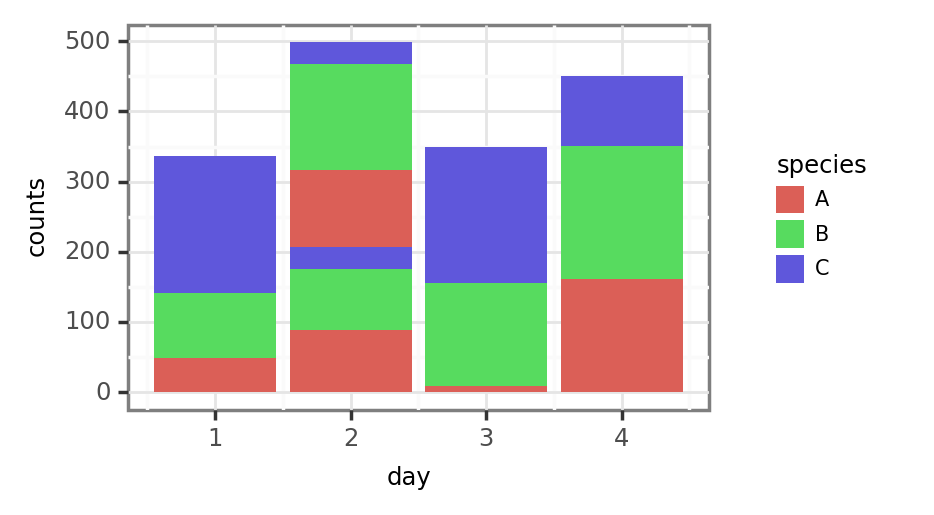
Since the default position is stack, specifying the group as the replicate stacks the bars for each of the replicates of day 2 following the order of species-replicate: A-1, B-1, C-1, A-2, B-2, C-2. Fair enough, this is probably the expected and desired behaviour.
Dodged Behaviour
The issue arises when we attempt to dodge the groups, so that the height of the bars still represents the total counts in a single sample:
position_dodge
(p9.ggplot(full_df)
 + p9.aes('day', 'counts', fill='species', group='replicate')
 + p9.geom_col(position='dodge')
)
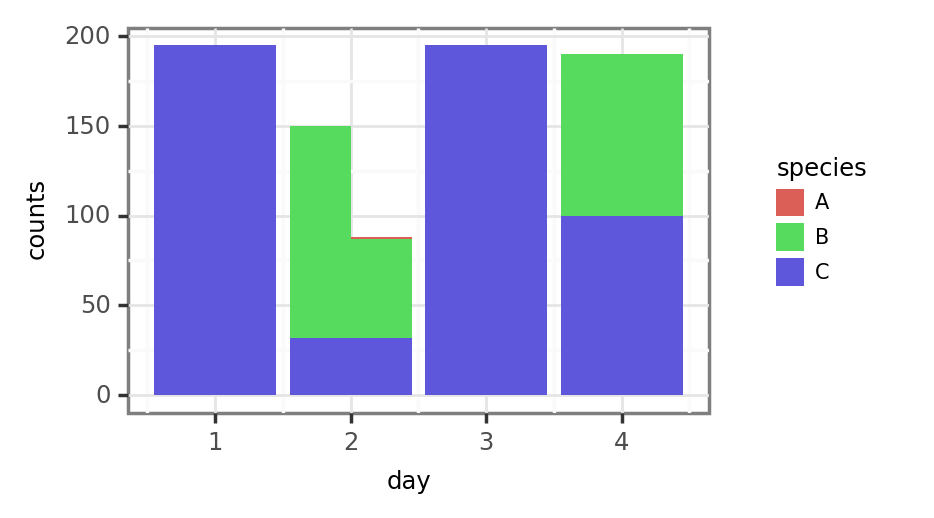
The group (replicates) have now been properly dodged/unstacked in day 2, but the previously stacked species all start now in the same x-y coords of the day-group instead of being stacked. Lowering the alpha a tad helps to see it better:

position_dodge2
The results with position_dodge2 are also problematic, since the width of the bars doesn't seem to be properly calculated (day 1 values become half as wide, while values for day 2 stay the same and overlap with values from the other days).
In any case, this completely unstacks the species/fill aesthetic, which is something we don't want even if bars' width was properly calculated.
The hacky solution
I thought that manually changing the x values (works in this case but would be a bit harder if the x variable was a Categorical, for instance) and generating a width variable to pass as an aesthetic manually setting the width of the day 2 values to .25 should allow me to make this work:
(full_df
 .assign(day=lambda dd: np.where(dd.replicate == 2, dd.day + .22, dd.day))
 .assign(day=lambda dd: np.where(dd.day==2, dd.day - .22, dd.day))
 .assign(width=lambda dd: np.where(dd.day.round() == 2, .4, .8))
 .pipe(lambda dd: p9.ggplot(dd)
 + p9.aes('day', 'counts', fill='species', group='replicate')
 + p9.geom_col(position='stack', mapping=p9.aes(width='width'))
)

I actually managed to solve this while writing the issue with this hacky solution, but still, it feels like there might be some way to include this behaviour in some position variety? I don't know if this situation is common enough to justify generating a specific position_dodgestack or something like that, but what do you think?
- Lingua principale
- Python
- Stelle
- 4.8k
- Fork
- 260
- Merge medio
- 2g 12h
- PR unite (30g)
- 4
Preparare l'ambiente
Questo progetto non fornisce container di sviluppo, Dockerfile né guida per i contributori, quindi l'ambiente è a tuo carico: parti dal suo README e consulta la nostra guida al primo contributo per i passaggi generali.
Come iniziare
- Leggi tutta la issue e poi la guida ai contributi del progetto.
- Commenta sulla issue per dire che te ne occupi tu — evita che due persone facciano lo stesso lavoro.
- Fai un fork del repository e lavora su un branch.
- Apri una pull request che faccia riferimento al numero della issue.
Altre issue di has2k1/plotnine
-
Difficoltà 2/5 1-3 ore Idoneità per principianti 66/100
I maintainer di solito rispondono entro 1 giorno
-
Enhancement
Difficoltà 3/5 Mezza giornata Idoneità per principianti 55/100
has2k1/plotnine#1141 · 2 commenti ·
I maintainer di solito rispondono entro 1 giorno
-
Enhancement
Difficoltà 4/5 3-5 giorni Idoneità per principianti 52/100
has2k1/plotnine#1081 · 3 commenti ·
I maintainer di solito rispondono entro 1 giorno
-
Discussion
Difficoltà 5/5 Più di una settimana Idoneità per principianti 30/100
has2k1/plotnine#1047 · 15 commenti · 3 reazioni ·
I maintainer di solito rispondono entro 1 giorno
-
Documentation Plot Composition Question
Difficoltà 3/5 1-2 giorni Idoneità per principianti 45/100
has2k1/plotnine#1036 · 1 commento ·
I maintainer di solito rispondono entro 1 giorno
Tutte le issue di has2k1/plotnine
Issue simili
-
[Bug]: Python SDK overwrites OVPack backups with HTTP 200 JSON errorsForse già presa @stefanielizeth73-art l’ha presa oggi. Aperta
Difficoltà 2/5 1-3 ore Idoneità per principianti 76/100
volcengine/OpenViking#7347 ·
I maintainer di solito rispondono entro 1 giorno
-
Difficoltà 2/5 1-3 ore Idoneità per principianti 72/100
duolicious/duolicious#1943 ·
I maintainer di solito rispondono entro 1 giorno
-
Difficoltà 2/5 1-3 ore Idoneità per principianti 76/100
fedora-infra/anitya#2166 ·
I maintainer di solito rispondono entro 1 giorno
-
Difficoltà 2/5 1-3 ore Idoneità per principianti 78/100
NVIDIA/auto-ontology#486 ·
I maintainer di solito rispondono entro 1 giorno
-
Difficoltà 2/5 1-3 ore Idoneità per principianti 69/100
NVIDIA/SkillEvaluator#446 ·
I maintainer di solito rispondono entro 2 giorni