Groups and stacked/dodged positions.
Maintainer thường phản hồi trong vòng 1 ngày
Chưa có ai nhận issue này.
Đánh giá
- Độ khó
- 5/5
- Thời gian dự kiến
- Hơn một tuần
- Mức phù hợp với người mới
- 28/100
- Loại issue
- Tính năng
- Độ rõ ràng
- Khá rõ ràng
- Mức độ hoạt động
- Đình trệ
- Lĩnh vực
- data-visualization
Hướng nghiên cứu
Bắt đầu bằng cách tái hiện các ví dụ với geom_col, position='stack', position='dodge' và position_dodge2 bằng dữ liệu full_df được cung cấp. Theo dõi cách các position này xử lý các ánh xạ group='replicate' và fill='species' được chỉ định tường minh; khi hoàn tất, cần cung cấp một cách đã được lập tài liệu và kiểm thử để dodge các nhóm replicate trong khi vẫn giữ species được xếp chồng, không cần điều chỉnh thủ công x hoặc width.
Do mô hình lập chỉ mục viết ra từ nội dung của issue.
Mô tả
I'm dealing with a figure where I would like to be able to dodge columns based on the group aesthetic while having the columns stay stacked on the fill aesthetic.
My intuition was that for geometries that use the group aesthetic, color/fill is assumed to be used as the group when it is not explicitly mapped to a variable. This seems to be the case with geom_line, for instance.
However, when using position_dodge and an explicitly mapped group, the bars appear to still be dodged by the group + fill variable.
To show some examples with a toy dataset:
df = pd.DataFrame(dict(
    day=np.repeat(range(1, 5), 3),
    species=np.tile(['A', 'B', 'C'], 4),
    counts=np.random.randint(0, 200, 12),
    replicate=1
))

df_replicates = df.query('day==2').assign(replicate=2).assign(counts=np.random.randint(0, 200, 3))

full_df = pd.concat([df, df_replicates])
| day | species | counts | replicate |
|---|---|---|---|
| 1 | A | 49 | 1 |
| 1 | B | 92 | 1 |
| 1 | C | 195 | 1 |
| 2 | A | 110 | 1 |
| 2 | B | 150 | 1 |
| 2 | C | 32 | 1 |
| 3 | A | 9 | 1 |
| 3 | B | 146 | 1 |
| 3 | C | 195 | 1 |
| 4 | A | 161 | 1 |
| 4 | B | 190 | 1 |
| 4 | C | 100 | 1 |
| 2 | A | 88 | 2 |
| 2 | B | 87 | 2 |
| 2 | C | 32 | 2 |
In this case, we have two different samples/replicates in day 2.
Default Behaviour
(p9.ggplot(full_df)
 + p9.aes('day', 'counts', fill='species', group='replicate')
 + p9.geom_col()
)
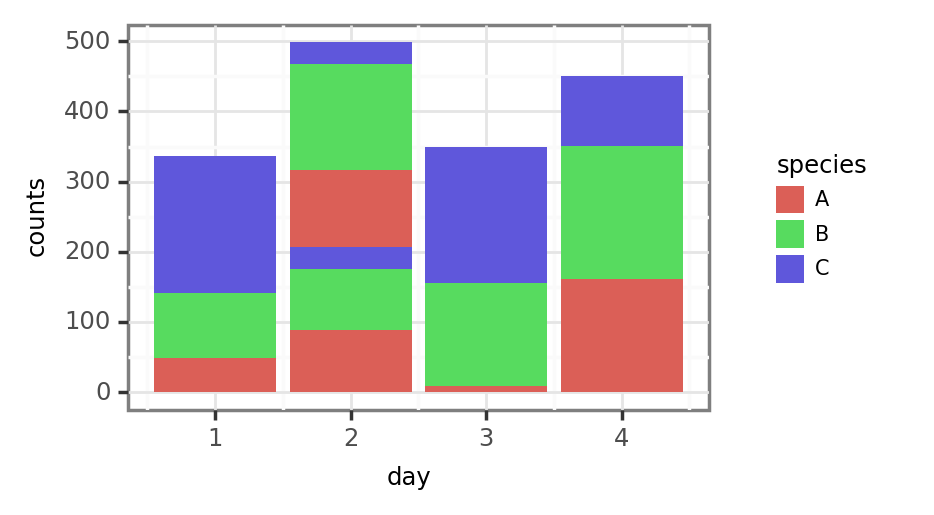
Since the default position is stack, specifying the group as the replicate stacks the bars for each of the replicates of day 2 following the order of species-replicate: A-1, B-1, C-1, A-2, B-2, C-2. Fair enough, this is probably the expected and desired behaviour.
Dodged Behaviour
The issue arises when we attempt to dodge the groups, so that the height of the bars still represents the total counts in a single sample:
position_dodge
(p9.ggplot(full_df)
 + p9.aes('day', 'counts', fill='species', group='replicate')
 + p9.geom_col(position='dodge')
)
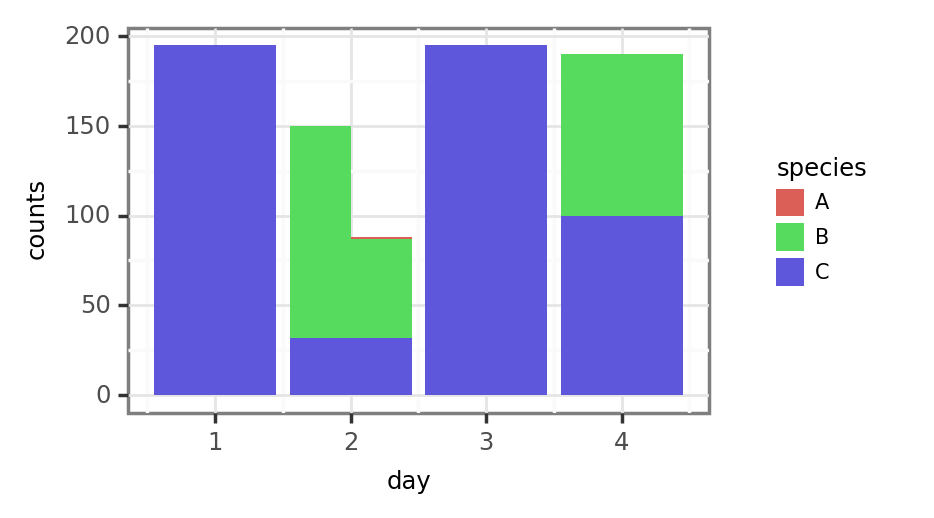
The group (replicates) have now been properly dodged/unstacked in day 2, but the previously stacked species all start now in the same x-y coords of the day-group instead of being stacked. Lowering the alpha a tad helps to see it better:

position_dodge2
The results with position_dodge2 are also problematic, since the width of the bars doesn't seem to be properly calculated (day 1 values become half as wide, while values for day 2 stay the same and overlap with values from the other days).
In any case, this completely unstacks the species/fill aesthetic, which is something we don't want even if bars' width was properly calculated.
The hacky solution
I thought that manually changing the x values (works in this case but would be a bit harder if the x variable was a Categorical, for instance) and generating a width variable to pass as an aesthetic manually setting the width of the day 2 values to .25 should allow me to make this work:
(full_df
 .assign(day=lambda dd: np.where(dd.replicate == 2, dd.day + .22, dd.day))
 .assign(day=lambda dd: np.where(dd.day==2, dd.day - .22, dd.day))
 .assign(width=lambda dd: np.where(dd.day.round() == 2, .4, .8))
 .pipe(lambda dd: p9.ggplot(dd)
 + p9.aes('day', 'counts', fill='species', group='replicate')
 + p9.geom_col(position='stack', mapping=p9.aes(width='width'))
)

I actually managed to solve this while writing the issue with this hacky solution, but still, it feels like there might be some way to include this behaviour in some position variety? I don't know if this situation is common enough to justify generating a specific position_dodgestack or something like that, but what do you think?
- Ngôn ngữ chính
- Python
- Star
- 4.8k
- Fork
- 260
- Merge trung bình
- 2 ngày 12 giờ
- Pull request đã merge (30 ngày)
- 4
Chuẩn bị môi trường
Dự án này không cung cấp dev container, Dockerfile hay hướng dẫn đóng góp, nên bạn cần tự thiết lập môi trường: hãy bắt đầu từ README và xem hướng dẫn đóng góp lần đầu của chúng tôi để biết các bước chung.
Bắt đầu từ đâu
- Đọc hết issue, rồi đọc hướng dẫn đóng góp của dự án.
- Bình luận trên issue rằng bạn sẽ nhận — tránh hai người làm cùng một việc.
- Fork repository và làm thay đổi trên một nhánh.
- Mở pull request có tham chiếu số hiệu của issue.
Issue khác của has2k1/plotnine
-
Độ khó 2/5 1-3 giờ Mức phù hợp với người mới 66/100
Maintainer thường phản hồi trong vòng 1 ngày
-
Enhancement
Độ khó 3/5 Nửa ngày Mức phù hợp với người mới 55/100
has2k1/plotnine#1141 · 2 bình luận ·
Maintainer thường phản hồi trong vòng 1 ngày
-
Enhancement
Độ khó 4/5 3-5 ngày Mức phù hợp với người mới 52/100
has2k1/plotnine#1081 · 3 bình luận ·
Maintainer thường phản hồi trong vòng 1 ngày
-
Discussion
Độ khó 5/5 Hơn một tuần Mức phù hợp với người mới 30/100
has2k1/plotnine#1047 · 15 bình luận · 3 reaction ·
Maintainer thường phản hồi trong vòng 1 ngày
-
Documentation Plot Composition Question
Độ khó 3/5 1-2 ngày Mức phù hợp với người mới 45/100
has2k1/plotnine#1036 · 1 bình luận ·
Maintainer thường phản hồi trong vòng 1 ngày
Tất cả issue của has2k1/plotnine
Issue tương tự
-
Độ khó 2/5 1-3 giờ Mức phù hợp với người mới 72/100
bytedance/agentkit-samples#277 ·
-
ai-driven-fuzzing bug claude Minor
Độ khó 2/5 1-3 giờ Mức phù hợp với người mới 83/100
Maintainer thường phản hồi trong vòng 2 ngày
-
Edit: TVS Encarnacion [PY]Đang mởchannels:edit check:passed
Độ khó 2/5 1-3 giờ Mức phù hợp với người mới 72/100
Maintainer thường phản hồi trong vòng 1 ngày
-
[Bug] The blue-green mitigation strategy lists catalog names and views before the source tablesĐang mở
Độ khó 2/5 1-3 giờ Mức phù hợp với người mới 72/100
aws-samples/sample-aws-genai-db-modernizer#2097 · 1 bình luận ·
Maintainer thường phản hồi trong vòng 1 ngày
-
Độ khó 2/5 1-3 giờ Mức phù hợp với người mới 68/100
Maintainer thường phản hồi trong vòng 1 ngày