Support Iceberg table encryption (Java-compatible)
維護者通常 3 天內回覆
還沒有人認領這個 Issue。
評估
- 難度
- 5/5
- 預估耗時
- 一週以上
- 新手友好度
- 8/100
- Issue 類型
- 功能
- 描述清晰度
- 基本清楚
- 活躍度
- 活躍
- 領域
- cryptography, data, security
研究方向
This is a multi-PR design epic, so start by reading the vendored Arrow file encryption_internal_nossl.cc, which shows why Parquet encryption is compiled out, and the encryption-keys handling in table metadata. Newcomers should not take the epic as a whole; the phase 1 items are already assigned to the author and tracked separately (#989, #990, #991). Done means one of those scoped PRs merges with Java interop vectors passing.
由索引模型根據 Issue 內容生成。
描述
Feature Description
What the feature achieves:
Adds Iceberg table encryption to iceberg-cpp, wire-compatible with the Java implementation (StandardEncryptionManager). iceberg-cpp can read tables that Java encrypted, and Java can read encrypted tables that iceberg-cpp writes. Data files, delete files, deletion vectors, manifests and manifest lists are encrypted; metadata.json is not, as in Java.
Design: Java-compatible standard encryption scheme
C++ targets the Java-compatible standard scheme, checked against the published AGS1 spec and the proposed encryption specification (apache/iceberg#16527, not yet merged). Java compatibility and convergence on the cross-implementation standard are both goals:
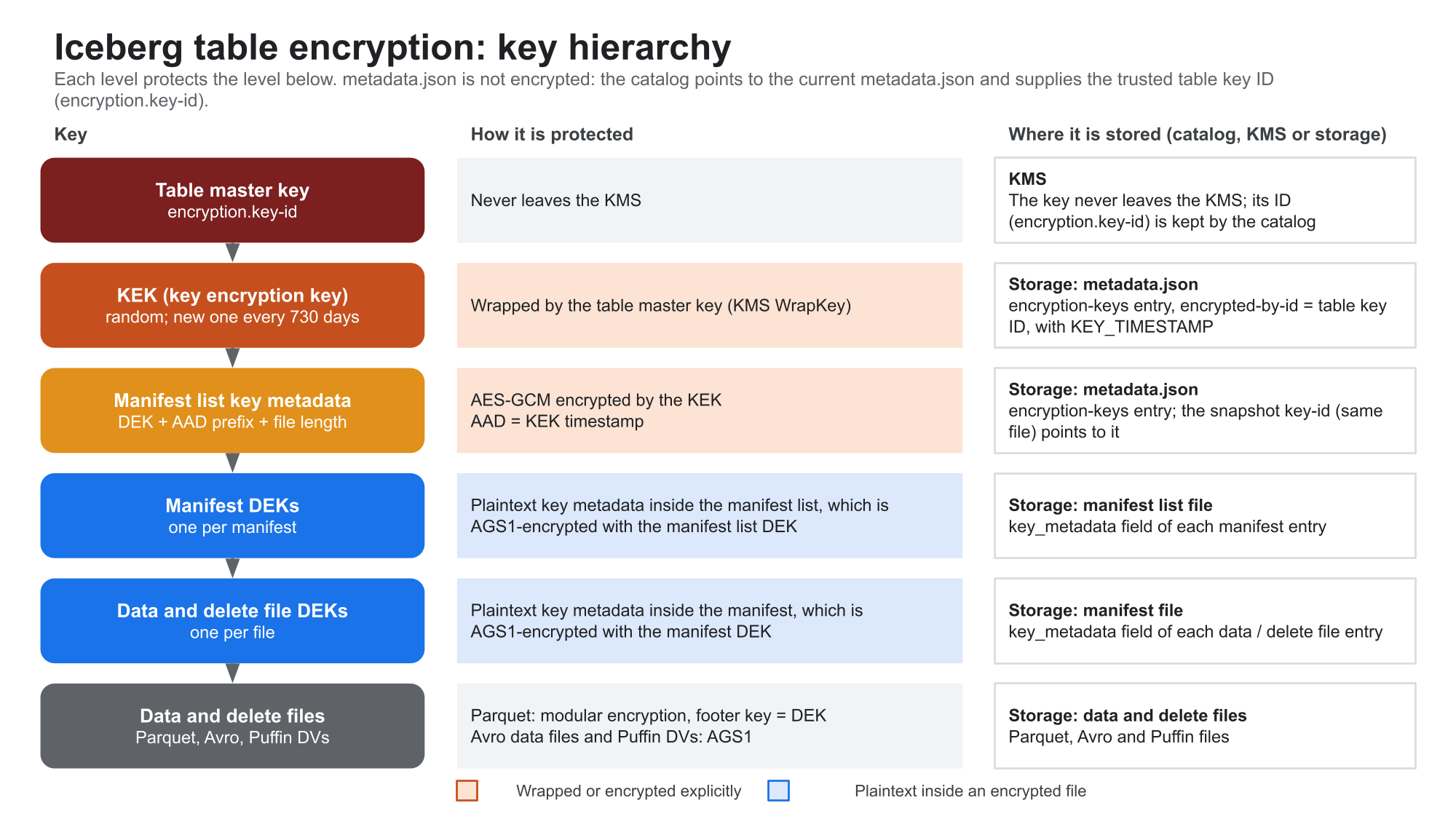
- Key hierarchy (envelope encryption). The table master key stays in the KMS (
encryption.key-id). It wraps key encryption keys (KEKs), which are kept in the table metadataencryption-keyswith aKEY_TIMESTAMPand rotated every 730 days. A KEK AES-GCM-encrypts the key metadata of each manifest list (AAD = KEK timestamp); the snapshotkey-idpoints to that entry. Manifest DEKs live in the manifest listkey_metadata, and data/delete file DEKs live in the manifestkey_metadata, both in plaintext inside an encrypted file. - Key metadata.
StandardKeyMetadata: version byte1followed by an Avro record{encryption_key, aad_prefix, file_length}. The stored length is recorded for every encrypted file, including Parquet, because Java requires it for AGS1 reads (iceberg-rust found this in apache/iceberg-rust#3236). - File formats. Parquet data and delete files use Parquet modular encryption (encrypted footer,
PARE, footer key = DEK, AAD prefix not stored in the file). Manifests, manifest lists, Avro data files and Puffin deletion vectors use AES GCM Streams (AGS1, spec). - Trust model. Encryption requires format v3. The table key ID cannot change once set. Catalogs must take the key ID from a trusted source, not only from
metadata.json; the REST catalog creates its KMS client from client-side properties only.
Library layering: the core library iceberg stays free of crypto dependencies. It defines the interfaces (KeyManagementClient, EncryptionManager, EncryptingFileIO) and reaches the implementations through registries, the same pattern as ReaderFactoryRegistry and FileIORegistry. The bundle library iceberg_bundle (Arrow, Avro, Parquet) adds OpenSSL and the standard implementation. Cloud KMS clients are an optional library, iceberg_kms.
Why this feature is needed:
Problem: encrypted Iceberg tables written by Java (Spark, Flink, Trino with the Java library) cannot be used from C++ engines today.
Current gaps in iceberg-cpp:
- Table metadata
encryption-keysand snapshotkey-idare parsed and preserved; resolving these keys for encrypted reads remains to be implemented - AES-GCM, AGS1 streams and
StandardKeyMetadatafoundations have landed; KMS interfaces, encryption-manager integration and table read/write wiring remain - Vendored Arrow can now be built with Parquet modular encryption using
ICEBERG_ENCRYPTION=ON(default OFF) - Writers have no guard: writing to an encrypted table would silently write plaintext files
- Table-level encryption is listed as "not yet planned" in the v3 roadmap (#959)
Other implementations: Java has the core in main (Hive catalog wired end to end); iceberg-rust has merged an 18-step PR series (apache/iceberg-rust#2034); Python and Go have started.
User Experience
How users will use this feature:
Build:
# Opt in to bundle encryption primitives (default OFF; requires OpenSSL)
-DICEBERG_ENCRYPTION=ON
# Optional: AWS KMS, Google Cloud KMS and Azure Key Vault clients
-DICEBERG_BUILD_KMS=ON
Configuration (same property names as Java):
| Level | Property | Description |
|---|---|---|
| Catalog | encryption.kms-type |
Built-in KMS client: aws, gcp or azure |
| Catalog | encryption.kms-impl |
Name of a KMS client registered with KmsRegistry::Register |
| Table | encryption.key-id |
ID of the table master key in the KMS; enables encryption |
| Table | encryption.data-key-length |
Length of data keys: 16 (default), 24 or 32 bytes |
Usage example:
// Built-in client from the (client-side) catalog properties, e.g. for REST:
//   encryption.kms-type = aws
//   client.region       = us-west-2
auto catalog = iceberg::rest::RestCatalog::Make(config);

// Or a custom KMS client
class MyKms : public iceberg::KeyManagementClient { /* WrapKey / UnwrapKey */ };
iceberg::KmsRegistry::Register("my-kms", [] { return std::make_unique<MyKms>(); });

// Tables loaded from the catalog get an EncryptingFileIO; scans, writers and
// commits encrypt and decrypt transparently. No API changes for readers/writers.
Read/write behavior:
- Scans of encrypted tables decrypt manifest lists, manifests, data files, delete files and deletion vectors
- Commits write encrypted files and add the new KEK and manifest list key entries to
encryption-keys - A catalog without a KMS client can load an encrypted table but fails cleanly on read or commit
- A wrong key fails with an error, not an exception or garbage data
Known Limitations (not supported)
These follow the Java implementation, which does not support them yet either:
- Column-level encryption (per-column keys) — apache/iceberg#14768
- Encrypted table and partition statistics files — apache/iceberg#17533
- Removing unused keys when snapshots expire — apache/iceberg#16352
- Re-wrapping keys with a new master key — apache/iceberg#18240
- REST KMS credential vending — apache/iceberg#17155
- Hive catalog: table operations are not implemented in iceberg-cpp yet, so there is nothing to wire
- Cloud credential providers: the KMS clients take explicit credentials or tokens; instance profiles, Google application default credentials and Azure managed identities are not supported (register a custom client instead)
API Changes:
New public APIs:
// Snapshot
std::optional<std::string> Snapshot::key_id;  // JSON "key-id"

// Key management
class KeyManagementClient {
  virtual Result<std::vector<uint8_t>> WrapKey(std::span<const uint8_t> key,
                                               std::string_view wrapping_key_id) = 0;
  virtual Result<std::vector<uint8_t>> UnwrapKey(std::span<const uint8_t> wrapped_key,
                                                 std::string_view wrapping_key_id) = 0;
};
class KmsRegistry;               // Register / Load / FromCatalogProperties

// Encryption
class EncryptionManager;         // StandardEncryptionManager in the bundle library
class EncryptionManagerRegistry;
class EncryptingFileIO;          // FileIO wrapper used by tables
struct StandardKeyMetadata;

// Reader/writer options
ReaderOptions::key_metadata;
WriterOptions::key_metadata;
Spec and Compatibility
- Does this change public interfaces/APIs? Yes — new classes above,
Snapshot::key_id,ReaderOptions/WriterOptions::key_metadata - Does this change storage format? No — it implements the existing v3 spec fields (
encryption-keys, snapshotkey-id,key_metadata) and the AGS1 spec, byte-compatible with Java - End-to-end interoperability acceptance criteria (not yet delivered by the merged foundation PRs):
- C++ reads a Java-written encrypted table (AGS1 manifest lists and manifests, PARE Parquet, AGS1 Avro data files, an encrypted deletion vector)
- Java reads a C++-written encrypted table and decrypts its deletion vector
- Merged foundations include inline Java-generated key metadata and AGS1 test vectors; full-table fixtures and bidirectional table interoperability remain end-to-end acceptance work
Task Breakdown
Status as of October 21, 2026: steps 1–4 are merged. Step 5 (#1031) is open and needs an update after #1030 merged. Full encrypted-table read/write support is still pending.
Proposed as a series of small PRs, following the order of the iceberg-rust series. Steps that do not depend on each other can be reviewed in parallel.
Phase 1: Foundations (no behavior change)
- 1. Build: Parquet modular encryption and OpenSSL in the vendored Arrow (plus zstd) — #989 (owner: @shangxinli)
- 2.
Snapshot::key_idand JSONkey-id— #990 (owner: @shangxinli) - 3.
StandardKeyMetadatawith Java test vectors — #991 (owner: @shangxinli) - 4. AES-GCM cipher and AGS1 input/output files — #1030 (owner: @shangxinli)
- 5.
KeyManagementClient,KmsRegistry,InMemoryKms(tests and local development) — #1031 (owner: @shangxinli) - 6.
EncryptionManagerandStandardEncryptionManager(KEK rotation, 1-hour unwrap cache) (owner: @shangxinli) - 7.
EncryptingFileIO(owner: @shangxinli)
Phase 2: Read path
- 8. Read encrypted manifest lists (owner: @shangxinli)
- 9. Read encrypted manifests (owner: @shangxinli)
- 10. Read encrypted Parquet/Avro data and delete files (owner: @shangxinli)
Phase 3: Write path
- 11. Block writes to encrypted tables until supported (no silent plaintext) (owner: @shangxinli)
- 12. KMS from catalog properties; in-memory, SQL and REST catalog wiring with a trusted key ID (owner: @shangxinli)
- 13. Write encrypted manifests and manifest lists (stored length through the Avro writer) (owner: @shangxinli)
- 14. Write encrypted data and delete files (owner: @shangxinli)
- 15. Encrypted Puffin deletion vectors (owner: @shangxinli)
- 16. Enable encrypted writes, end-to-end commit test, docs; also fixes manifest
partition-specmetadata to be the fields array, which Java requires (owner: @shangxinli)
Phase 4: KMS clients
- 17. AWS KMS (SigV4), Google Cloud KMS and Azure Key Vault clients in optional
iceberg_kms(owner: @shangxinli)
Feedback welcome on the library layering, the registry approach and the PR split.
Related Issues
- #959 — Track remaining Iceberg v3 feature support (table-level encryption metadata)
- apache/iceberg-rust#2034 — Support client-side encryption (iceberg-rust epic)
- apache/iceberg-rust#3236 — File length in key metadata for Java interop
- apache/iceberg#13225 — REST catalog encryption support (Java)
- apache/iceberg#16527 — Key metadata format in the spec
- apache/iceberg#16157 — Reading encrypted deletion vectors (Java)
- 主要語言
- C++
- 星號
- 230
- 分支
- 138
- 平均合併
- 4 天 2 小時
- 30 天內合併 PR
- 61
環境準備
這個專案沒有提供開發容器、Dockerfile 或貢獻指南,環境需要你自己搭建:先看它的 README,通用步驟見我們的新手貢獻指南。
從這裡開始
- 先讀完整個 Issue,再讀專案的貢獻指南。
- 在 Issue 下留言說明你要接手 —— 這能避免兩個人做同樣的事。
- Fork 儲存庫,在一個分支上完成修改。
- 送出 Pull Request,並在描述裡引用這個 Issue 編號。
apache/iceberg-cpp 的其他 Issue
-
Parquet reader: fall back to positional field IDs when a file has no field IDs and no name mapping未關閉
難度 4/5 3-5 天 新手友好度 45/100
apache/iceberg-cpp#1046 ·
維護者通常 3 天內回覆
-
難度 5/5 一週以上 新手友好度 12/100
apache/iceberg-cpp#1027 · 4 則留言 ·
維護者通常 3 天內回覆
-
難度 4/5 3-5 天 新手友好度 35/100
apache/iceberg-cpp#1000 · 2 則留言 · 1 個 reaction ·
維護者通常 3 天內回覆
-
難度 5/5 一週以上 新手友好度 20/100
apache/iceberg-cpp#959 · 1 則留言 ·
維護者通常 3 天內回覆
-
難度 5/5 一週以上 新手友好度 35/100
apache/iceberg-cpp#946 · 6 則留言 ·
維護者通常 3 天內回覆
查看 apache/iceberg-cpp 的全部 Issue
相似的 Issue
-
難度 2/5 1-3 小時 新手友好度 72/100
KhronosGroup/Vulkan-Tutorial#534 ·
-
難度 2/5 1-3 小時 新手友好度 65/100
維護者通常 2 天內回覆
-
bug IO
難度 2/5 1-3 小時 新手友好度 65/100
MrNeRF/LichtFeld-Studio#3824 ·
維護者通常 1 天內回覆
-
難度 2/5 1-3 小時 新手友好度 77/100
throneproj/Throne#2043 ·
維護者通常 2 天內回覆
-
難度 1/5 1 小時以內 新手友好度 88/100
Perchik71/Creation-Kit-Platform-Extended#267 ·
維護者通常 1 天內回覆