Support Iceberg table encryption (Java-compatible)
Maintainer antworten meist innerhalb von 2 Tagen
Dieses Issue hat noch niemand übernommen.
Bewertung
- Schwierigkeit
- 5/5
- Geschätzter Aufwand
- Über eine Woche
- Anfängerfreundlichkeit
- 8/100
- Issue-Typ
- Feature
- Klarheit
- Größtenteils klar
- Aktivitätsstatus
- Aktiv
- Bereich
- cryptography, data, security
Rechercherichtung
This is a multi-PR design epic, so start by reading the vendored Arrow file encryption_internal_nossl.cc, which shows why Parquet encryption is compiled out, and the encryption-keys handling in table metadata. Newcomers should not take the epic as a whole; the phase 1 items are already assigned to the author and tracked separately (#989, #990, #991). Done means one of those scoped PRs merges with Java interop vectors passing.
Vom Indexierungsmodell aus dem Issue-Text verfasst.
Beschreibung
Feature Description
What the feature achieves:
Adds Iceberg table encryption to iceberg-cpp, wire-compatible with the Java implementation (StandardEncryptionManager). iceberg-cpp can read tables that Java encrypted, and Java can read encrypted tables that iceberg-cpp writes. Data files, delete files, deletion vectors, manifests and manifest lists are encrypted; metadata.json is not, as in Java.
Design: follow the Java scheme exactly
Java defines the formats, so the C++ design matches it rather than adding anything new:
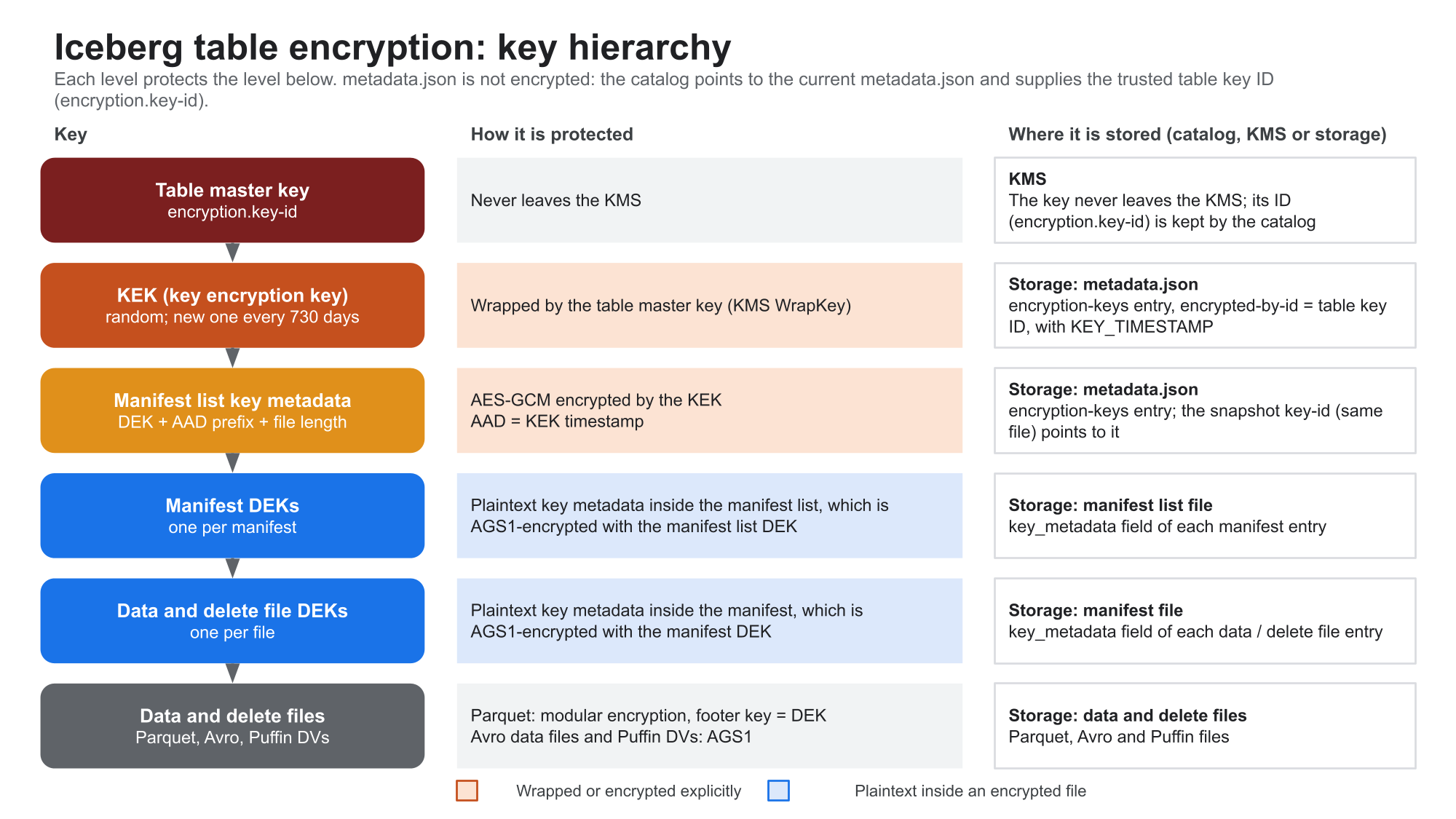
- Key hierarchy (envelope encryption). The table master key stays in the KMS (
encryption.key-id). It wraps key encryption keys (KEKs), which are kept in the table metadataencryption-keyswith aKEY_TIMESTAMPand rotated every 730 days. A KEK AES-GCM-encrypts the key metadata of each manifest list (AAD = KEK timestamp); the snapshotkey-idpoints to that entry. Manifest DEKs live in the manifest listkey_metadata, and data/delete file DEKs live in the manifestkey_metadata, both in plaintext inside an encrypted file. - Key metadata.
StandardKeyMetadata: version byte1followed by an Avro record{encryption_key, aad_prefix, file_length}. The stored length is recorded for every encrypted file, including Parquet, because Java requires it for AGS1 reads (iceberg-rust found this in apache/iceberg-rust#3236). - File formats. Parquet data and delete files use Parquet modular encryption (encrypted footer,
PARE, footer key = DEK, AAD prefix not stored in the file). Manifests, manifest lists, Avro data files and Puffin deletion vectors use AES GCM Streams (AGS1, spec). - Trust model. Encryption requires format v3. The table key ID cannot change once set. Catalogs must take the key ID from a trusted source, not only from
metadata.json; the REST catalog creates its KMS client from client-side properties only.
Library layering: the core library iceberg stays free of crypto dependencies. It defines the interfaces (KeyManagementClient, EncryptionManager, EncryptingFileIO) and reaches the implementations through registries, the same pattern as ReaderFactoryRegistry and FileIORegistry. The bundle library iceberg_bundle (Arrow, Avro, Parquet) adds OpenSSL and the standard implementation. Cloud KMS clients are an optional library, iceberg_kms.
Why this feature is needed:
Problem: encrypted Iceberg tables written by Java (Spark, Flink, Trino with the Java library) cannot be used from C++ engines today.
Current gaps in iceberg-cpp:
- Table metadata
encryption-keysis parsed, but there is no snapshotkey-id, so encrypted snapshots cannot be resolved - No crypto: no AES-GCM, no AGS1 streams, no key metadata, no KMS integration
- The vendored Arrow builds Parquet with encryption compiled out (
encryption_internal_nossl.cc) - Writers have no guard: writing to an encrypted table would silently write plaintext files
- Table-level encryption is listed as "not yet planned" in the v3 roadmap (#959)
Other implementations: Java has the core in main (Hive catalog wired end to end); iceberg-rust has merged an 18-step PR series (apache/iceberg-rust#2034); Python and Go have started.
User Experience
How users will use this feature:
Build:
# Bundle library with encryption (ON by default; requires OpenSSL)
-DICEBERG_ENCRYPTION=ON
# Optional: AWS KMS, Google Cloud KMS and Azure Key Vault clients
-DICEBERG_BUILD_KMS=ON
Configuration (same property names as Java):
| Level | Property | Description |
|---|---|---|
| Catalog | encryption.kms-type |
Built-in KMS client: aws, gcp or azure |
| Catalog | encryption.kms-impl |
Name of a KMS client registered with KmsRegistry::Register |
| Table | encryption.key-id |
ID of the table master key in the KMS; enables encryption |
| Table | encryption.data-key-length |
Length of data keys: 16 (default), 24 or 32 bytes |
Usage example:
// Built-in client from the (client-side) catalog properties, e.g. for REST:
//   encryption.kms-type = aws
//   client.region       = us-west-2
auto catalog = iceberg::rest::RestCatalog::Make(config);

// Or a custom KMS client
class MyKms : public iceberg::KeyManagementClient { /* WrapKey / UnwrapKey */ };
iceberg::KmsRegistry::Register("my-kms", [] { return std::make_unique<MyKms>(); });

// Tables loaded from the catalog get an EncryptingFileIO; scans, writers and
// commits encrypt and decrypt transparently. No API changes for readers/writers.
Read/write behavior:
- Scans of encrypted tables decrypt manifest lists, manifests, data files, delete files and deletion vectors
- Commits write encrypted files and add the new KEK and manifest list key entries to
encryption-keys - A catalog without a KMS client can load an encrypted table but fails cleanly on read or commit
- A wrong key fails with an error, not an exception or garbage data
Known Limitations (not supported)
These follow the Java implementation, which does not support them yet either:
- Column-level encryption (per-column keys) — apache/iceberg#14768
- Encrypted table and partition statistics files — apache/iceberg#17533
- Removing unused keys when snapshots expire — apache/iceberg#16352
- Re-wrapping keys with a new master key — apache/iceberg#18240
- REST KMS credential vending — apache/iceberg#17155
- Hive catalog: table operations are not implemented in iceberg-cpp yet, so there is nothing to wire
- Cloud credential providers: the KMS clients take explicit credentials or tokens; instance profiles, Google application default credentials and Azure managed identities are not supported (register a custom client instead)
API Changes:
New public APIs:
// Snapshot
std::optional<std::string> Snapshot::key_id;  // JSON "key-id"

// Key management
class KeyManagementClient {
  virtual Result<std::vector<uint8_t>> WrapKey(std::span<const uint8_t> key,
                                               std::string_view wrapping_key_id) = 0;
  virtual Result<std::vector<uint8_t>> UnwrapKey(std::span<const uint8_t> wrapped_key,
                                                 std::string_view wrapping_key_id) = 0;
};
class KmsRegistry;               // Register / Load / FromCatalogProperties

// Encryption
class EncryptionManager;         // StandardEncryptionManager in the bundle library
class EncryptionManagerRegistry;
class EncryptingFileIO;          // FileIO wrapper used by tables
struct StandardKeyMetadata;

// Reader/writer options
ReaderOptions::key_metadata;
WriterOptions::key_metadata;
Spec and Compatibility
- Does this change public interfaces/APIs? Yes — new classes above,
Snapshot::key_id,ReaderOptions/WriterOptions::key_metadata - Does this change storage format? No — it implements the existing v3 spec fields (
encryption-keys, snapshotkey-id,key_metadata) and the AGS1 spec, byte-compatible with Java - Interoperability is verified both ways with Java:
- C++ reads a Java-written encrypted table (AGS1 manifest lists and manifests, PARE Parquet, AGS1 Avro data files, an encrypted deletion vector)
- Java reads a C++-written encrypted table and decrypts its deletion vector
- Small Java-generated fixtures (key metadata, AGS1 vectors, a wrapped KEK, a small encrypted table) are checked in as test resources
Task Breakdown
Proposed as a series of small PRs, following the order of the iceberg-rust series. Steps that do not depend on each other can be reviewed in parallel.
Phase 1: Foundations (no behavior change)
- 1. Build: Parquet modular encryption and OpenSSL in the vendored Arrow (plus zstd) — #989 (owner: @shangxinli)
- 2.
Snapshot::key_idand JSONkey-id— #990 (owner: @shangxinli) - 3.
StandardKeyMetadatawith Java test vectors — #991 (owner: @shangxinli) - 4. AES-GCM cipher and AGS1 input/output files (owner: @shangxinli)
- 5.
KeyManagementClient,KmsRegistry,InMemoryKms(tests only) (owner: @shangxinli) - 6.
EncryptionManagerandStandardEncryptionManager(KEK rotation, 1-hour unwrap cache) (owner: @shangxinli) - 7.
EncryptingFileIO(owner: @shangxinli)
Phase 2: Read path
- 8. Read encrypted manifest lists (owner: @shangxinli)
- 9. Read encrypted manifests (owner: @shangxinli)
- 10. Read encrypted Parquet/Avro data and delete files (owner: @shangxinli)
Phase 3: Write path
- 11. Block writes to encrypted tables until supported (no silent plaintext) (owner: @shangxinli)
- 12. KMS from catalog properties; in-memory, SQL and REST catalog wiring with a trusted key ID (owner: @shangxinli)
- 13. Write encrypted manifests and manifest lists (stored length through the Avro writer) (owner: @shangxinli)
- 14. Write encrypted data and delete files (owner: @shangxinli)
- 15. Encrypted Puffin deletion vectors (owner: @shangxinli)
- 16. Enable encrypted writes, end-to-end commit test, docs; also fixes manifest
partition-specmetadata to be the fields array, which Java requires (owner: @shangxinli)
Phase 4: KMS clients
- 17. AWS KMS (SigV4), Google Cloud KMS and Azure Key Vault clients in optional
iceberg_kms(owner: @shangxinli)
Feedback welcome on the library layering, the registry approach and the PR split.
Related Issues
- #959 — Track remaining Iceberg v3 feature support (table-level encryption metadata)
- apache/iceberg-rust#2034 — Support client-side encryption (iceberg-rust epic)
- apache/iceberg-rust#3236 — File length in key metadata for Java interop
- apache/iceberg#13225 — REST catalog encryption support (Java)
- apache/iceberg#16527 — Key metadata format in the spec
- apache/iceberg#16157 — Reading encrypted deletion vectors (Java)
- Vorherrschende Sprache
- C++
- Sterne
- 228
- Forks
- 136
- Ø Merge
- 5 T. 22 Std.
- Gemergte PRs (30 T.)
- 52
Entwicklungsumgebung
Dieses Projekt bietet weder Dev-Container noch Dockerfile noch Beitragsleitfaden – die Einrichtung liegt bei Ihnen. Beginnen Sie mit der README; die allgemeinen Schritte stehen in unserem Leitfaden für den ersten Beitrag.
Erste Schritte
- Lesen Sie das ganze Issue und danach den Beitragsleitfaden des Projekts.
- Schreiben Sie ins Issue, dass Sie es übernehmen — das erspart doppelte Arbeit.
- Forken Sie das Repository und arbeiten Sie in einem Branch.
- Öffnen Sie einen Pull Request, der die Issue-Nummer nennt.
Mehr aus apache/iceberg-cpp
-
bug: TableMetadataBuilder::RemoveSchemas leaves removed ids in the schema indexEvtl. vergeben @LuciferYang hat das vor 3 Tagen übernommen. Offen
Schwierigkeit 2/5 1-3 Stunden Anfängerfreundlichkeit 72/100
apache/iceberg-cpp#1011 ·
Maintainer antworten meist innerhalb von 2 Tagen
-
build: regression after #1021 — Arrow's arrow_SOURCE_DIR collides with FetchContent on CMake 3.28, breaks vendored Arrow buildEvtl. vergeben @raulcd hat das vor 1 Tag übernommen. Offen
Schwierigkeit 3/5 Ein halber Tag Anfängerfreundlichkeit 22/100
apache/iceberg-cpp#1028 · 1 Kommentar ·
Maintainer antworten meist innerhalb von 2 Tagen
-
Schwierigkeit 5/5 Über eine Woche Anfängerfreundlichkeit 12/100
apache/iceberg-cpp#1027 ·
Maintainer antworten meist innerhalb von 2 Tagen
-
bug: gzip table metadata is neither written nor detected as gzipEvtl. vergeben @LuciferYang hat das vor 3 Tagen übernommen. Offen
Schwierigkeit 3/5 1-2 Tage Anfängerfreundlichkeit 66/100
apache/iceberg-cpp#1013 ·
Maintainer antworten meist innerhalb von 2 Tagen
-
Schwierigkeit 4/5 3-5 Tage Anfängerfreundlichkeit 35/100
apache/iceberg-cpp#1000 · 2 Kommentare · 1 Reaktion ·
Maintainer antworten meist innerhalb von 2 Tagen
Alle Issues in apache/iceberg-cpp
Ähnliche Issues
-
Web3 RPC: one-element batch request returns an object instead of an array (breaks ethers.js v6)Offen
Schwierigkeit 2/5 1-3 Stunden Anfängerfreundlichkeit 75/100
FISCO-BCOS/FISCO-BCOS#5706 ·
Maintainer antworten meist innerhalb von 3 Tagen
-
Schwierigkeit 1/5 Unter einer Stunde Anfängerfreundlichkeit 85/100
521xueweihan/HelloGitHub#4011 ·
-
docs(simulation): Quickstart publishes UDP 14550, which the SITL images' own docs say not to doOffenstatus:needs-triage
Schwierigkeit 1/5 1-3 Stunden Anfängerfreundlichkeit 78/100
PX4/PX4-Autopilot#29292 · 1 Kommentar ·
Maintainer antworten meist innerhalb von 1 Tag
-
bug core p3
Schwierigkeit 2/5 1-3 Stunden Anfängerfreundlichkeit 76/100
RunanywhereAI/runanywhere-sdks#1142 ·
Maintainer antworten meist innerhalb von 1 Tag
-
I/O internal correctness medium priority rt_lib
Schwierigkeit 2/5 1-3 Stunden Anfängerfreundlichkeit 79/100
Maintainer antworten meist innerhalb von 1 Tag