Support Iceberg table encryption (Java-compatible)
Les mainteneurs répondent en général sous 2 jours
Évaluation
- Difficulté
- 5/5
- Temps estimé
- Plus d'une semaine
- Accessibilité débutants
- 8/100
- Type d'issue
- Fonctionnalité
- Clarté
- Plutôt claire
- Activité
- Active
- Domaine
- cryptography, data, security
Piste de recherche
This is a multi-PR design epic, so start by reading the vendored Arrow file encryption_internal_nossl.cc, which shows why Parquet encryption is compiled out, and the encryption-keys handling in table metadata. Newcomers should not take the epic as a whole; the phase 1 items are already assigned to the author and tracked separately (#989, #990, #991). Done means one of those scoped PRs merges with Java interop vectors passing.
Rédigé par le modèle d'indexation à partir du texte de l'issue.
Description
Feature Description
What the feature achieves:
Adds Iceberg table encryption to iceberg-cpp, wire-compatible with the Java implementation (StandardEncryptionManager). iceberg-cpp can read tables that Java encrypted, and Java can read encrypted tables that iceberg-cpp writes. Data files, delete files, deletion vectors, manifests and manifest lists are encrypted; metadata.json is not, as in Java.
Design: follow the Java scheme exactly
Java defines the formats, so the C++ design matches it rather than adding anything new:
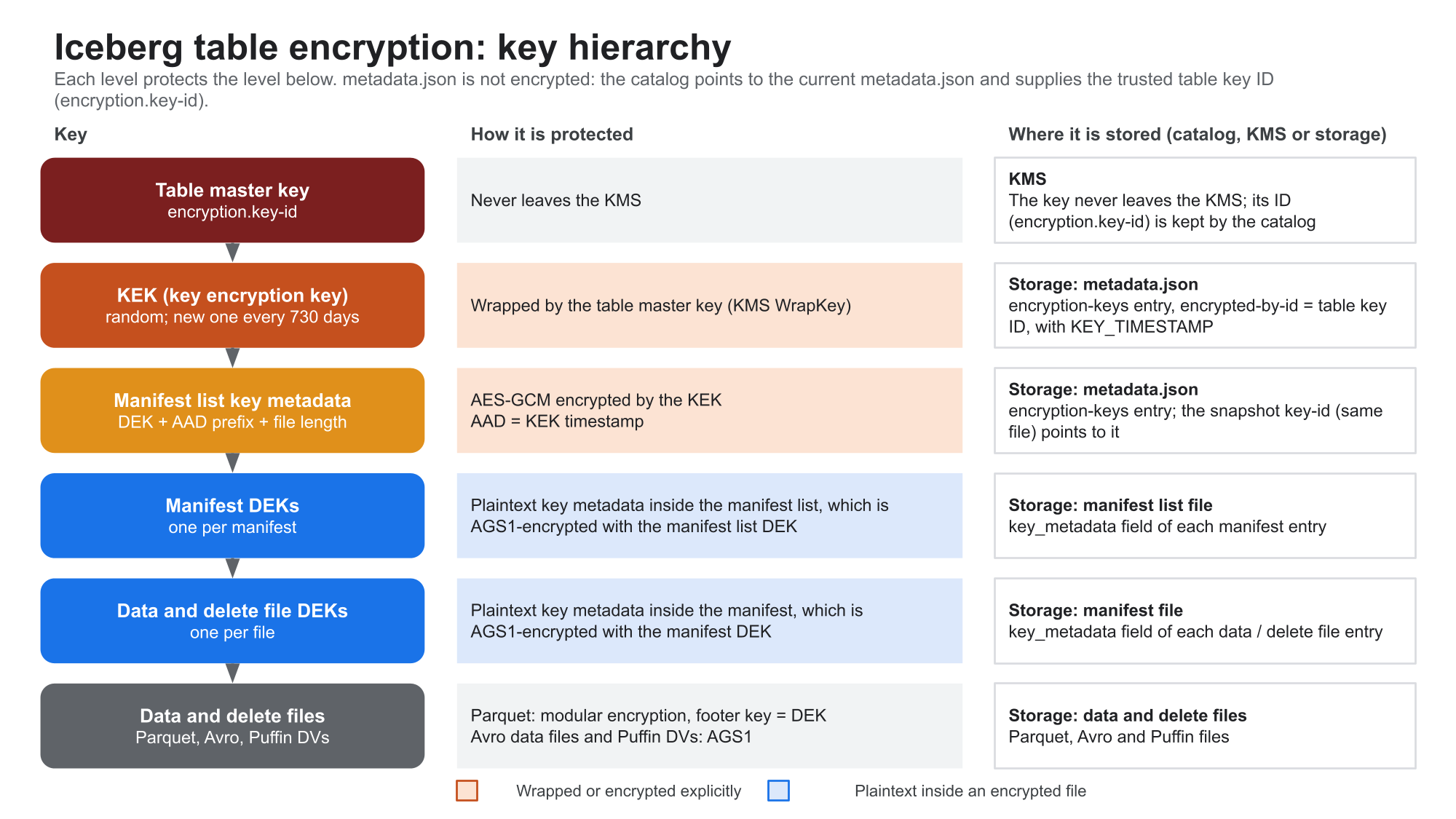
- Key hierarchy (envelope encryption). The table master key stays in the KMS (
encryption.key-id). It wraps key encryption keys (KEKs), which are kept in the table metadataencryption-keyswith aKEY_TIMESTAMPand rotated every 730 days. A KEK AES-GCM-encrypts the key metadata of each manifest list (AAD = KEK timestamp); the snapshotkey-idpoints to that entry. Manifest DEKs live in the manifest listkey_metadata, and data/delete file DEKs live in the manifestkey_metadata, both in plaintext inside an encrypted file. - Key metadata.
StandardKeyMetadata: version byte1followed by an Avro record{encryption_key, aad_prefix, file_length}. The stored length is recorded for every encrypted file, including Parquet, because Java requires it for AGS1 reads (iceberg-rust found this in apache/iceberg-rust#3236). - File formats. Parquet data and delete files use Parquet modular encryption (encrypted footer,
PARE, footer key = DEK, AAD prefix not stored in the file). Manifests, manifest lists, Avro data files and Puffin deletion vectors use AES GCM Streams (AGS1, spec). - Trust model. Encryption requires format v3. The table key ID cannot change once set. Catalogs must take the key ID from a trusted source, not only from
metadata.json; the REST catalog creates its KMS client from client-side properties only.
Library layering: the core library iceberg stays free of crypto dependencies. It defines the interfaces (KeyManagementClient, EncryptionManager, EncryptingFileIO) and reaches the implementations through registries, the same pattern as ReaderFactoryRegistry and FileIORegistry. The bundle library iceberg_bundle (Arrow, Avro, Parquet) adds OpenSSL and the standard implementation. Cloud KMS clients are an optional library, iceberg_kms.
Why this feature is needed:
Problem: encrypted Iceberg tables written by Java (Spark, Flink, Trino with the Java library) cannot be used from C++ engines today.
Current gaps in iceberg-cpp:
- Table metadata
encryption-keysis parsed, but there is no snapshotkey-id, so encrypted snapshots cannot be resolved - No crypto: no AES-GCM, no AGS1 streams, no key metadata, no KMS integration
- The vendored Arrow builds Parquet with encryption compiled out (
encryption_internal_nossl.cc) - Writers have no guard: writing to an encrypted table would silently write plaintext files
- Table-level encryption is listed as "not yet planned" in the v3 roadmap (#959)
Other implementations: Java has the core in main (Hive catalog wired end to end); iceberg-rust has merged an 18-step PR series (apache/iceberg-rust#2034); Python and Go have started.
User Experience
How users will use this feature:
Build:
# Bundle library with encryption (ON by default; requires OpenSSL)
-DICEBERG_ENCRYPTION=ON
# Optional: AWS KMS, Google Cloud KMS and Azure Key Vault clients
-DICEBERG_BUILD_KMS=ON
Configuration (same property names as Java):
| Level | Property | Description |
|---|---|---|
| Catalog | encryption.kms-type |
Built-in KMS client: aws, gcp or azure |
| Catalog | encryption.kms-impl |
Name of a KMS client registered with KmsRegistry::Register |
| Table | encryption.key-id |
ID of the table master key in the KMS; enables encryption |
| Table | encryption.data-key-length |
Length of data keys: 16 (default), 24 or 32 bytes |
Usage example:
// Built-in client from the (client-side) catalog properties, e.g. for REST:
//   encryption.kms-type = aws
//   client.region       = us-west-2
auto catalog = iceberg::rest::RestCatalog::Make(config);

// Or a custom KMS client
class MyKms : public iceberg::KeyManagementClient { /* WrapKey / UnwrapKey */ };
iceberg::KmsRegistry::Register("my-kms", [] { return std::make_unique<MyKms>(); });

// Tables loaded from the catalog get an EncryptingFileIO; scans, writers and
// commits encrypt and decrypt transparently. No API changes for readers/writers.
Read/write behavior:
- Scans of encrypted tables decrypt manifest lists, manifests, data files, delete files and deletion vectors
- Commits write encrypted files and add the new KEK and manifest list key entries to
encryption-keys - A catalog without a KMS client can load an encrypted table but fails cleanly on read or commit
- A wrong key fails with an error, not an exception or garbage data
Known Limitations (not supported)
These follow the Java implementation, which does not support them yet either:
- Column-level encryption (per-column keys) — apache/iceberg#14768
- Encrypted table and partition statistics files — apache/iceberg#17533
- Removing unused keys when snapshots expire — apache/iceberg#16352
- Re-wrapping keys with a new master key — apache/iceberg#18240
- REST KMS credential vending — apache/iceberg#17155
- Hive catalog: table operations are not implemented in iceberg-cpp yet, so there is nothing to wire
- Cloud credential providers: the KMS clients take explicit credentials or tokens; instance profiles, Google application default credentials and Azure managed identities are not supported (register a custom client instead)
API Changes:
New public APIs:
// Snapshot
std::optional<std::string> Snapshot::key_id;  // JSON "key-id"

// Key management
class KeyManagementClient {
  virtual Result<std::vector<uint8_t>> WrapKey(std::span<const uint8_t> key,
                                               std::string_view wrapping_key_id) = 0;
  virtual Result<std::vector<uint8_t>> UnwrapKey(std::span<const uint8_t> wrapped_key,
                                                 std::string_view wrapping_key_id) = 0;
};
class KmsRegistry;               // Register / Load / FromCatalogProperties

// Encryption
class EncryptionManager;         // StandardEncryptionManager in the bundle library
class EncryptionManagerRegistry;
class EncryptingFileIO;          // FileIO wrapper used by tables
struct StandardKeyMetadata;

// Reader/writer options
ReaderOptions::key_metadata;
WriterOptions::key_metadata;
Spec and Compatibility
- Does this change public interfaces/APIs? Yes — new classes above,
Snapshot::key_id,ReaderOptions/WriterOptions::key_metadata - Does this change storage format? No — it implements the existing v3 spec fields (
encryption-keys, snapshotkey-id,key_metadata) and the AGS1 spec, byte-compatible with Java - Interoperability is verified both ways with Java:
- C++ reads a Java-written encrypted table (AGS1 manifest lists and manifests, PARE Parquet, AGS1 Avro data files, an encrypted deletion vector)
- Java reads a C++-written encrypted table and decrypts its deletion vector
- Small Java-generated fixtures (key metadata, AGS1 vectors, a wrapped KEK, a small encrypted table) are checked in as test resources
Task Breakdown
Proposed as a series of small PRs, following the order of the iceberg-rust series. Steps that do not depend on each other can be reviewed in parallel.
Phase 1: Foundations (no behavior change)
- 1. Build: Parquet modular encryption and OpenSSL in the vendored Arrow (plus zstd) — #989 (owner: @shangxinli)
- 2.
Snapshot::key_idand JSONkey-id— #990 (owner: @shangxinli) - 3.
StandardKeyMetadatawith Java test vectors — #991 (owner: @shangxinli) - 4. AES-GCM cipher and AGS1 input/output files (owner: @shangxinli)
- 5.
KeyManagementClient,KmsRegistry,InMemoryKms(tests only) (owner: @shangxinli) - 6.
EncryptionManagerandStandardEncryptionManager(KEK rotation, 1-hour unwrap cache) (owner: @shangxinli) - 7.
EncryptingFileIO(owner: @shangxinli)
Phase 2: Read path
- 8. Read encrypted manifest lists (owner: @shangxinli)
- 9. Read encrypted manifests (owner: @shangxinli)
- 10. Read encrypted Parquet/Avro data and delete files (owner: @shangxinli)
Phase 3: Write path
- 11. Block writes to encrypted tables until supported (no silent plaintext) (owner: @shangxinli)
- 12. KMS from catalog properties; in-memory, SQL and REST catalog wiring with a trusted key ID (owner: @shangxinli)
- 13. Write encrypted manifests and manifest lists (stored length through the Avro writer) (owner: @shangxinli)
- 14. Write encrypted data and delete files (owner: @shangxinli)
- 15. Encrypted Puffin deletion vectors (owner: @shangxinli)
- 16. Enable encrypted writes, end-to-end commit test, docs; also fixes manifest
partition-specmetadata to be the fields array, which Java requires (owner: @shangxinli)
Phase 4: KMS clients
- 17. AWS KMS (SigV4), Google Cloud KMS and Azure Key Vault clients in optional
iceberg_kms(owner: @shangxinli)
Feedback welcome on the library layering, the registry approach and the PR split.
Related Issues
- #959 — Track remaining Iceberg v3 feature support (table-level encryption metadata)
- apache/iceberg-rust#2034 — Support client-side encryption (iceberg-rust epic)
- apache/iceberg-rust#3236 — File length in key metadata for Java interop
- apache/iceberg#13225 — REST catalog encryption support (Java)
- apache/iceberg#16527 — Key metadata format in the spec
- apache/iceberg#16157 — Reading encrypted deletion vectors (Java)
- Langage dominant
- C++
- Étoiles
- 226
- Forks
- 133
- Merge moyen
- 6 j 2 h
- PR mergées (30 j)
- 49
Préparer son environnement
Ce projet ne fournit ni conteneur de développement, ni Dockerfile, ni guide de contribution : l'installation est à votre charge. Commencez par son README, et consultez notre guide de la première contribution pour les étapes générales.
Par où commencer
- Lisez l'issue en entier, puis le guide de contribution du projet.
- Signalez en commentaire que vous la prenez — cela évite que deux personnes fassent le même travail.
- Forkez le dépôt et travaillez sur une branche.
- Ouvrez une pull request qui référence le numéro de l'issue.
Autres issues de apache/iceberg-cpp
-
bug: TableMetadataBuilder::RemoveSchemas leaves removed ids in the schema indexPeut-être pris @LuciferYang l’a pris il y a 2 jours. Ouverte
Difficulté 2/5 1-3 heures Accessibilité débutants 72/100
apache/iceberg-cpp#1011 ·
Les mainteneurs répondent en général sous 2 jours
-
bug: gzip table metadata is neither written nor detected as gzipPeut-être pris @LuciferYang l’a pris il y a 2 jours. Ouverte
Difficulté 3/5 1-2 jours Accessibilité débutants 66/100
apache/iceberg-cpp#1013 ·
Les mainteneurs répondent en général sous 2 jours
-
Big-endian compatibility failures in bucket hashing and Avro/deletion-vector serializationPeut-être pris Une pull request liée à cette issue est ouverte ou déjà fusionnée. Ouverte
Difficulté 4/5 3-5 jours Accessibilité débutants 35/100
apache/iceberg-cpp#1000 · 2 commentaires · 1 réaction ·
Les mainteneurs répondent en général sous 2 jours
-
Difficulté 5/5 Plus d'une semaine Accessibilité débutants 20/100
apache/iceberg-cpp#959 · 1 commentaire ·
Les mainteneurs répondent en général sous 2 jours
-
Difficulté 5/5 Plus d'une semaine Accessibilité débutants 35/100
apache/iceberg-cpp#946 · 6 commentaires ·
Les mainteneurs répondent en général sous 2 jours
Toutes les issues de apache/iceberg-cpp
Issues similaires
-
Difficulté 2/5 1-3 heures Accessibilité débutants 66/100
-
Difficulté 2/5 1-3 heures Accessibilité débutants 62/100
NVIDIA-RTX/NRI#277 ·
Les mainteneurs répondent en général sous 1 jour
-
os:Linux
Difficulté 2/5 1-3 heures Accessibilité débutants 72/100
Les mainteneurs répondent en général sous 1 jour
-
Difficulté 2/5 1-3 heures Accessibilité débutants 76/100
-
acceptable_buffer_backends: unknown backend names are silently ignoredPeut-être pris @mini-1235 l’a pris aujourd’hui. Ouverte
Difficulté 2/5 1-3 heures Accessibilité débutants 70/100
ros2/rmw_fastrtps#945 ·
Les mainteneurs répondent en général sous 1 jour