Saturated pixels reach ngmix unflagged: survey flag bit 8 marks only the first pixel of each saturated run
Los mantenedores suelen responder en 1 día
Nadie ha tomado este issue todavía.
Evaluación
- Dificultad
- 4/5
- Tiempo estimado
- 3-5 días
- Aptitud para principiantes
- 50/100
- Tipo de issue
- Error
- Claridad
- Bastante claro
- Estado de actividad
- Activo
- Stack tecnológico
- python
- Área
- computer-vision
Línea de trabajo
Start in split_exp, tracing how per-CCD flag files are produced and how SExtractor and the vignets consume them. Review default_exp.sex for the SATUR_LEVEL setting, then use the saturation evidence in /n17data/cdaley/scratch/saturation/ to check the proposed clipping, growth, and bleed-tail masks. Done means saturated pixels and their proposed extensions are flagged consistently without masking more good pixels than expected.
Escrito por el modelo de indexación a partir del texto del issue.
Descripción
Saturated pixels reach ngmix unflagged and at full weight. In the CFIS survey flag map, bit 8 marks only the first (lowest-column) pixel of each horizontal run of saturated pixels. A 1-px bleed trail therefore looks fully flagged, while wider trail sections and star cores are mostly unflagged. Nothing downstream catches the rest:
- The v2 pipeline has no mask rule, and
prepare_ngmix_weightsnever tests image values. - SExtractor's saturation flag is inert, because
SATURATE = 65535in the headers while the int16 images clip at 32760.
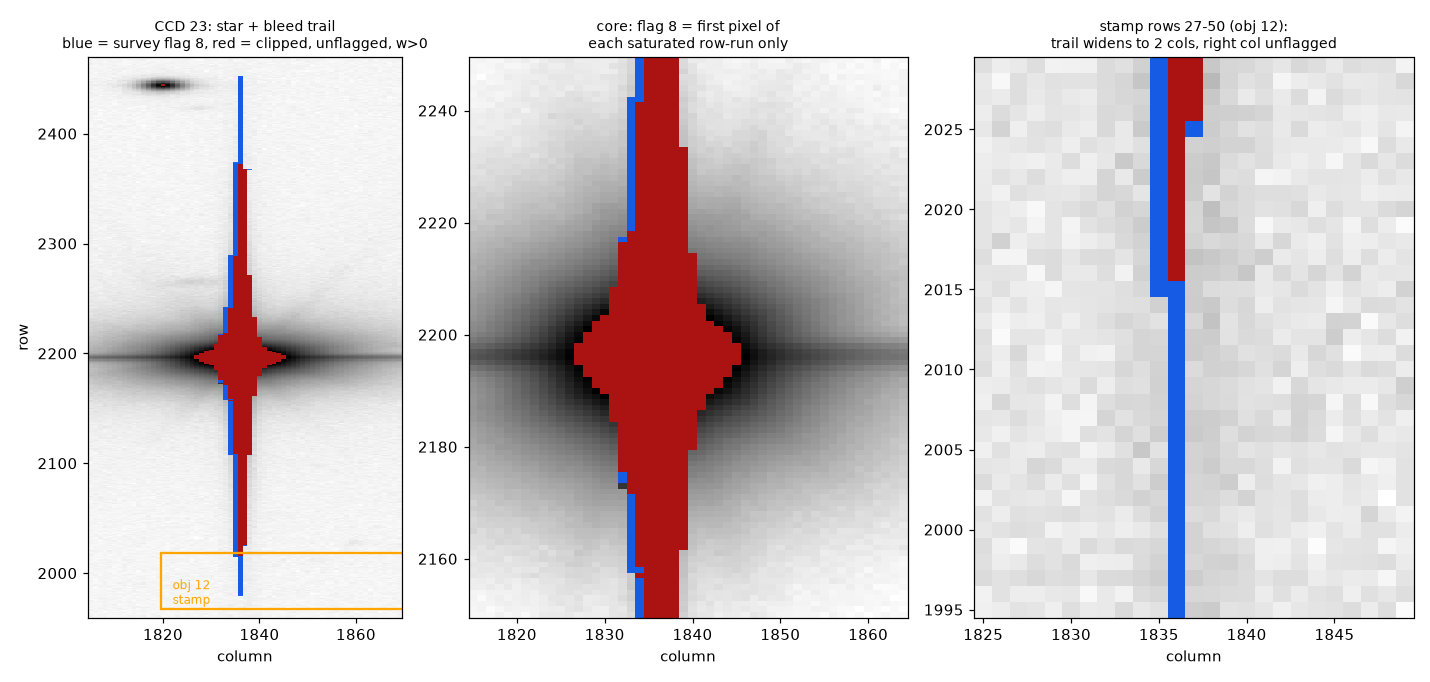
Exposure 2086786p, CCD 23. Blue: survey flag bit 8. Red: clipped, unflagged, weight > 0. Right: the trail widens to two columns, and only the left one is flagged. Each red pixel there is about 2,400σ.
Scale (4 exposures × 40 CCDs): 80–88% of clipped pixels are unflagged, 66k–99k per exposure. In horizontal runs of clipped pixels at least 2 px wide, 76% have only the first pixel flagged. The pattern is the same on both amplifiers.
Impact on shapes, so far small:
- Among galaxy-like epoch stamps on tile 202.301, after the neighbour mask, 0.05% contain such a pixel, and 0.02% within 8 px of the centre. Most of those are coadd detections lying on a trail.
- PSF stars (MAG_AUTO > 18) sit below the clipping onset at mag 17.0–17.4 (inferred, not checked star by star).
- Shear impact is not measured.
Proposed fix, in split_exp, ORed into each per-CCD flag file so that SExtractor and the vignets both see it:
- flag
image ≥ 0.9 × 32760, which catches all of them at 0.02% of good pixels; - grow the mask by 1 px (3×3) for the charge spilled into the next column, about +1.5 to 3σ on the side away from the readout amplifier;
- extend it ±20 rows along the column for the bleed tails, which are still +2σ at 20 px. Total cost about 0.06–0.07% of good pixels.
Dilating bit 8 instead catches at most 50%, at 0.9% of the area. Separately, set SATUR_LEVEL ≈ 29000 in default_exp.sex so that exposure FLAGS bit 4 works.
Open: why the upstream flag-map production marks only the first pixel of each run. Someone who knows the CFIS flag pipeline would know.
Evidence on candide: /n17data/cdaley/scratch/saturation/ (scripts, the 4 exposures, figures, including fig_stats.png).
— Claude Opus 5.5, on behalf of Cail
- Lenguaje dominante
- Python
- Estrellas
- 18
- Forks
- 14
- Merge medio
- 2 d 10 h
- PR fusionados (30 d)
- 37
Preparar el entorno
- Incluye un Dockerfile o un archivo de Docker Compose
- Tiene una plantilla de pull request
- Leer la guía de contribución
Primeros pasos
- Lee el issue completo y luego la guía de contribución del proyecto.
- Comenta en el issue que vas a ocuparte — evita que dos personas hagan lo mismo.
- Haz un fork del repositorio y trabaja en una rama.
- Abre un pull request que haga referencia al número del issue.
Más de CosmoStat/shapepipe
-
Dificultad 1/5 Menos de una hora Aptitud para principiantes 85/100
Los mantenedores suelen responder en 1 día
-
Dificultad 2/5 1-3 horas Aptitud para principiantes 75/100
Los mantenedores suelen responder en 1 día
-
Dificultad 4/5 3-5 días Aptitud para principiantes 25/100
Los mantenedores suelen responder en 1 día
-
Dificultad 4/5 3-5 días Aptitud para principiantes 45/100
Los mantenedores suelen responder en 1 día
-
Workflow: sp run refreshes the code snapshot before the lock; re-clean erases exposure tombstones; missing run-dir undetectedPosiblemente ocupada Un pull request vinculado a esta issue está abierto o ya se fusionó. Abierto
Dificultad 4/5 3-5 días Aptitud para principiantes 45/100
Los mantenedores suelen responder en 1 día
Todos los issues de CosmoStat/shapepipe
Issues similares
-
Broken links in the docsAbierto
Dificultad 1/5 Menos de una hora Aptitud para principiantes 78/100
uniswap-python/uniswap-python#487 ·
-
[Bug]: agent_final_response still returns the abandoned branch's answer after navigate moves HEAD backPosiblemente ocupada @enyst la tomó hoy. Abiertobug priority:low ready-for-dev
Dificultad 2/5 1-3 horas Aptitud para principiantes 72/100
OpenHands/software-agent-sdk#5822 ·
Los mantenedores suelen responder en 1 día
-
Dificultad 1/5 Menos de una hora Aptitud para principiantes 72/100
-
area: server enhancement good first issue
Dificultad 2/5 1-3 horas Aptitud para principiantes 82/100
scs0209/laya-guard#52 ·
Los mantenedores suelen responder en 1 día
-
Dificultad 2/5 1-3 horas Aptitud para principiantes 82/100
Los mantenedores suelen responder en 2 días