Saturated pixels reach ngmix unflagged: survey flag bit 8 marks only the first pixel of each saturated run
Maintainer thường phản hồi trong vòng 1 ngày
Chưa có ai nhận issue này.
Đánh giá
- Độ khó
- 4/5
- Thời gian dự kiến
- 3-5 ngày
- Mức phù hợp với người mới
- 50/100
- Loại issue
- Lỗi
- Độ rõ ràng
- Khá rõ ràng
- Mức độ hoạt động
- Sôi nổi
- Công nghệ
- python
- Lĩnh vực
- computer-vision
Hướng nghiên cứu
Start in split_exp, tracing how per-CCD flag files are produced and how SExtractor and the vignets consume them. Review default_exp.sex for the SATUR_LEVEL setting, then use the saturation evidence in /n17data/cdaley/scratch/saturation/ to check the proposed clipping, growth, and bleed-tail masks. Done means saturated pixels and their proposed extensions are flagged consistently without masking more good pixels than expected.
Do mô hình lập chỉ mục viết ra từ nội dung của issue.
Mô tả
Saturated pixels reach ngmix unflagged and at full weight. In the CFIS survey flag map, bit 8 marks only the first (lowest-column) pixel of each horizontal run of saturated pixels. A 1-px bleed trail therefore looks fully flagged, while wider trail sections and star cores are mostly unflagged. Nothing downstream catches the rest:
- The v2 pipeline has no mask rule, and
prepare_ngmix_weightsnever tests image values. - SExtractor's saturation flag is inert, because
SATURATE = 65535in the headers while the int16 images clip at 32760.
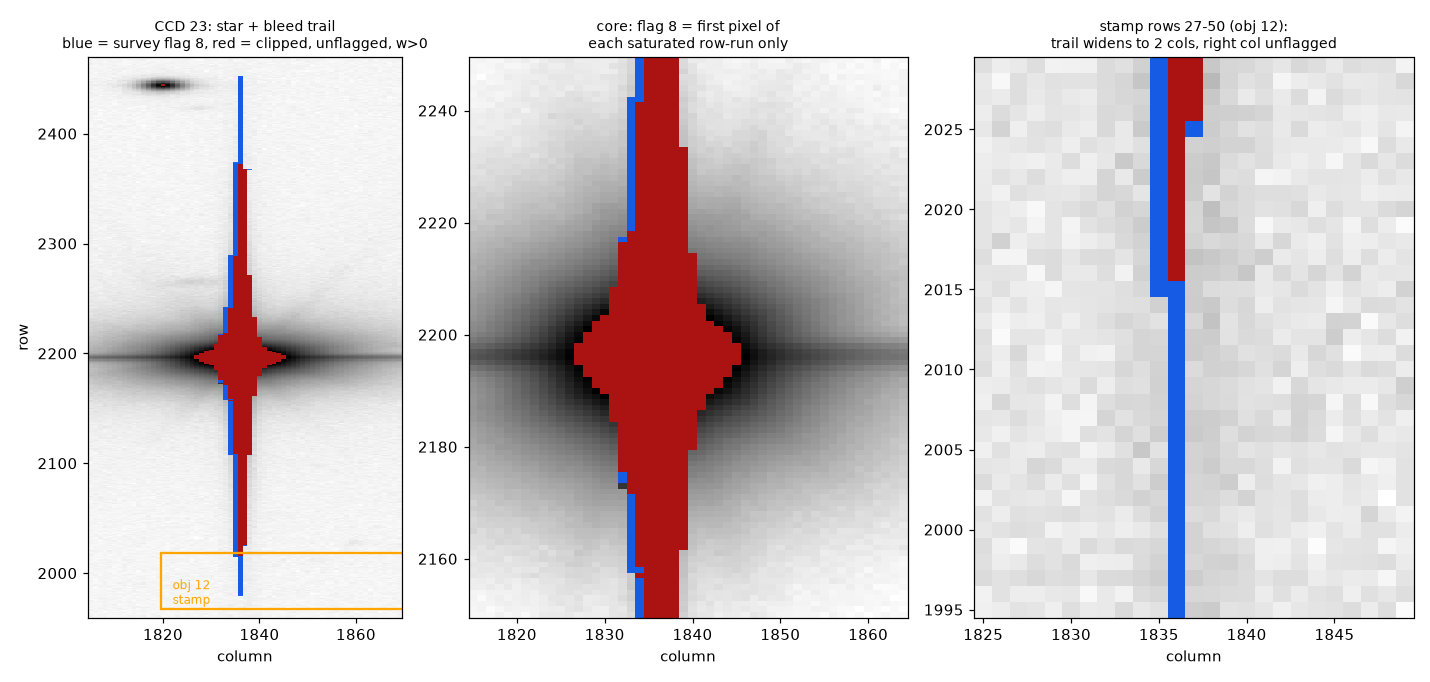
Exposure 2086786p, CCD 23. Blue: survey flag bit 8. Red: clipped, unflagged, weight > 0. Right: the trail widens to two columns, and only the left one is flagged. Each red pixel there is about 2,400σ.
Scale (4 exposures × 40 CCDs): 80–88% of clipped pixels are unflagged, 66k–99k per exposure. In horizontal runs of clipped pixels at least 2 px wide, 76% have only the first pixel flagged. The pattern is the same on both amplifiers.
Impact on shapes, so far small:
- Among galaxy-like epoch stamps on tile 202.301, after the neighbour mask, 0.05% contain such a pixel, and 0.02% within 8 px of the centre. Most of those are coadd detections lying on a trail.
- PSF stars (MAG_AUTO > 18) sit below the clipping onset at mag 17.0–17.4 (inferred, not checked star by star).
- Shear impact is not measured.
Proposed fix, in split_exp, ORed into each per-CCD flag file so that SExtractor and the vignets both see it:
- flag
image ≥ 0.9 × 32760, which catches all of them at 0.02% of good pixels; - grow the mask by 1 px (3×3) for the charge spilled into the next column, about +1.5 to 3σ on the side away from the readout amplifier;
- extend it ±20 rows along the column for the bleed tails, which are still +2σ at 20 px. Total cost about 0.06–0.07% of good pixels.
Dilating bit 8 instead catches at most 50%, at 0.9% of the area. Separately, set SATUR_LEVEL ≈ 29000 in default_exp.sex so that exposure FLAGS bit 4 works.
Open: why the upstream flag-map production marks only the first pixel of each run. Someone who knows the CFIS flag pipeline would know.
Evidence on candide: /n17data/cdaley/scratch/saturation/ (scripts, the 4 exposures, figures, including fig_stats.png).
— Claude Opus 5.5, on behalf of Cail
- Ngôn ngữ chính
- Python
- Star
- 18
- Fork
- 14
- Merge trung bình
- 2 ngày 10 giờ
- Pull request đã merge (30 ngày)
- 37
Chuẩn bị môi trường
- Có Dockerfile hoặc tệp Docker Compose
- Có mẫu pull request
- Đọc hướng dẫn đóng góp
Bắt đầu từ đâu
- Đọc hết issue, rồi đọc hướng dẫn đóng góp của dự án.
- Bình luận trên issue rằng bạn sẽ nhận — tránh hai người làm cùng một việc.
- Fork repository và làm thay đổi trên một nhánh.
- Mở pull request có tham chiếu số hiệu của issue.
Issue khác của CosmoStat/shapepipe
-
Độ khó 1/5 Dưới một giờ Mức phù hợp với người mới 85/100
Maintainer thường phản hồi trong vòng 1 ngày
-
Độ khó 2/5 1-3 giờ Mức phù hợp với người mới 75/100
Maintainer thường phản hồi trong vòng 1 ngày
-
Độ khó 4/5 3-5 ngày Mức phù hợp với người mới 25/100
Maintainer thường phản hồi trong vòng 1 ngày
-
Độ khó 4/5 3-5 ngày Mức phù hợp với người mới 45/100
Maintainer thường phản hồi trong vòng 1 ngày
-
Workflow: sp run refreshes the code snapshot before the lock; re-clean erases exposure tombstones; missing run-dir undetectedCó thể đã có người làm Có pull request liên kết đang mở hoặc đã được merge. Đang mở
Độ khó 4/5 3-5 ngày Mức phù hợp với người mới 45/100
Maintainer thường phản hồi trong vòng 1 ngày
Tất cả issue của CosmoStat/shapepipe
Issue tương tự
-
Độ khó 2/5 1-3 giờ Mức phù hợp với người mới 85/100
Maintainer thường phản hồi trong vòng 1 ngày
-
infrastructure qa
Độ khó 2/5 1-3 giờ Mức phù hợp với người mới 84/100
khuisman/mcp-gee-sweet#1068 ·
Maintainer thường phản hồi trong vòng 1 ngày
-
The book has a Nix install section that chelis.ch lacks, and it names two of the three systemsĐang mởarea:ecosystem documentation
Độ khó 2/5 1-3 giờ Mức phù hợp với người mới 78/100
Chelis-Lang/chelis#3866 ·
Maintainer thường phản hồi trong vòng 1 ngày
-
`lvm_compact` has no self-hosted twin, and `docs/158` §5 says every language-face component mustĐang mởbug sev-3 vm
Độ khó 2/5 1-3 giờ Mức phù hợp với người mới 65/100
-
issue: Picking a prompt from the / menu in a channel inserts a command chip instead of the promptĐang mởbug confirmed issue
Độ khó 2/5 Nửa ngày Mức phù hợp với người mới 78/100
open-webui/open-webui#32712 · 2 bình luận ·
Maintainer thường phản hồi trong vòng 1 ngày