Flow analysis
還沒有人認領這個 Issue。
評估
研究方向
首先定位 issue 中描述的目前 Roslyn 流程分析整合,並追蹤 GetNode 範例如何產生圖形邊。當流程狀態輔助節點能夠跨分支追蹤區域變數的可空性,且回傳值取決於推斷出的非空 mapping 型別,而不是宣告的 nullable 型別時,這項工作就完成了。
由索引模型根據 Issue 內容生成。
描述
Currently our inference re-uses Roslyn's flow-analysis.
However, this has some fundamental problems.
9:	Dictionary<T, Node> mapping = new Dictionary<T, Node>();

11:	Node? GetNode(T element)
	{
13:		Node? node;
14:		if (!mapping.TryGetValue(element, out node))
15:		{
16:			node = new Node();
17:			mapping.Add(element, node);
18:		}
19:		return node;
	}

There's no edges created for line 16/17 because here Roslyn knows that node is non-null.
Line 14 creates two edges: one from <nullable> because TryGetValue will assign null when returning false; the other from mapping!1#2 (the mapping field's Node type argument) when TryGetValue returns true.
The return statement creates an edge from the variable's type, because Roslyn's flow analysis can't guarantee us that the variable is non-null -- our Roslyn code analysis runs under the pessimistic assumption that all types-to-be-inferred might end up nullable, so it considers mapping to be Dictionary<T, Node?>, which leaves open the possibility that GetNode returns null.
However, after our inference decides that mapping!1#2 is non-null, it would be correct to also indicate that the GetNode return value is non-null. After all, if no node exists yet, the function will create one.
The issue here is that Roslyn's flow analysis isn't aware of our types-to-be-inferred.
It would be better if, instead of using Roslyn's flow analysis, we had our own that keeps track of node's nullability.
The idea would be to create additional "helper" graph nodes for the different flow states of a local variable of reference type.
After TryGetValue initializes node, it's flow-state would be (true: mapping!1#2, false: <nullable>). Within the if body, the flow-state would initially be <nullable>, but after line 16 would change to <nonnull>.
After the if, the flow-state from both alternatives could be re-combined by creating a new node "node-after-line-18" and edges from the nodes from the two if-branches -- in this case <nonnull> from the then-branch and mapping!1#2 from the else branch.
Then the return statement would create an edge from this "node-after-line-18" instead of the node for the variable's declared type.
All flow-state nodes associated with a variable would have an edge to the variable's declared type node.
We'd end up with a graph somewhat like this:
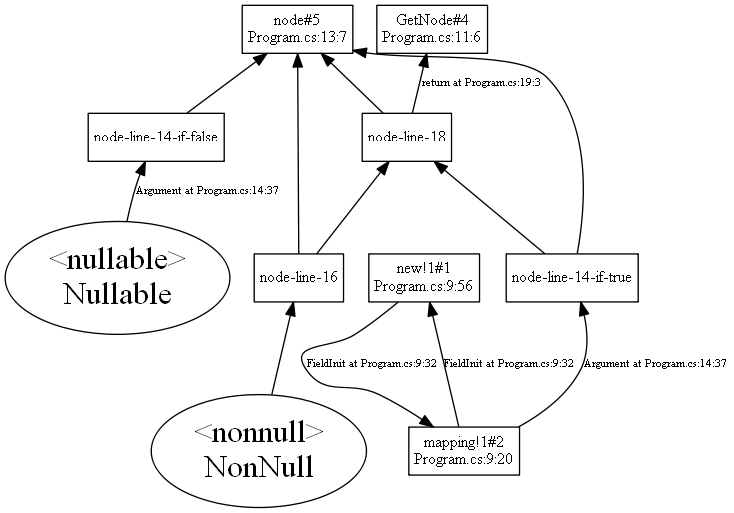
Thus in the end, node would be inferred as nullable, but the GetNode return type would only depend on mapping!1#2 and thus can be inferred depending on whether there's a mapping.Add(x, null) access somewhere else in the program.
- 主要語言
- C#
- 星號
- 38
- 分支
- 6
- PR 合併指標
- 30 天內沒有已合併 PR
環境準備
這個專案沒有提供開發容器、Dockerfile 或貢獻指南,環境需要你自己搭建:先看它的 README,通用步驟見我們的新手貢獻指南。
從這裡開始
- 先讀完整個 Issue,再讀專案的貢獻指南。
- 在 Issue 下留言說明你要接手 —— 這能避免兩個人做同樣的事。
- Fork 儲存庫,在一個分支上完成修改。
- 送出 Pull Request,並在描述裡引用這個 Issue 編號。
icsharpcode/NullabilityInference 的其他 Issue
-
難度 4/5 3-5 天 新手友好度 35/100
icsharpcode/NullabilityInference#13 · 1 個 reaction ·
-
難度 3/5 1-2 天 新手友好度 42/100
-
難度 5/5 一週以上 新手友好度 15/100
-
難度 5/5 一週以上 新手友好度 35/100
-
難度 5/5 一週以上 新手友好度 25/100
icsharpcode/NullabilityInference#6 · 2 則留言 ·
查看 icsharpcode/NullabilityInference 的全部 Issue
相似的 Issue
-
bug
難度 2/5 1-3 小時 新手友好度 72/100
維護者通常 3 天內回覆
-
bug python
難度 1/5 1 小時以內 新手友好度 88/100
ilia-sokolov/OfficeAgent.NET#89 ·
維護者通常 13 天內回覆
-
documentation
難度 2/5 1-3 小時 新手友好度 82/100
juandresrodca/AdminForge#66 ·
維護者通常 1 天內回覆
-
難度 2/5 1-3 小時 新手友好度 70/100
維護者通常 1 天內回覆
-
難度 2/5 1-3 小時 新手友好度 72/100
umbraco/Umbraco.Automate#612 ·
維護者通常 1 天內回覆