Flow analysis
Nessuno ha ancora preso questa issue.
Valutazione
- Difficoltà
- 5/5
- Tempo stimato
- Più di una settimana
- Idoneità per principianti
- 32/100
Direzione di ricerca
Inizia individuando l’attuale integrazione dell’analisi del flusso di Roslyn descritta nell’issue e traccia il modo in cui l’esempio GetNode produce gli archi del grafo. Il lavoro è completato quando i nodi helper dello stato del flusso tengono traccia della nullabilità delle variabili locali tra i rami e il valore restituito dipende dal tipo di mapping non nullable inferito invece che dal tipo nullable dichiarato.
Scritto dal modello di indicizzazione a partire dal testo della issue.
Descrizione
Currently our inference re-uses Roslyn's flow-analysis.
However, this has some fundamental problems.
9:	Dictionary<T, Node> mapping = new Dictionary<T, Node>();

11:	Node? GetNode(T element)
	{
13:		Node? node;
14:		if (!mapping.TryGetValue(element, out node))
15:		{
16:			node = new Node();
17:			mapping.Add(element, node);
18:		}
19:		return node;
	}

There's no edges created for line 16/17 because here Roslyn knows that node is non-null.
Line 14 creates two edges: one from <nullable> because TryGetValue will assign null when returning false; the other from mapping!1#2 (the mapping field's Node type argument) when TryGetValue returns true.
The return statement creates an edge from the variable's type, because Roslyn's flow analysis can't guarantee us that the variable is non-null -- our Roslyn code analysis runs under the pessimistic assumption that all types-to-be-inferred might end up nullable, so it considers mapping to be Dictionary<T, Node?>, which leaves open the possibility that GetNode returns null.
However, after our inference decides that mapping!1#2 is non-null, it would be correct to also indicate that the GetNode return value is non-null. After all, if no node exists yet, the function will create one.
The issue here is that Roslyn's flow analysis isn't aware of our types-to-be-inferred.
It would be better if, instead of using Roslyn's flow analysis, we had our own that keeps track of node's nullability.
The idea would be to create additional "helper" graph nodes for the different flow states of a local variable of reference type.
After TryGetValue initializes node, it's flow-state would be (true: mapping!1#2, false: <nullable>). Within the if body, the flow-state would initially be <nullable>, but after line 16 would change to <nonnull>.
After the if, the flow-state from both alternatives could be re-combined by creating a new node "node-after-line-18" and edges from the nodes from the two if-branches -- in this case <nonnull> from the then-branch and mapping!1#2 from the else branch.
Then the return statement would create an edge from this "node-after-line-18" instead of the node for the variable's declared type.
All flow-state nodes associated with a variable would have an edge to the variable's declared type node.
We'd end up with a graph somewhat like this:
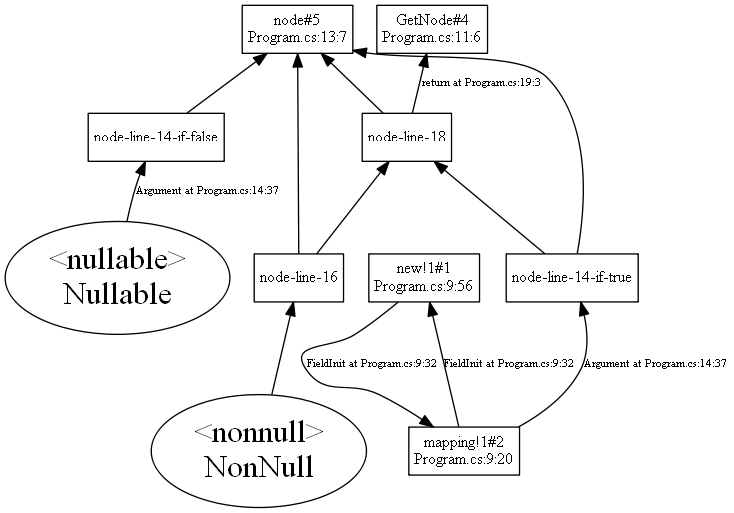
Thus in the end, node would be inferred as nullable, but the GetNode return type would only depend on mapping!1#2 and thus can be inferred depending on whether there's a mapping.Add(x, null) access somewhere else in the program.
- Lingua principale
- C#
- Stelle
- 38
- Fork
- 6
- Metriche di merge delle PR
- Nessuna PR unita negli ultimi 30g
Preparare l'ambiente
Questo progetto non fornisce container di sviluppo, Dockerfile né guida per i contributori, quindi l'ambiente è a tuo carico: parti dal suo README e consulta la nostra guida al primo contributo per i passaggi generali.
Come iniziare
- Leggi tutta la issue e poi la guida ai contributi del progetto.
- Commenta sulla issue per dire che te ne occupi tu — evita che due persone facciano lo stesso lavoro.
- Fai un fork del repository e lavora su un branch.
- Apri una pull request che faccia riferimento al numero della issue.
Altre issue di icsharpcode/NullabilityInference
-
Distribute as dotnet toolAperta
Difficoltà 4/5 3-5 giorni Idoneità per principianti 35/100
icsharpcode/NullabilityInference#13 · 1 reazione ·
-
Difficoltà 3/5 1-2 giorni Idoneità per principianti 42/100
-
Difficoltà 5/5 Più di una settimana Idoneità per principianti 15/100
-
Difficoltà 5/5 Più di una settimana Idoneità per principianti 35/100
-
Difficoltà 5/5 Più di una settimana Idoneità per principianti 25/100
icsharpcode/NullabilityInference#6 · 2 commenti ·
Tutte le issue di icsharpcode/NullabilityInference
Issue simili
-
Difficoltà 2/5 1-3 ore Idoneità per principianti 72/100
umbraco/Umbraco.Automate#612 ·
I maintainer di solito rispondono entro 1 giorno
-
崩溃日志只按 CRLF 分行Aperta
Difficoltà 2/5 1-3 ore Idoneità per principianti 72/100
PCL-Community/PCL-CE#3872 ·
I maintainer di solito rispondono entro 1 giorno
-
type:task ux
Difficoltà 2/5 1-3 ore Idoneità per principianti 72/100
elsa-workflows/elsa-foundation#5253 ·
I maintainer di solito rispondono entro 1 giorno