Flow analysis
まだ誰も着手していません。
評価
- 難易度
- 5/5
- 見積もり時間
- 1週間以上
- 初心者へのやさしさ
- 32/100
調査の方向性
まず、issue に記載されている現在の Roslyn のフロー分析統合を見つけ、GetNode の例がどのようにグラフのエッジを生成するかを追跡します。フローステートのヘルパーノードが分岐をまたいでローカル変数の null 許容性を追跡し、戻り値が宣言された nullable 型ではなく、推論された non-null マッピング型に依存するようになれば作業は完了です。
索引モデルが issue の本文から書いたものです。
説明
Currently our inference re-uses Roslyn's flow-analysis.
However, this has some fundamental problems.
9:	Dictionary<T, Node> mapping = new Dictionary<T, Node>();

11:	Node? GetNode(T element)
	{
13:		Node? node;
14:		if (!mapping.TryGetValue(element, out node))
15:		{
16:			node = new Node();
17:			mapping.Add(element, node);
18:		}
19:		return node;
	}

There's no edges created for line 16/17 because here Roslyn knows that node is non-null.
Line 14 creates two edges: one from <nullable> because TryGetValue will assign null when returning false; the other from mapping!1#2 (the mapping field's Node type argument) when TryGetValue returns true.
The return statement creates an edge from the variable's type, because Roslyn's flow analysis can't guarantee us that the variable is non-null -- our Roslyn code analysis runs under the pessimistic assumption that all types-to-be-inferred might end up nullable, so it considers mapping to be Dictionary<T, Node?>, which leaves open the possibility that GetNode returns null.
However, after our inference decides that mapping!1#2 is non-null, it would be correct to also indicate that the GetNode return value is non-null. After all, if no node exists yet, the function will create one.
The issue here is that Roslyn's flow analysis isn't aware of our types-to-be-inferred.
It would be better if, instead of using Roslyn's flow analysis, we had our own that keeps track of node's nullability.
The idea would be to create additional "helper" graph nodes for the different flow states of a local variable of reference type.
After TryGetValue initializes node, it's flow-state would be (true: mapping!1#2, false: <nullable>). Within the if body, the flow-state would initially be <nullable>, but after line 16 would change to <nonnull>.
After the if, the flow-state from both alternatives could be re-combined by creating a new node "node-after-line-18" and edges from the nodes from the two if-branches -- in this case <nonnull> from the then-branch and mapping!1#2 from the else branch.
Then the return statement would create an edge from this "node-after-line-18" instead of the node for the variable's declared type.
All flow-state nodes associated with a variable would have an edge to the variable's declared type node.
We'd end up with a graph somewhat like this:
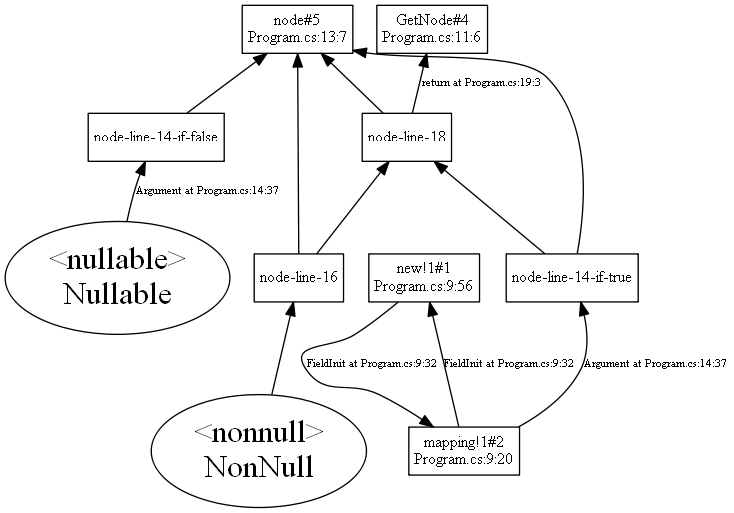
Thus in the end, node would be inferred as nullable, but the GetNode return type would only depend on mapping!1#2 and thus can be inferred depending on whether there's a mapping.Add(x, null) access somewhere else in the program.
- 主要言語
- C#
- スター
- 38
- フォーク
- 6
- PR マージ指標
- 30日以内にマージされた PR はありません
環境構築
このプロジェクトには開発コンテナ、Dockerfile、コントリビューションガイドがありません。まず README を読み、一般的な手順ははじめてのコントリビューションガイドを参照してください。
はじめの一歩
- issue を最後まで読み、次にプロジェクトのコントリビューションガイドを読みます。
- 着手することを issue にコメントします — 二人が同じ作業をするのを防げます。
- リポジトリをフォークし、ブランチを切って変更します。
- issue 番号を参照したプルリクエストを送ります。
icsharpcode/NullabilityInference のほかの issue
-
難易度 4/5 3〜5日 初心者へのやさしさ 35/100
icsharpcode/NullabilityInference#13 · リアクション 1 件 ·
-
難易度 3/5 1〜2日 初心者へのやさしさ 42/100
-
難易度 5/5 1週間以上 初心者へのやさしさ 15/100
-
難易度 5/5 1週間以上 初心者へのやさしさ 35/100
-
難易度 5/5 1週間以上 初心者へのやさしさ 25/100
icsharpcode/NullabilityInference#6 · コメント 2 件 ·
icsharpcode/NullabilityInference の issue をすべて見る
似ている issue
-
難易度 2/5 1〜3時間 初心者へのやさしさ 72/100
umbraco/Umbraco.Automate#612 ·
メンテナーはふだん 1 日以内に返信
-
崩溃日志只按 CRLF 分行オープン
難易度 2/5 1〜3時間 初心者へのやさしさ 72/100
PCL-Community/PCL-CE#3872 ·
メンテナーはふだん 1 日以内に返信
-
type:task ux
難易度 2/5 1〜3時間 初心者へのやさしさ 72/100
elsa-workflows/elsa-foundation#5253 ·
メンテナーはふだん 1 日以内に返信