Section 3.5 (sorting shorthand properties first) can impair readability
Nessuno ha ancora preso questa issue.
Valutazione
- Difficoltà
- 5/5
- Tempo stimato
- Più di una settimana
- Idoneità per principianti
- 35/100
- Tipo di issue
- Documentazione
- Chiarezza
- Abbastanza chiara
- Stato di attività
- Ferma
- Stack tecnologico
- javascript, typescript
- Ambito
- documentation
Direzione di ricerca
Leggi la sezione 3.5 di Airbnb JavaScript Style Guide insieme agli esempi TypeScript di discriminated-union e domain-ordering presenti in questa issue. Esamina la pull request di VotingWorks collegata e gli esempi citati dei progetti Airbnb, quindi determina se le indicazioni debbano essere rimosse o richiedano eccezioni esplicite. Il lavoro è completo quando la regola pubblicata riflette chiaramente le indicazioni di leggibilità scelte dai maintainer.
Scritto dal modello di indicizzazione a partire dal testo della issue.
Descrizione
Hello 👋! My company (VotingWorks) is attempting to use the Airbnb JavaScript Style Guide and ran into a problem with Section 3.5, which says:
Group your shorthand properties at the beginning of your object declaration.
Why? It’s easier to tell which properties are using the shorthand.
It is true that it's easier to tell which properties are using the shorthand if you do it this way. I surmise that a more general motivation for this rule is to improve the ability for a human reading the object expression to understand it, i.e. make it more readable. However, this rule makes it harder for humans to understand the code in some circumstances:
TypeScript discriminated unions
Let's say you have some types like this:
interface HandMarkedPaperBallotPage {
  type: 'hmpb'
  precinctId: string
  ballotStyleId: string
  pageNumber: number
  marks: readonly Mark[]
  // …
}

interface BallotMarkingDeviceBallotPage {
  type: 'bmd'
  precinctId: string
  ballotStyleId: string
  votes: Record<string, string>
  // …
}

type PageInterpretation =
  | HandMarkedPaperBallotPage
  | BallotMarkingDeviceBallotPage
PageInterpretation is a discriminated union of two variants: HandMarkedPaperBallotPage and BallotMarkingDeviceBallotPage. When working with a PageInterpretation, the type property helps TypeScript discriminate between the possible variants, leading to type-safe access for the properties that are specific to that variant:
if (page.type === 'hmpb') {
  console.log('hand-marked paper had these marks:', page.marks)
} else {
  console.log('ballot marking device recorded these votes:', page.votes)
}
When a developer writes an object expression of type PageInterpretation it is most common to type the discriminator first like so:
function interpretImage(imagePath: string): PageInterpretation {
  // …
  if (detectedBmdBallot) {
    const precinctId = detectedBmdBallot.getPrecinctId()
    // …
    return {
      type: 'bmd',
      precinctId,
      // …
    }
  }
}
There are two reasons for this:
- it makes it immediately clear which variant type the object has.
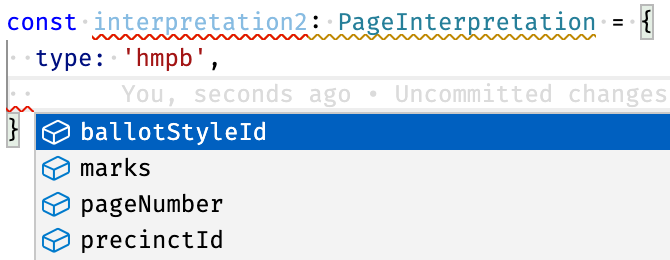
- it tells an IDE (like VS Code) which properties to help autocomplete when typing the code for the object.
Without a leading discriminator (shows all properties for all variants):
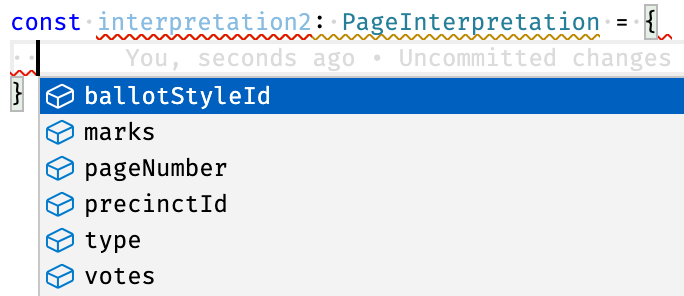
With a leading discriminator (shows only the properties for the detected variant):
Domain-specified property order
In many domains the order of properties maps to the order of values from the domain. For example, dates and times:
DateTime.fromObject({
  year,
  month,
  day: lastDayOfMonth && day > lastDayOfMonth ? lastDayOfMonth : day,
  hour,
  minute: name === 'minute' ? partValue : newValue.minute,
  zone: newValue.zone,
})
Following rule 3.5 here would require that hour move above day, hurting readability. I could unnecessarily write it as hour: hour (violating the object-shorthand rule) or come up with a new name for hour so that it cannot be written as shorthand instead.
Similarly, the HTTP request/response cycle is another domain with a natural ordering of properties following the order of values in the actual content of a request or response:
fetchMock.patchOnce('/config/election', {
  status: 400,
  body,
})
Following rule 3.5 here would put body above status, again hurting readability.
Arbitrary inconsistency in object property ordering
In many places, especially test files, it is common to build many of the same object type over and over. Requiring that the order of properties vary depending on which properties happen to be eligible for shorthand hurts readability and maybe even performance in v8.
Why is this a problem?
You could rightfully point out that eslint-config-airbnb does not actually enforce this rule. I agree that for nearly everyone this is not a problem since they can simply choose to ignore this requirement in scenarios like I outlined above. However, VotingWorks is attempting to certify our voting system with the VVSG 2.0 federal standard defined by the EAC. That document has the following requirement:
2.1-C – Acceptable coding conventions
Application logic must adhere to a published, credible set of coding rules, conventions, or standards (called "coding conventions") that enhance the workmanship, security, integrity, testability, and maintainability of applications.
…
Coding conventions are considered to be published if they appear in a publicly available book, magazine, journal, or new media with analogous circulation and availability, or if they are publicly available on the Internet. This requirement attempts to clarify the “published, reviewed, and industry-accepted” language appearing in previous iterations of the VVSG, but the intent of the requirement is unchanged.
Coding conventions are considered to be credible if at least two different organizations with no ties to the creator of the rules or to the manufacturer seeking conformity assessment, and which are not themselves voting equipment manufacturers, independently decided to adopt them and made active use of them at some point within the three years before conformity assessment was first sought. This requirement attempts to clarify the “published, reviewed, and industry-accepted” language appearing in previous iterations of the VVSG, but the intent of the requirement is unchanged.
The Airbnb JavaScript Style Guide is likely the best choice to meet such a requirement, and as I mentioned we intend to fully adopt it. However, we don't have the luxury of picking and choosing the parts that we consider to be good, so we would likely have to follow the whole thing to the letter. Section 3.5, as written, would make our codebase worse. Here's a pull request I created that updates the codebase to follow this requirement: https://github.com/votingworks/vxsuite/pull/778. I can't pick a single change that obviously makes it better, and I can pick many that make it worse. The examples above came from or were inspired by this PR.
Airbnb itself doesn't even follow this rule in its open source projects:
- react-dates/CalendarMonth.jsx
- react-dates/DateRangePicker_spec.jsx
- react-dates/DayPickerSingleDateController.jsx
- react-dates/DayPicker.jsx
- ts-migrate/index.ts
- visx/DataProvider.ts
What should change?
I think this rule should either be scrapped entirely or modified to focus on the real aim: improving the ability to understand the object. While ordering properties with shorthand properties first can improve readability, it should be counterbalanced against other concerns such as domain-specific property order or better enabling discriminated unions. If this rule is left in, it should make it clear that these or other concerns may override it.
Thanks for your time 🙏 I know this was a rather long issue. We complain because we care ❤️
- Lingua principale
- JavaScript
- Stelle
- 148k
- Fork
- 26.6k
- Metriche di merge delle PR
- Nessuna PR unita negli ultimi 30g
Preparare l'ambiente
Questo progetto non fornisce container di sviluppo, Dockerfile né guida per i contributori, quindi l'ambiente è a tuo carico: parti dal suo README e consulta la nostra guida al primo contributo per i passaggi generali.
Come iniziare
- Leggi tutta la issue e poi la guida ai contributi del progetto.
- Commenta sulla issue per dire che te ne occupi tu — evita che due persone facciano lo stesso lavoro.
- Fai un fork del repository e lavora su un branch.
- Apri una pull request che faccia riferimento al numero della issue.
Altre issue di airbnb/javascript
-
Severity: Unhandled promise rejection in `whitespace-async.js` when ESLint async path is usedForse già presa @bodapatisaikrishna l’ha presa 24 giorni fa. Aperta
Difficoltà 2/5 1-3 ore Idoneità per principianti 78/100
airbnb/javascript#3237 · 6 commenti ·
-
Inconsistent semicolon usage in examples (Arrays vs Functions)Forse già presa @Developer-shivamMishra l’ha presa 15 giorni fa. Aperta
Difficoltà 2/5 1-3 ore Idoneità per principianti 68/100
airbnb/javascript#3152 · 4 commenti ·
-
No error handling around execSync + JSON.parse in whitespace.js (ESLint 9 path)Forse già presa @dataCenter430 l’ha presa 219 giorni fa. Aperta
Difficoltà 2/5 1-3 ore Idoneità per principianti 48/100
airbnb/javascript#3238 · 8 commenti ·
-
Upgrading eslint-plugin-react-hooksForse già presa @weihongyu12 l’ha presa 365 giorni fa. Aperta
Difficoltà 3/5 1-2 giorni Idoneità per principianti 38/100
airbnb/javascript#3186 · 3 commenti · 2 reazioni ·
-
Difficoltà 3/5 1-2 giorni Idoneità per principianti 45/100
airbnb/javascript#3173 · 9 commenti · 1 reazione ·
Tutte le issue di airbnb/javascript
Issue simili
-
enhancement good first issue
Difficoltà 2/5 1-3 ore Idoneità per principianti 88/100
anoopcodehack/DevBoard#609 ·
I maintainer di solito rispondono entro 1 giorno
-
Difficoltà 2/5 1-3 ore Idoneità per principianti 86/100
openai/codex-plugin-cc#813 ·
-
area: ops type: test
Difficoltà 2/5 1-3 ore Idoneità per principianti 79/100
accensa/x402-facilitator-stellar#559 ·
I maintainer di solito rispondono entro 1 giorno
-
Difficoltà 2/5 1-3 ore Idoneità per principianti 78/100
bilawalsidhu/gods-eye-view#1060 ·
I maintainer di solito rispondono entro 1 giorno
-
Progress difficulty filter lists Hard before MediumForse già presa @Pandamachi l’ha presa oggi. Aperta
Difficoltà 2/5 1-3 ore Idoneità per principianti 86/100
sysprog21/codetrial#281 · 1 commento ·
I maintainer di solito rispondono entro 1 giorno