Section 3.5 (sorting shorthand properties first) can impair readability
Nadie ha tomado este issue todavía.
Evaluación
- Dificultad
- 5/5
- Tiempo estimado
- Más de una semana
- Aptitud para principiantes
- 35/100
- Tipo de issue
- Documentación
- Claridad
- Bastante claro
- Estado de actividad
- Estancado
- Stack tecnológico
- javascript, typescript
- Área
- documentation
Línea de trabajo
Lee la Sección 3.5 de Airbnb JavaScript Style Guide junto con los ejemplos de TypeScript sobre discriminated-union y domain-ordering de este issue. Revisa el pull request de VotingWorks enlazado y los ejemplos citados de proyectos de Airbnb, y determina si es necesario eliminar la guía o añadir excepciones explícitas. Se considera terminado cuando la regla publicada refleja claramente la guía de legibilidad elegida por los maintainers.
Escrito por el modelo de indexación a partir del texto del issue.
Descripción
Hello 👋! My company (VotingWorks) is attempting to use the Airbnb JavaScript Style Guide and ran into a problem with Section 3.5, which says:
Group your shorthand properties at the beginning of your object declaration.
Why? It’s easier to tell which properties are using the shorthand.
It is true that it's easier to tell which properties are using the shorthand if you do it this way. I surmise that a more general motivation for this rule is to improve the ability for a human reading the object expression to understand it, i.e. make it more readable. However, this rule makes it harder for humans to understand the code in some circumstances:
TypeScript discriminated unions
Let's say you have some types like this:
interface HandMarkedPaperBallotPage {
  type: 'hmpb'
  precinctId: string
  ballotStyleId: string
  pageNumber: number
  marks: readonly Mark[]
  // …
}

interface BallotMarkingDeviceBallotPage {
  type: 'bmd'
  precinctId: string
  ballotStyleId: string
  votes: Record<string, string>
  // …
}

type PageInterpretation =
  | HandMarkedPaperBallotPage
  | BallotMarkingDeviceBallotPage
PageInterpretation is a discriminated union of two variants: HandMarkedPaperBallotPage and BallotMarkingDeviceBallotPage. When working with a PageInterpretation, the type property helps TypeScript discriminate between the possible variants, leading to type-safe access for the properties that are specific to that variant:
if (page.type === 'hmpb') {
  console.log('hand-marked paper had these marks:', page.marks)
} else {
  console.log('ballot marking device recorded these votes:', page.votes)
}
When a developer writes an object expression of type PageInterpretation it is most common to type the discriminator first like so:
function interpretImage(imagePath: string): PageInterpretation {
  // …
  if (detectedBmdBallot) {
    const precinctId = detectedBmdBallot.getPrecinctId()
    // …
    return {
      type: 'bmd',
      precinctId,
      // …
    }
  }
}
There are two reasons for this:
- it makes it immediately clear which variant type the object has.
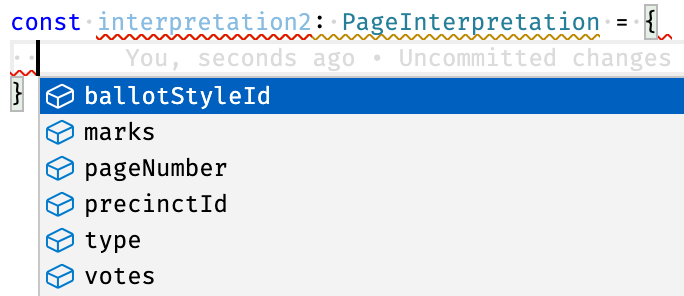
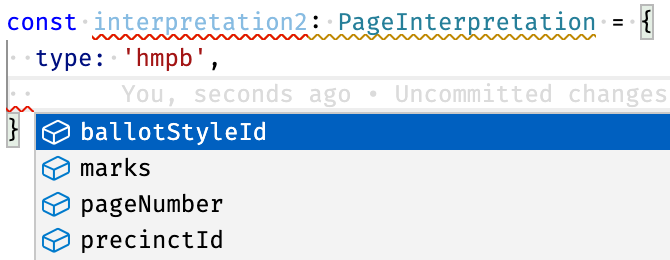
- it tells an IDE (like VS Code) which properties to help autocomplete when typing the code for the object.
Without a leading discriminator (shows all properties for all variants):
With a leading discriminator (shows only the properties for the detected variant):
Domain-specified property order
In many domains the order of properties maps to the order of values from the domain. For example, dates and times:
DateTime.fromObject({
  year,
  month,
  day: lastDayOfMonth && day > lastDayOfMonth ? lastDayOfMonth : day,
  hour,
  minute: name === 'minute' ? partValue : newValue.minute,
  zone: newValue.zone,
})
Following rule 3.5 here would require that hour move above day, hurting readability. I could unnecessarily write it as hour: hour (violating the object-shorthand rule) or come up with a new name for hour so that it cannot be written as shorthand instead.
Similarly, the HTTP request/response cycle is another domain with a natural ordering of properties following the order of values in the actual content of a request or response:
fetchMock.patchOnce('/config/election', {
  status: 400,
  body,
})
Following rule 3.5 here would put body above status, again hurting readability.
Arbitrary inconsistency in object property ordering
In many places, especially test files, it is common to build many of the same object type over and over. Requiring that the order of properties vary depending on which properties happen to be eligible for shorthand hurts readability and maybe even performance in v8.
Why is this a problem?
You could rightfully point out that eslint-config-airbnb does not actually enforce this rule. I agree that for nearly everyone this is not a problem since they can simply choose to ignore this requirement in scenarios like I outlined above. However, VotingWorks is attempting to certify our voting system with the VVSG 2.0 federal standard defined by the EAC. That document has the following requirement:
2.1-C – Acceptable coding conventions
Application logic must adhere to a published, credible set of coding rules, conventions, or standards (called "coding conventions") that enhance the workmanship, security, integrity, testability, and maintainability of applications.
…
Coding conventions are considered to be published if they appear in a publicly available book, magazine, journal, or new media with analogous circulation and availability, or if they are publicly available on the Internet. This requirement attempts to clarify the “published, reviewed, and industry-accepted” language appearing in previous iterations of the VVSG, but the intent of the requirement is unchanged.
Coding conventions are considered to be credible if at least two different organizations with no ties to the creator of the rules or to the manufacturer seeking conformity assessment, and which are not themselves voting equipment manufacturers, independently decided to adopt them and made active use of them at some point within the three years before conformity assessment was first sought. This requirement attempts to clarify the “published, reviewed, and industry-accepted” language appearing in previous iterations of the VVSG, but the intent of the requirement is unchanged.
The Airbnb JavaScript Style Guide is likely the best choice to meet such a requirement, and as I mentioned we intend to fully adopt it. However, we don't have the luxury of picking and choosing the parts that we consider to be good, so we would likely have to follow the whole thing to the letter. Section 3.5, as written, would make our codebase worse. Here's a pull request I created that updates the codebase to follow this requirement: https://github.com/votingworks/vxsuite/pull/778. I can't pick a single change that obviously makes it better, and I can pick many that make it worse. The examples above came from or were inspired by this PR.
Airbnb itself doesn't even follow this rule in its open source projects:
- react-dates/CalendarMonth.jsx
- react-dates/DateRangePicker_spec.jsx
- react-dates/DayPickerSingleDateController.jsx
- react-dates/DayPicker.jsx
- ts-migrate/index.ts
- visx/DataProvider.ts
What should change?
I think this rule should either be scrapped entirely or modified to focus on the real aim: improving the ability to understand the object. While ordering properties with shorthand properties first can improve readability, it should be counterbalanced against other concerns such as domain-specific property order or better enabling discriminated unions. If this rule is left in, it should make it clear that these or other concerns may override it.
Thanks for your time 🙏 I know this was a rather long issue. We complain because we care ❤️
- Lenguaje dominante
- JavaScript
- Estrellas
- 148k
- Forks
- 26.6k
- Métricas de merge de PR
- Sin PR fusionados en 30 d
Preparar el entorno
Este proyecto no incluye contenedor de desarrollo, Dockerfile ni guía de contribución, así que la configuración corre por tu cuenta: empieza por su README y consulta nuestra guía para la primera contribución para los pasos generales.
Primeros pasos
- Lee el issue completo y luego la guía de contribución del proyecto.
- Comenta en el issue que vas a ocuparte — evita que dos personas hagan lo mismo.
- Haz un fork del repositorio y trabaja en una rama.
- Abre un pull request que haga referencia al número del issue.
Más de airbnb/javascript
-
Severity: Unhandled promise rejection in `whitespace-async.js` when ESLint async path is usedPosiblemente ocupada @bodapatisaikrishna la tomó hace 24 días. Abierto
Dificultad 2/5 1-3 horas Aptitud para principiantes 78/100
airbnb/javascript#3237 · 6 comentarios ·
-
Inconsistent semicolon usage in examples (Arrays vs Functions)Posiblemente ocupada @Developer-shivamMishra la tomó hace 14 días. Abierto
Dificultad 2/5 1-3 horas Aptitud para principiantes 68/100
airbnb/javascript#3152 · 4 comentarios ·
-
No error handling around execSync + JSON.parse in whitespace.js (ESLint 9 path)Posiblemente ocupada @dataCenter430 la tomó hace 219 días. Abierto
Dificultad 2/5 1-3 horas Aptitud para principiantes 48/100
airbnb/javascript#3238 · 8 comentarios ·
-
Upgrading eslint-plugin-react-hooksPosiblemente ocupada @weihongyu12 la tomó hace 365 días. Abierto
Dificultad 3/5 1-2 días Aptitud para principiantes 38/100
airbnb/javascript#3186 · 3 comentarios · 2 reacciones ·
-
Dificultad 3/5 1-2 días Aptitud para principiantes 45/100
airbnb/javascript#3173 · 9 comentarios · 1 reacción ·
Todos los issues de airbnb/javascript
Issues similares
-
Progress difficulty filter lists Hard before MediumPosiblemente ocupada @Pandamachi la tomó hoy. Abierto
Dificultad 2/5 1-3 horas Aptitud para principiantes 86/100
sysprog21/codetrial#281 · 1 comentario ·
Los mantenedores suelen responder en 1 día
-
[dsh-plugin.org | dsh-plugin-hub] plugin distribution incomplete: yjh051108/dsh-routing-suiteAbierto
Dificultad 2/5 1-3 horas Aptitud para principiantes 71/100
yjh051108/dsh-routing-suite#227 ·
-
Dificultad 2/5 1-3 horas Aptitud para principiantes 68/100
-
needs-triage release-watch
Dificultad 1/5 Menos de una hora Aptitud para principiantes 76/100
-
Dificultad 2/5 1-3 horas Aptitud para principiantes 66/100
remoteintech/remote-jobs#2271 ·
Los mantenedores suelen responder en 1 día