Proposal: adopt pdd-kit, open-source Product-Driven Development
維護者通常 3 天內回覆
還沒有人認領這個 Issue。
評估
- 難度
- 4/5
- 預估耗時
- 半天
- 新手友好度
- 15/100
- Issue 類型
- 功能
- 描述清晰度
- 需要釐清
- 活躍度
- 活躍
- 技術堆疊
- markdown, nodejs
- 領域
- documentation, tooling
研究方向
This is a proposal, not a defined change: the author asks whether maintainers want a product-model/ directory of Markdown files, and no code is to change until they decide. Start by opening the report with the npx pdd-toolkit view command on the product-model branch, then read the 'Where it fits' and 'Questions you may have' sections. Done means a maintainer has given a yes or no, and any accepted files would be reviewed as a separate pull request.
由索引模型根據 Issue 內容生成。
描述
Hi! I'm Itai, and I work on pdd-kit, an open-source tool for keeping a product model next to the code. I've mapped DevBoard's behavior into one.
Before opening any pull request, I'd like your opinion: would a model like this be useful to DevBoard's maintainers and contributors? It's on a branch of my fork, so nothing here changes unless you want it to.
pdd-kit is fully open source (MIT). The format, the CLI, the agent skills and the report are all in github.com/itai-gendler/pdd-kit.
Open the model's report
The model is on the product-model branch of my fork. One command opens its report in your browser; it runs locally:
npx pdd-toolkit view itai-gendler/DevBoard --branch product-model
Why a Product Model
The definition of your product already exists, just unstructured, incomplete and scattered across docs, code, tickets, chats and people. Every coding agent reconstructs it from scratch, and differently each time. PDD gives agents and humans a shared product model that is git-tracked, reviewable, and verifiable. (The problem, in full)
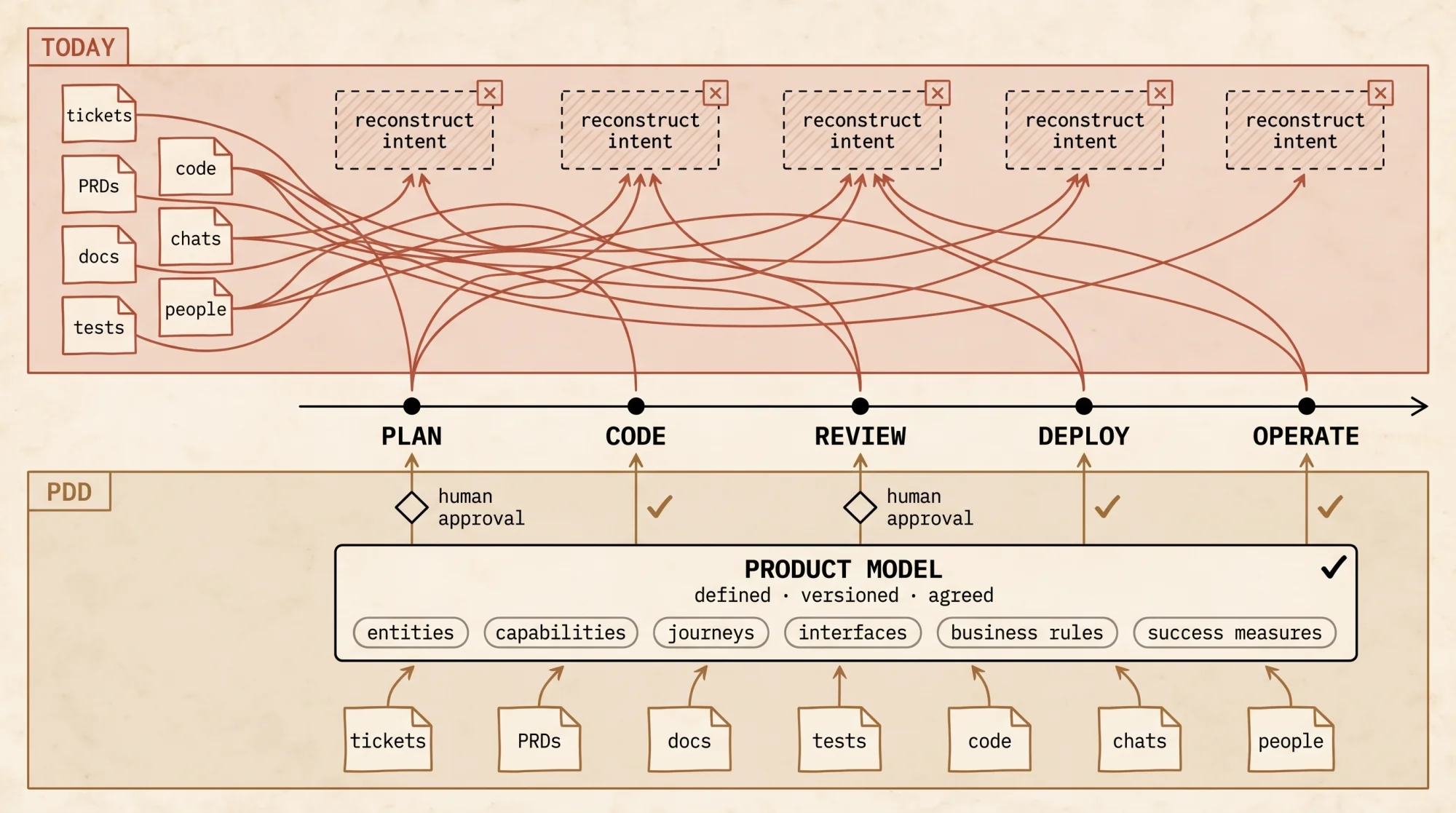
What it would add
product-model/, a Product Model of DevBoard: one definition of what the product does, as plain Markdown next to the code. It is made of:
- Entities (11): what the product keeps, and who acts on it (Task, Code Snippet, Pomodoro timer).
- Interfaces (1): how people and systems reach the product (DevBoard web).
- Capabilities (28): what the product lets someone do (Move task, Add code snippet, Focus Pomodoro).
- Journeys (6): one goal, carried across several capabilities (Try DevBoard, Start with account, Edit task details).
- Business Rules (21): what must always hold, and who may do what (Stored task statuses use the four-state vocabulary; More than five visible In Progress tasks produces a warning; In Progress tasks unchanged for seven days are marked stale).
- Variations (1): where the product works in more than one way (Demo Mode or account board).
It would be only new files under product-model/; no code, build or CI changes.
Where it fits
The model doesn't replace DevBoard's docs; it lets each of them focus. Today the product definition is spread across these sources, each holding a piece and none holding all of it:
| Information source | Its purpose | In DevBoard |
|---|---|---|
| Product Model | Defines what the product is | product-model/ (proposed) |
| User docs | Teaches people to use the product | README.md and devboard/README.md |
| Internal docs | Records architecture, design decisions, and onboarding | CONTRIBUTING.md |
| Design & architecture | Describes how it should look and work | None in the repository |
| Code & tests | Implements and verifies how it is built | devboard/client and devboard/server; no tests in the repository |
| Tickets, chats & people | Carry context, requests, and undocumented knowledge | GitHub issues and Discussions |
Some of the product isn't written down anywhere. Mapping DevBoard found product facts that only the code settles. These are just two examples, the most important ones:
- Archiving completed tasks deletes them. Neither README mentions archiving; the board's "Archive completed tasks" button deletes each Done task through the ordinary task delete, so there is nothing to restore, and it takes only the Done tasks that the current search or tag filter shows.
- Without a saved sign-in, the board opens in Demo Mode, and its tasks last only until reload. The READMEs describe only a register and login flow and never mention Demo Mode; a browser with no stored sign-in starts as a demo user instead of showing the login page, and demo tasks are created, changed and deleted only in the page's memory, never on the server.
A contributor needs these, and a user mostly doesn't. Putting them in the user docs turns the docs into a spec; the model gives them their own home, so the docs can stay about teaching. If something isn't in the model, nobody decided it.
Questions you may have
Short answers here; the full ones are in the PDD FAQ.
We already have docs and an AGENTS.md. Why add this? They help, and they stay. But user docs hold the part a user needs, and internal docs and AGENTS.md are free-form, each mixing product decisions with design and implementation. The rest lives only in the code, and every agent reconstructs it from scratch, differently each time, with nobody reviewing what it concluded. The model is one structured definition that agents and people read the same way. (Docs, AGENTS.md)
Does every contributor need an AI agent? No. Contributors who don't use agents work exactly as they do today, and updating the model is the same kind of work as updating docs or tests when behavior changes. Those who use an agent can have it done for them: /pdd-verify checks the code against the model, reports every gap, and fixes the ones they choose. (More)
Does it add work to every pull request? Today a behavior change can touch the code, the user docs and the internal docs, each holding part of it in its own way, so they drift. With the model, each fact has one home. It doesn't have to block a pull request either: the model can be updated in the same one, or catch up after changes land. The code references in the model (the links from each file to the code behind it) are optional; if you'd rather not keep them, I'll remove them. (More)
Does it change how we develop? No. PDD doesn't touch how you implement: your workflow, coding agents and planning tools stay, and nothing new runs in CI. Asking an agent to implement something works as it always has. How much of it to use is up to you: only map, to keep a clear model after changes land, or the full development loop, where /pdd-ideate records a change in the model first (nothing is written until you approve it), your agent implements it your way, and /pdd-verify checks the result when you ask it to. Letting pdd-kit orchestrate implementation, with verify planning the work in phases and checking each one, is opt-in and off by default. (More)
How is this different from spec-driven tools or AI-generated docs? Spec-driven tools such as OpenSpec and spec-kit describe each change; PDD defines the product and leaves the change to whichever tool you use. AI-generated docs such as DeepWiki mix product rules, architecture and configuration; the model draws that boundary explicitly. (SDD, DeepWiki)
How would reviewers see a model change? As a Git diff today, or as a report of any pull request's model with npx pdd-toolkit view anoopcodehack/DevBoard --pr <n>, without cloning. A visual diff in the report is in progress (itai-gendler/pdd-kit#19). (More)
Interesting questions about DevBoard that the Product Model now answers
The report opens on the model's Product Overview: what DevBoard is, why it exists, and where it stops. Every answer below is read from the model.
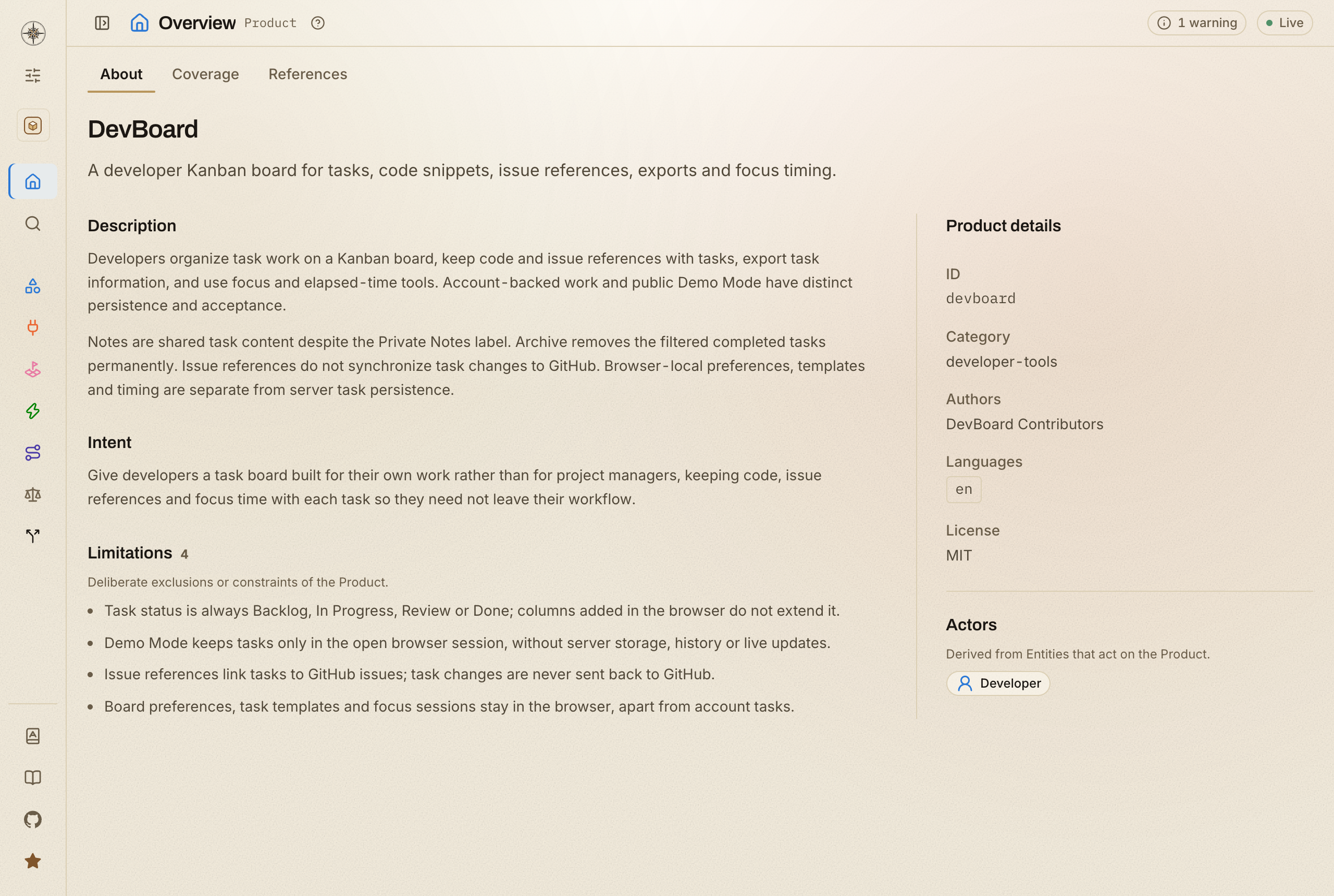
To follow along in the report, the same command as above:
npx pdd-toolkit view itai-gendler/DevBoard --branch product-model
1. Entities, and which capabilities change them
All 11 entities in the DevBoard model: what the product keeps, and who acts on it.
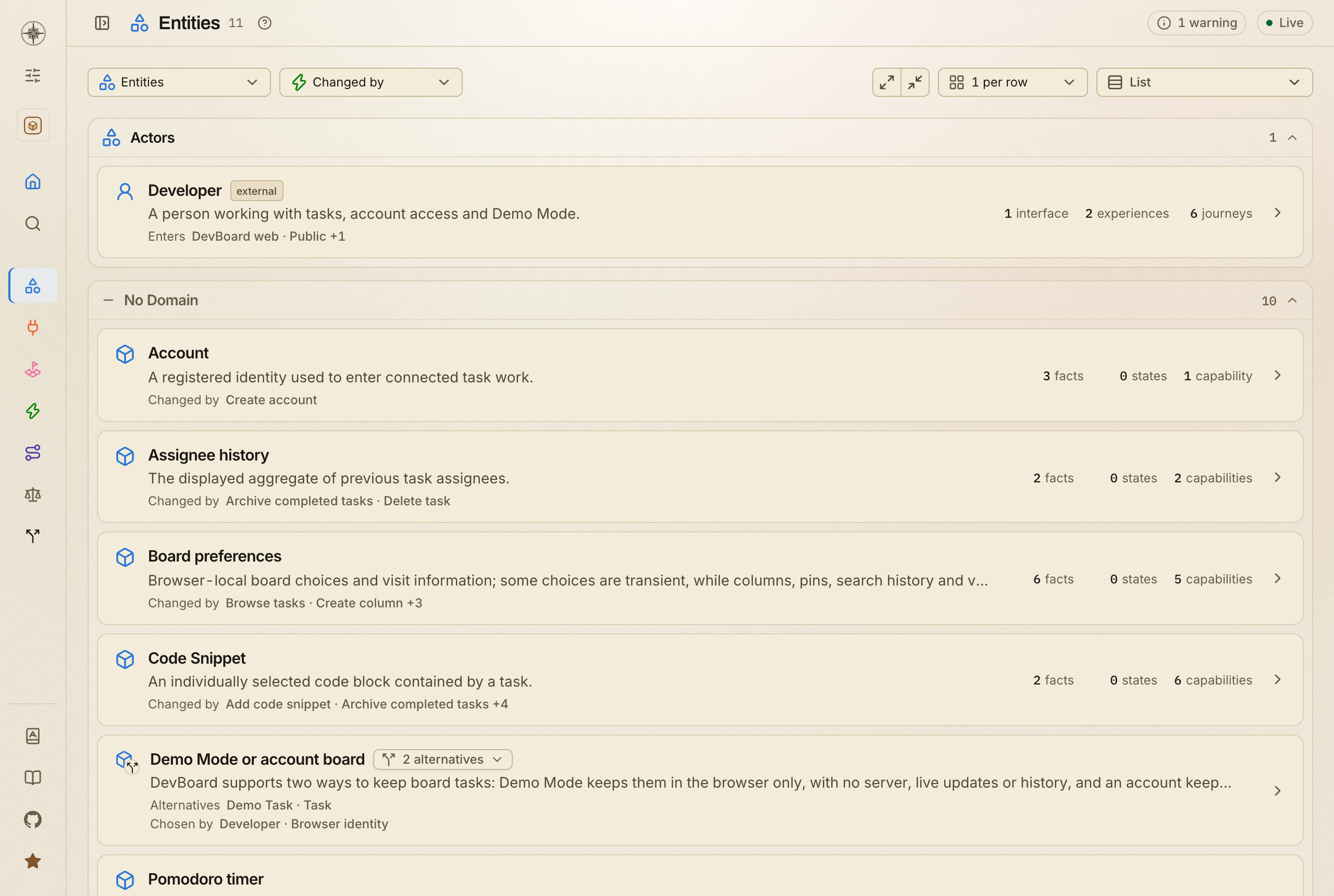
Which capabilities create, change or remove each entity, filtered to five capabilities:
- Add code snippet removes Code Snippets as well as creating one: saving the editor with new code replaces the task's whole snippet list with that one block.
- Archive completed tasks removes the Task, with its Code Snippets, Recent activity and Assignee history. There is no archive to restore from, and only the Done tasks that the current search or tag filter shows are removed.
- Move task removes and creates a Time tracker: elapsed time lives only in the card on screen, so a card moved to another column starts again at zero.
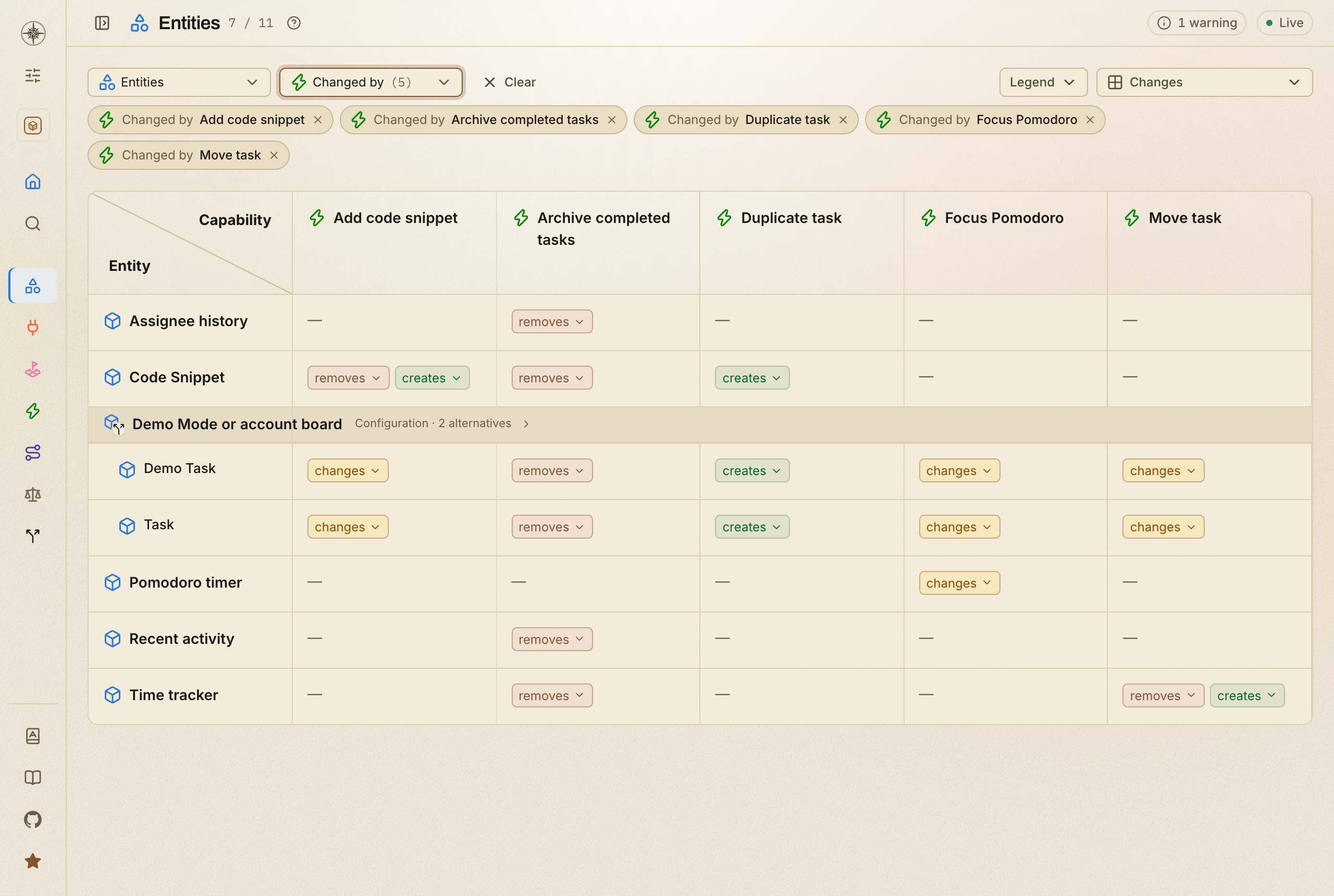
2. Business rules, and where they apply
All 21 business rules in the DevBoard model: what must always hold, and who may do what.
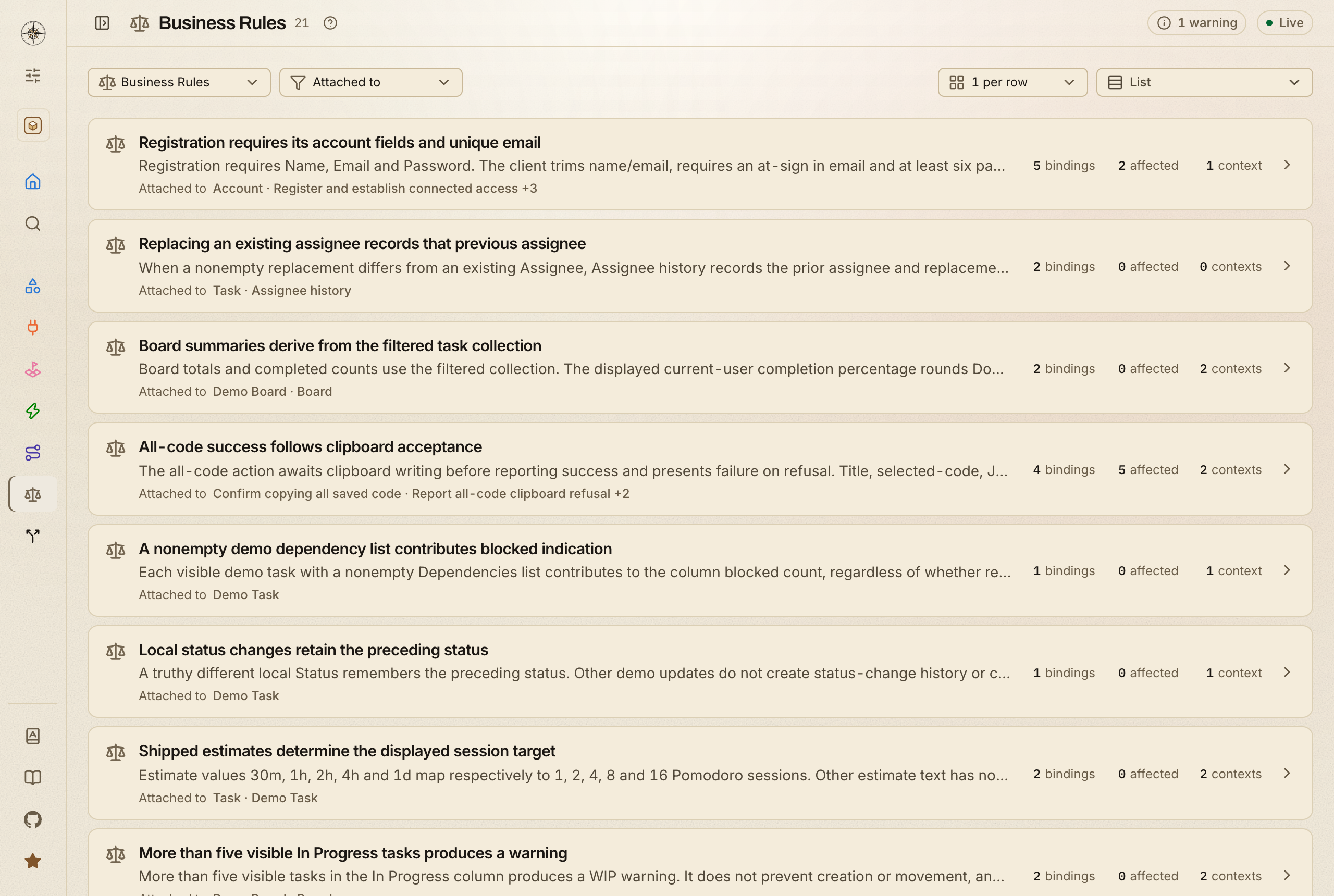
Where each business rule is attached, filtered to the Task, Demo Task and Pomodoro timer entities:
- Pomodoro uses its work and break cycle and stops at phase boundaries: 25-minute work sessions and 5-minute breaks, except a 15-minute break after every fourth session. The timer stops at each phase change and waits for Focus.
- Shipped estimates determine the displayed session target on both Task and Demo Task: the estimates 30m, 1h, 2h, 4h and 1d show targets of 1, 2, 4, 8 and 16 sessions, and any other estimate shows none.
- A dated task before local today is overdue unless Done: a task due today isn't overdue yet, and a Done task never is.
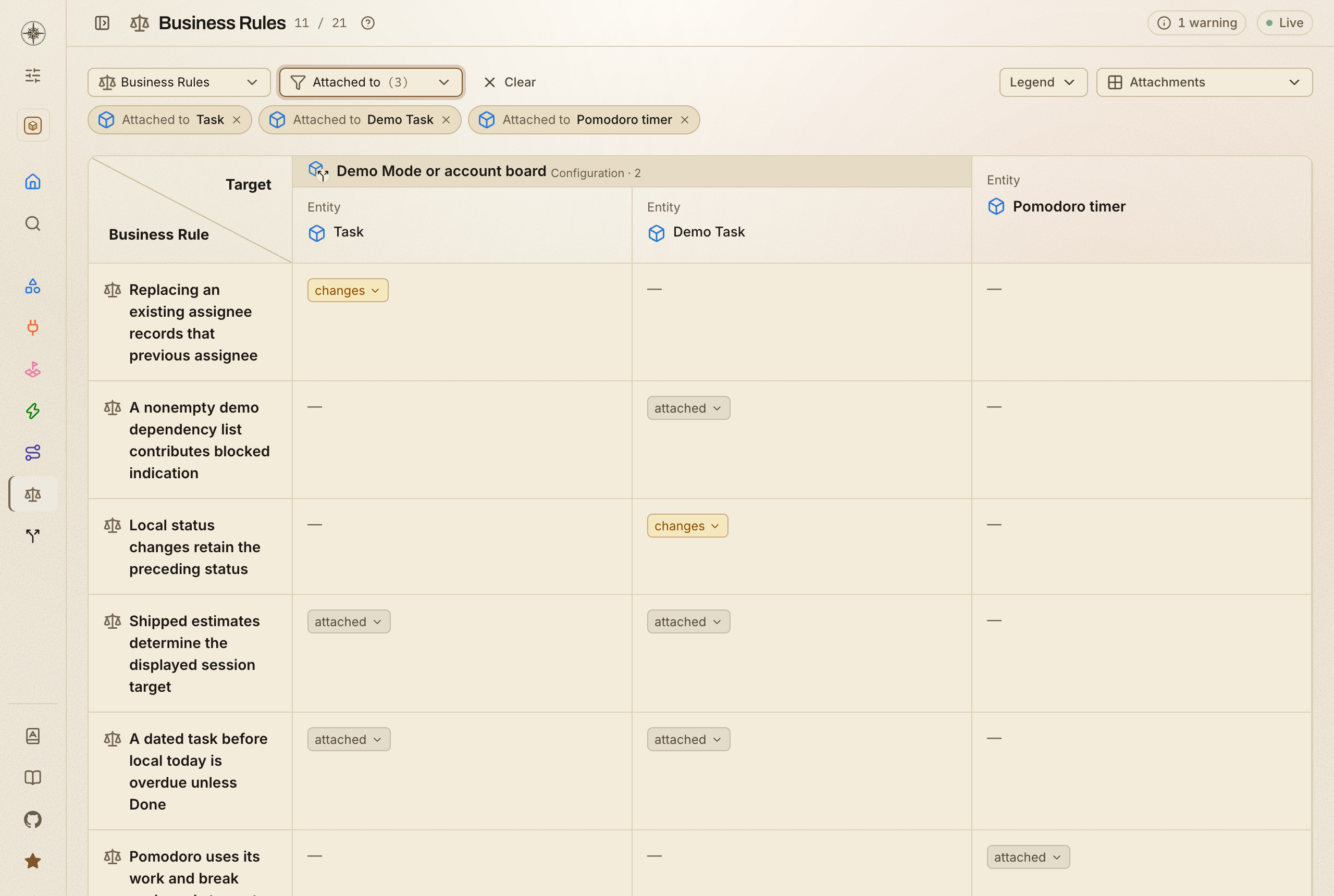
3. An entity: what it keeps, and how its state changes
The Task entity, one of the 11, and the information kept about it:
- Seventeen pieces of information, and Task is one of two alternatives. With an account, tasks are kept on the server; a browser with no stored sign-in starts in Demo Mode, where a Demo Task lives only in the open browser.
- Assignee is not ownership: any signed-in account can edit or delete any task, assigned or not.
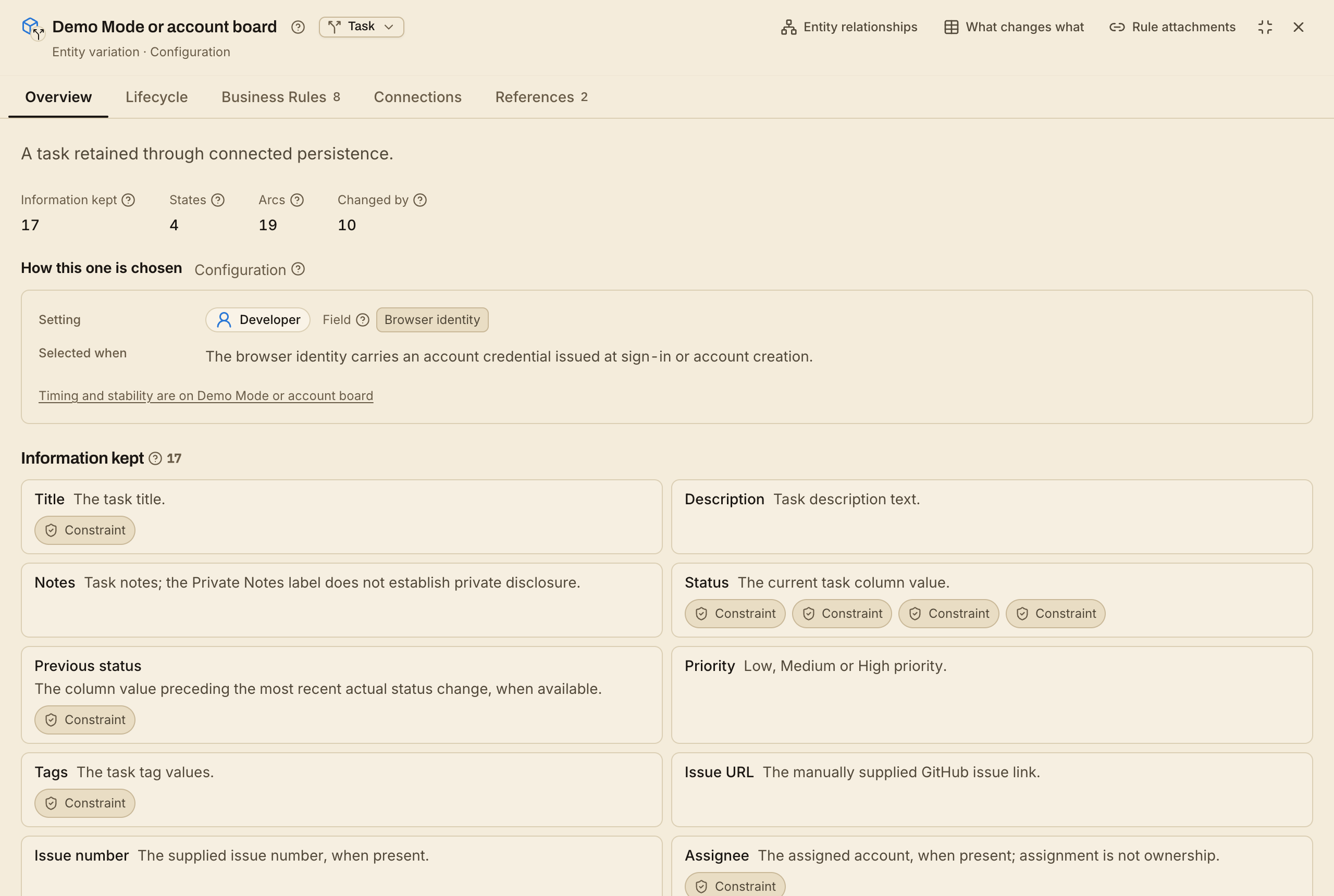
How it moves through its states, and the capability behind every move:
- Move task links every pair of the four states, in all 12 directions. The board enforces no order, and the warning past five In Progress tasks never stops a move.
- Create task can put a new task straight into In Progress, Review or Done, since the form has a Status field; Duplicate task keeps the original's status.
- Archive completed tasks leaves only from Done and ends in Removed: there is no Archived state.
4. A capability's scenarios, and one step by step
The 11 scenarios of the Focus Pomodoro capability:
- Eleven scenarios: the same five in Demo Mode and with an account (start or resume work, start or resume a break, finish a break, finish work with or without a task to credit), plus one only with an account, when the timer advances even though the task credit failed.
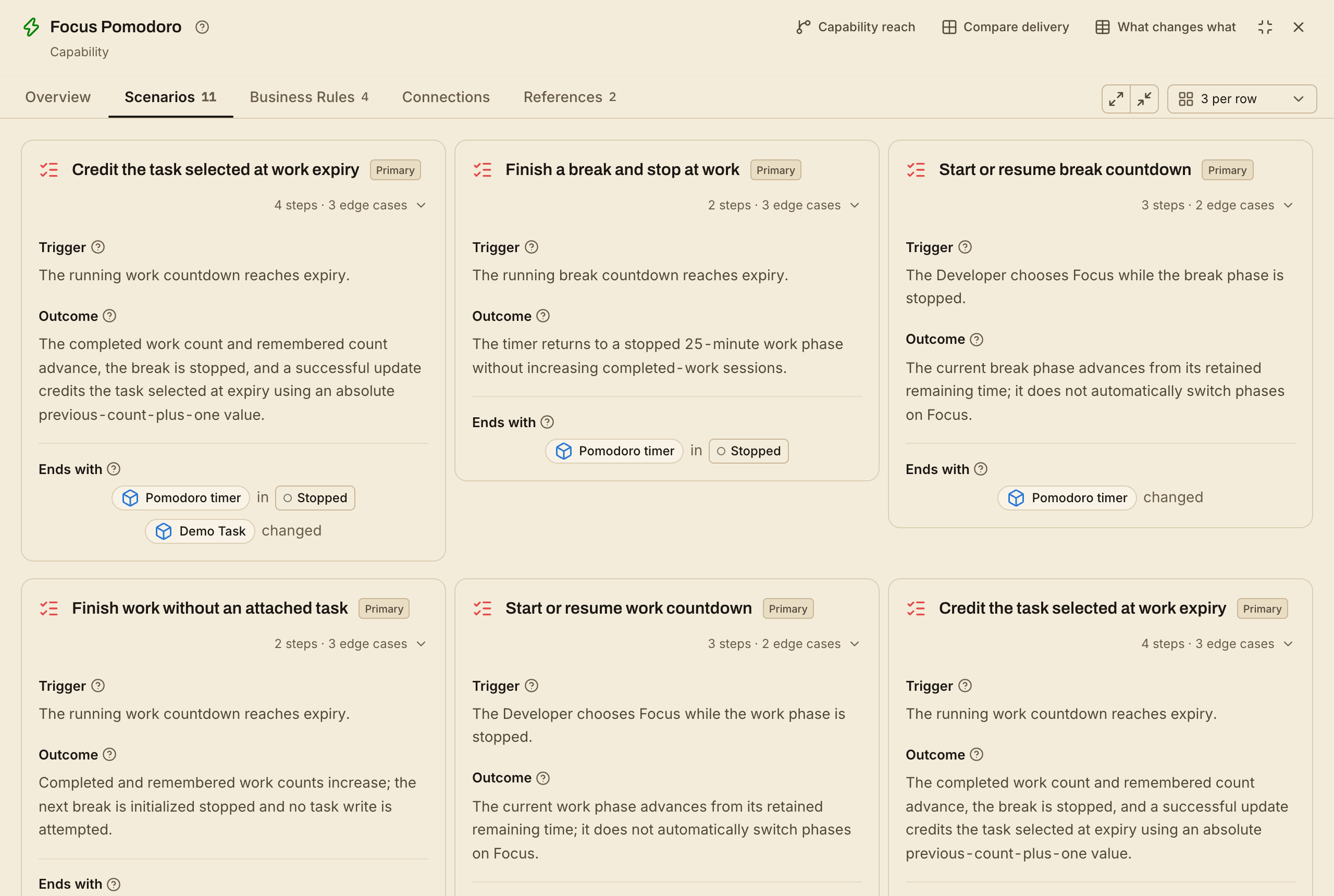
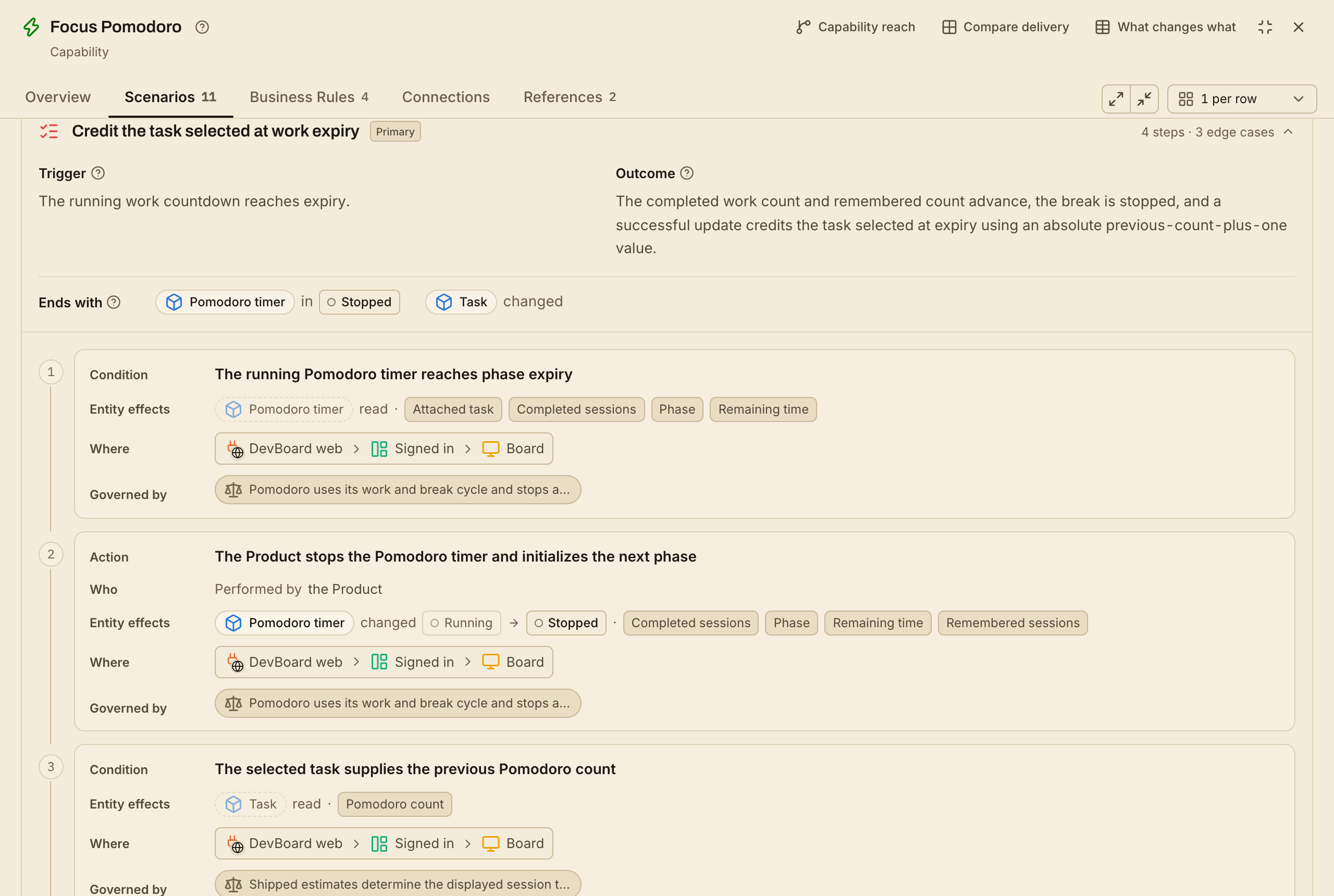
One of them, opened step by step:
- Credit the task selected at work expiry: the session goes to the task whose editor is open when the 25 minutes end, not the one open when the session started. With no editor open, no task is credited.
- The credit is the task's count plus one, written as a new value from the board's copy, not with the server's separate increment route, so two boards finishing sessions on one task can overwrite each other.
What I'm asking
- Is this useful for DevBoard? A yes, a no, or "not yet" all help.
- If it is, I'll open a focused pull request shaped however you prefer: smaller, split by area, or without the code references.
- If it isn't, feel free to close this issue.
How it was made
The model was mapped from main with AI agents, and I reviewed it personally. I'll answer questions myself, and I'm happy to take any feedback needed for adoption.
AI assistance: the model was drafted with Claude Code and Codex, using the pdd-map skill. I reviewed it, linted it with npx pdd-toolkit lint, and checked each finding above against the code. This issue was drafted with Claude's help and edited by me.
- 主要語言
- JavaScript
- 星號
- 39
- 分支
- 105
- 平均合併
- 2 天 15 小時
- 30 天內合併 PR
- 17
環境準備
- 沒有 Dockerfile 或 Docker Compose 檔案
- 沒有 Pull Request 範本
- 閱讀貢獻指南
從這裡開始
- 先讀完整個 Issue,再讀專案的貢獻指南。
- 在 Issue 下留言說明你要接手 —— 這能避免兩個人做同樣的事。
- Fork 儲存庫,在一個分支上完成修改。
- 送出 Pull Request,並在描述裡引用這個 Issue 編號。
anoopcodehack/DevBoard 的其他 Issue
-
enhancement good first issue
難度 2/5 1-3 小時 新手友好度 68/100
anoopcodehack/DevBoard#648 · 1 則留言 ·
維護者通常 3 天內回覆
-
Show "No snippets yet" empty state in task modal 💻可能重新可做 @tu-lasizzzz 於 36 天前認領,目前沒有進行中的 PR。 未關閉good first issue
難度 1/5 1 小時以內 新手友好度 96/100
anoopcodehack/DevBoard#639 · 2 則留言 · 已指派 1 人 ·
維護者通常 3 天內回覆
-
good first issue
難度 1/5 1 小時以內 新手友好度 96/100
anoopcodehack/DevBoard#637 ·
維護者通常 3 天內回覆
-
Add smooth horizontal scroll on board 🖱️可能重新可做 @nikhil9verma 於 43 天前認領,目前沒有進行中的 PR。 未關閉good first issue
難度 1/5 1-3 小時 新手友好度 85/100
anoopcodehack/DevBoard#615 · 2 則留言 ·
維護者通常 3 天內回覆
-
Show task creation date in modal footer 📅可能重新可做 @nikhil9verma 於 43 天前認領,目前沒有進行中的 PR。 未關閉good first issue
難度 1/5 1-3 小時 新手友好度 90/100
anoopcodehack/DevBoard#614 · 1 則留言 ·
維護者通常 3 天內回覆
查看 anoopcodehack/DevBoard 的全部 Issue
相似的 Issue
-
難度 2/5 1-3 小時 新手友好度 86/100
Forrest-Technologies/drover#1040 ·
維護者通常 1 天內回覆
-
難度 1/5 1 小時以內 新手友好度 85/100
維護者通常 1 天內回覆
-
good first issue help wanted
難度 1/5 1 小時以內 新手友好度 90/100
erkamyaman/rust-anything#702 ·
維護者通常 1 天內回覆
-
enhancement good first issue
難度 2/5 1-3 小時 新手友好度 85/100
-
good first issue help wanted
難度 2/5 1-3 小時 新手友好度 88/100
erkamyaman/unslop-anything#231 ·
維護者通常 1 天內回覆