Proposal: discover script content from pip packages, not just ~/MLC/repos git clones
Nadie ha tomado este issue todavía.
Evaluación
- Dificultad
- 5/5
- Tiempo estimado
- Más de una semana
- Aptitud para principiantes
- 30/100
Línea de trabajo
Empieza leyendo el prototipo de la Fase 1 en mlcflow#274 y la declaración del paquete en pyproject.toml. Después, compara su comportamiento de descubrimiento con el árbol script/ y el ámbito de automation/ descritos aquí. Se considera terminado cuando la decisión de migración, la precedencia pip-first y el override MLC_SCRIPT_SOURCE_PRIORITY estén acordados y documentados.
Escrito por el modelo de indexación a partir del texto del issue.
Descripción
Proposal: discover script content from pip packages, not just ~/MLC/repos git clones
Today, script content (mlperf-automations's 377+ script/<alias>/ directories) only reaches mlcflow via mlc pull repo — a git clone into ~/MLC/repos/. This proposes a second, additive way to get content: pip-installed packages that self-advertise via a Python entry point, discovered generically (no hardcoded package names, forks included).
The approach
A content package (mlc-scripts, or a third-party fork) declares itself in its own pyproject.toml:
[project.entry-points."mlc.script_packages"]
mlperf-automations = "mlc_scripts_content"
mlcflow enumerates mlc.script_packages entry points on startup — a fast, local, no-network metadata read — and merges each into the same repo/index machinery git-cloned repos already use. Aliasing is by PyPI distribution name, not the self-chosen entry-point name, so a fork republished under a different distribution name coexists safely even if it reuses the same entry-point name.
What it looks like in practice
Installing is enough — no mlc pull repo step needed:
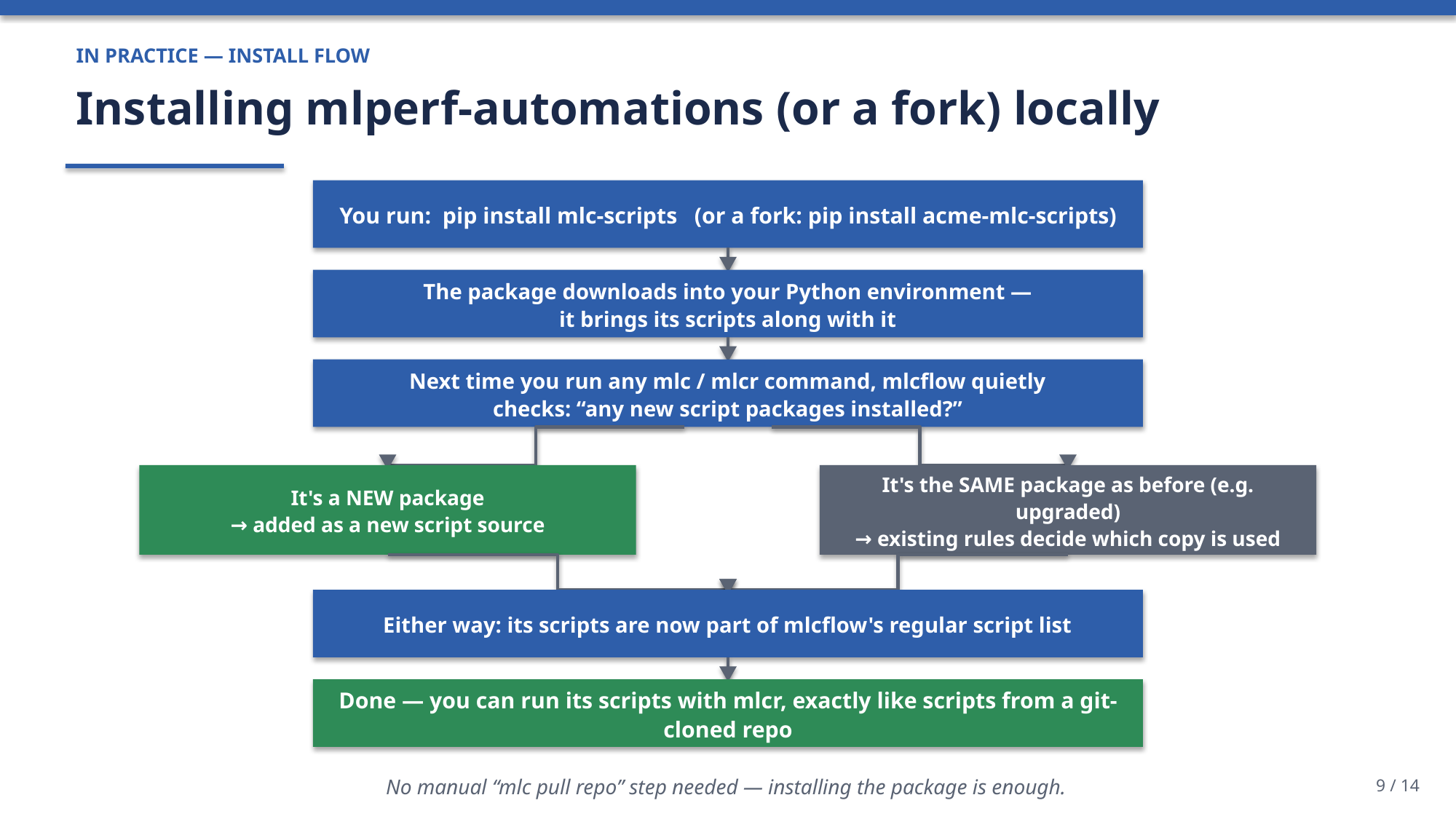
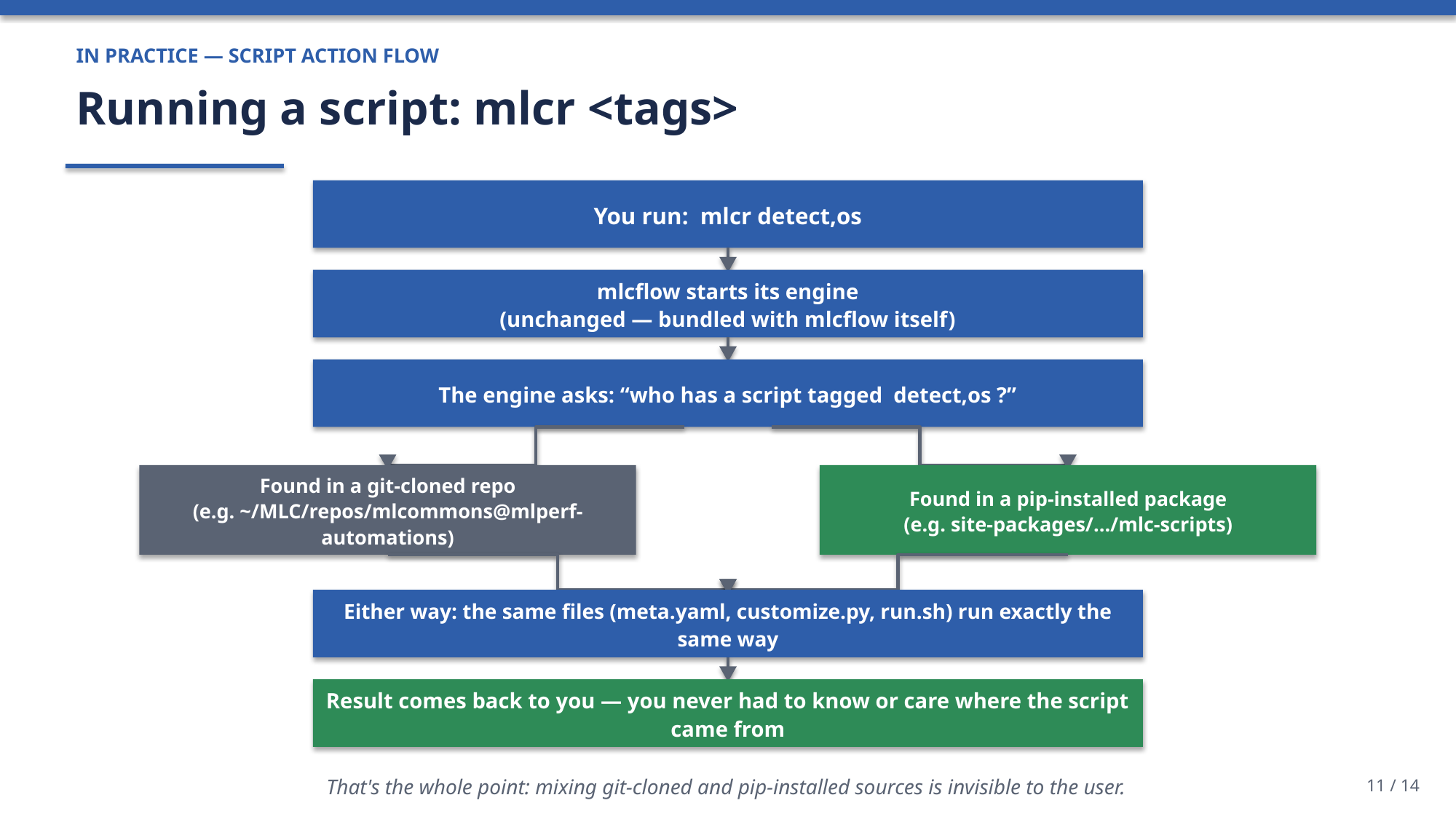
And running a script doesn't care where it came from — git-cloned and pip-installed sources are interchangeable, including cross-source dependencies:
Source precedence: pip first, ~/MLC/repos as fallback, flippable by env var
The Phase 1 prototype (mlcflow#274) currently does the opposite of the intended default: pip-sourced repos are prepended to the repo list, but repos processed later win uid conflicts, so a git clone in ~/MLC/repos silently overrides a pip-installed package today. That was fine for a prototype proving the mechanism, but it's not the intended long-term default.
Proposed default: pip-installed packages are checked first for a given script; ~/MLC/repos git clones are only consulted as a fallback when no installed package provides that script. Rationale — a pip install/pip install --upgrade is pinned and reproducible; a git clone in ~/MLC/repos can drift silently (stale git pull, local edits) without the user noticing. Pip-first makes the more trustworthy, more explicit source win by default.
Escape hatch: an env var reverses the order for anyone who needs the old behavior (local script development against a git checkout, debugging, CI pinned to a specific commit) without recompiling or reinstalling anything:
export MLC_SCRIPT_SOURCE_PRIORITY=git # default is "pip"
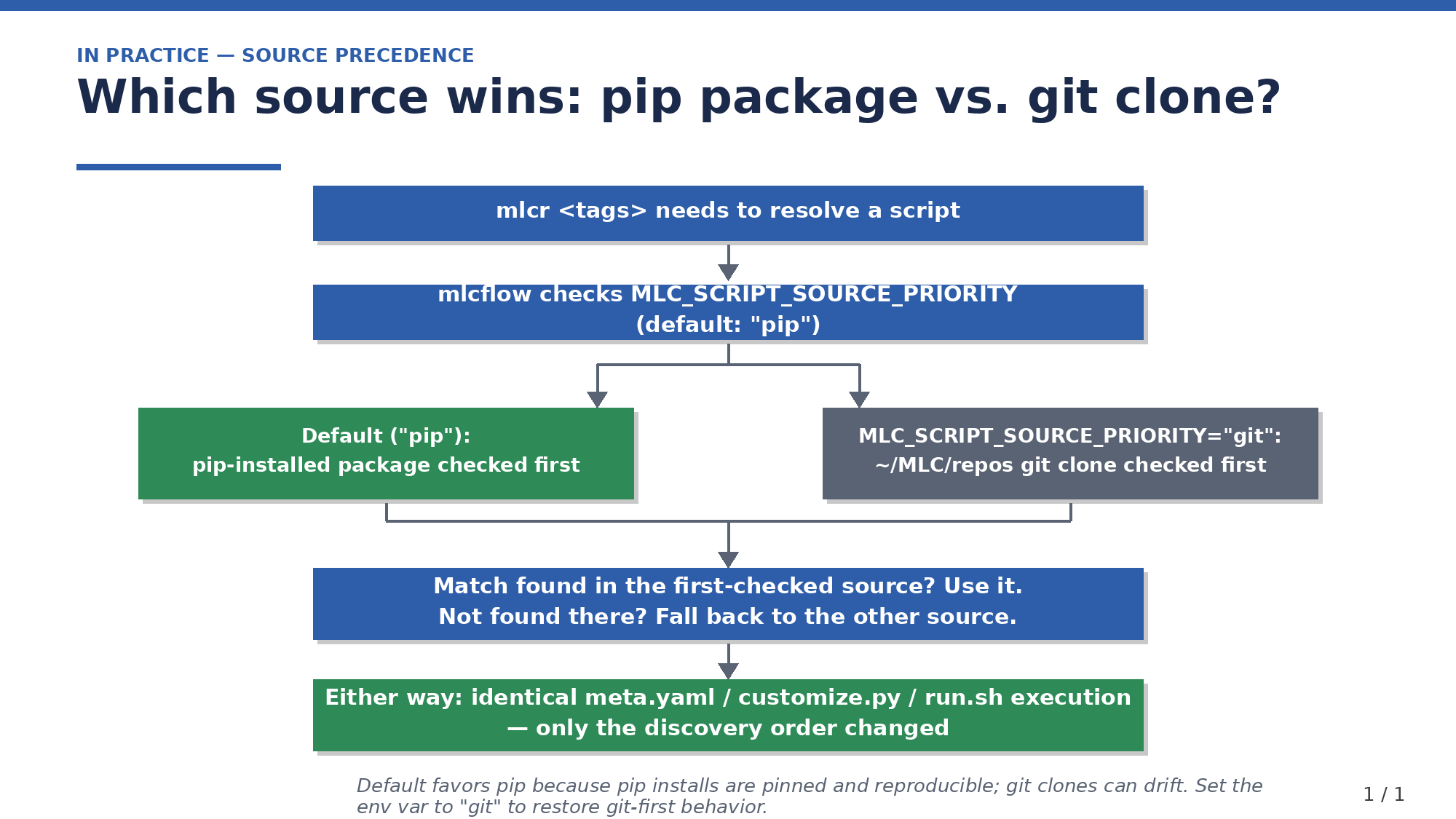
This is a per-script fallback, not "pick one source and ignore the other": if the priority source doesn't have a given script (or dependency), mlcflow still finds it in the other source. Cross-source dependency resolution (a git-cloned script depending on a pip-sourced one, or vice versa) is unaffected by which order they're checked in — it already works either way per the script-action-flow diagram above.
Scope of this issue
This tracks the longer-term decision: whether/when to migrate real script content (the full 377-script tree) to a properly packaged pip distribution, along with the source-precedence default and env-var override described above. Phase 1 (mlcflow#274) is a prototype proving the discovery mechanism only — it does not touch the real script tree or automation/, and does not yet implement the pip-first default or the env var; that's follow-up work once this proposal is agreed.
Full design detail (including the fork-disambiguation rationale and consequences to plan for — read-only pip-sourced repos, "latest" becoming an explicit pip install --upgrade, packaging prerequisites) is in the attached slide deck; happy to share the full deck if useful.
- Lenguaje dominante
- Python
- Estrellas
- 14
- Forks
- 17
- Merge medio
- 4 d 3 h
- PR fusionados (30 d)
- 2
Preparar el entorno
- Sin Dockerfile ni archivo de Docker Compose
- Tiene una plantilla de pull request
- Leer la guía de contribución
Primeros pasos
- Lee el issue completo y luego la guía de contribución del proyecto.
- Comenta en el issue que vas a ocuparte — evita que dos personas hagan lo mismo.
- Haz un fork del repositorio y trabaja en una rama.
- Abre un pull request que haga referencia al número del issue.
Más de mlcommons/mlcflow
Todos los issues de mlcommons/mlcflow
Issues similares
-
flaky: test_fire_returns_thread_per_http_entry_on_head waits 5 s per dispatch worker on busy shardsAbiertostatus/accepted type/bug
Dificultad 2/5 1-3 horas Aptitud para principiantes 74/100
microsoft/apm#5309 · 1 comentario ·
Los mantenedores suelen responder en 1 día
-
bug vector-store
Dificultad 2/5 1-3 horas Aptitud para principiantes 85/100
Los mantenedores suelen responder en 1 día
-
Dificultad 2/5 1-3 horas Aptitud para principiantes 74/100
EverMind-AI/Raven#1413 ·
Los mantenedores suelen responder en 1 día
-
Tests: parallel pyinstallcheck runs oversubscribe the machine through nested TBB and BLAS poolsPosiblemente ocupada Un pull request vinculado a esta issue está abierto o ya se fusionó. Abierto
Dificultad 2/5 1-3 horas Aptitud para principiantes 72/100
Los mantenedores suelen responder en 1 día
-
Dificultad 1/5 Menos de una hora Aptitud para principiantes 86/100
ACCESS-NRI/containerised-environments-infra#143 ·
Los mantenedores suelen responder en 2 días