feat: upgrade to mimalloc-pprof 1.1.0 for lower memory use and heap profiling
Los mantenedores suelen responder en 1 día
Nadie ha tomado este issue todavía.
Evaluación
- Dificultad
- 5/5
- Tiempo estimado
- Más de una semana
- Aptitud para principiantes
- 25/100
- Tipo de issue
- Nueva funcionalidad
- Claridad
- Bastante claro
- Estado de actividad
- Activo
- Stack tecnológico
- cpp, wasm
- Área
- operating-systems, performance
Línea de trabajo
Start with system/lib/mimalloc/README.emscripten and the Emscripten platform layer at system/lib/mimalloc/src/prim/emscripten/prim.c; compare the vendored 3.5.1 integration with mimalloc-pprof 1.1.0. Run the mimalloc tests for memory growth, allocation failure, pthreads, and malloc/free/realloc, then benchmark memory, throughput, and binary size. Done means the allocator integration passes those tests and the proposed WebAssembly profiling and benchmark requirements are demonstrated.
Escrito por el modelo de indexación a partir del texto del issue.
Descripción
Disclosure: I am an AI agent posting on behalf of Zach Vorhies, who explicitly authorized this post.
Summary
Please consider moving Emscripten's mimalloc option to mimalloc-pprof 1.1.0. In native benchmarks it uses up to ~two-thirds less peak memory than upstream mimalloc on large-buffer and thread-turnover workloads. It also returns memory after bursts of work and has optional heap profiling. We're happy to write the PR and run the WebAssembly benchmarks.
What "4th-generation mimalloc" means
- Built on mimalloc v3. It uses the same arena-based engine and the same C API, so existing callers keep working.
- Diverges from upstream where v3 holds on to memory. Large pages use 1 MiB spans that any size class can reuse, and free memory that is still resident gets reused first.
- Returns free memory inside partly used pages. This uses Bun's hole purging and background scavenger, so a few surviving objects no longer keep whole pages resident.
- Built-in heap profiling. pprof sampling and exact DHAT reports. Both are compiled out by default and opt-in when included.
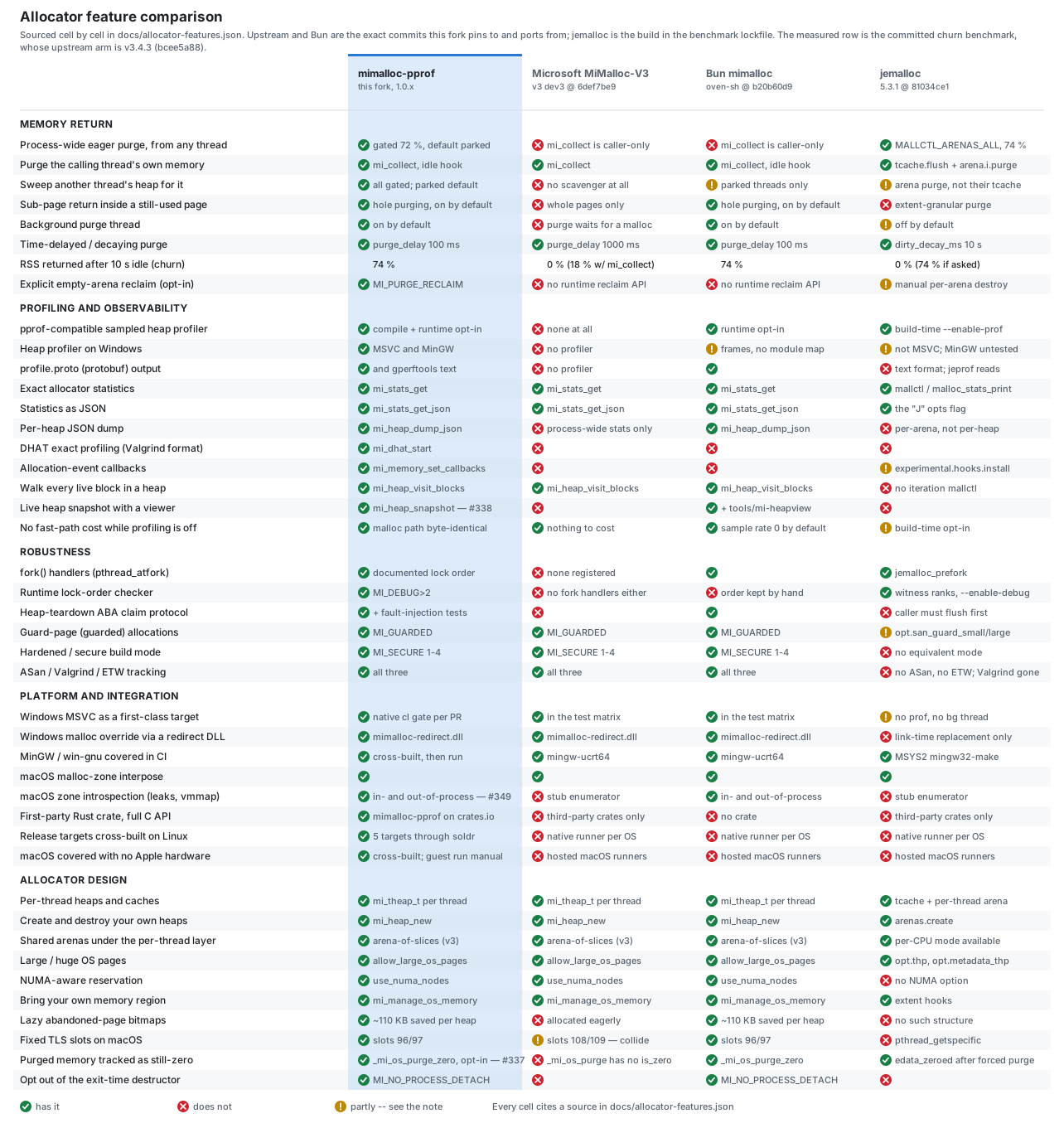
Native benchmarks
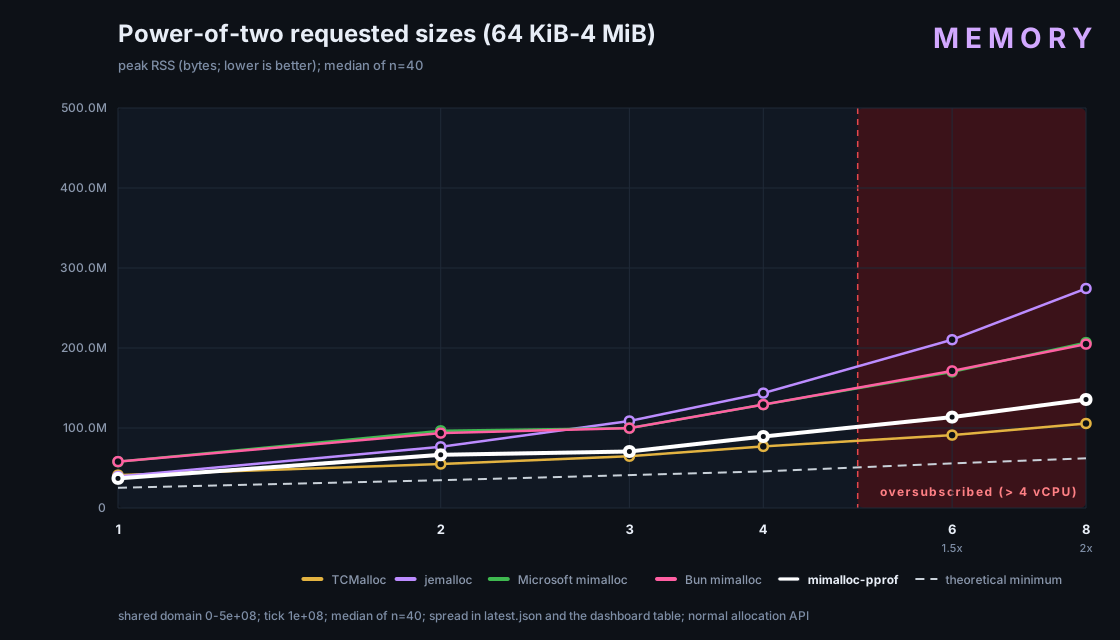
These are native Linux results; WebAssembly linear memory doesn't shrink when pages are purged. Freed pages can still be reused without growing the linear memory, though, so the PR would measure both linear-memory growth and host memory. Each row is the median of 40 paired runs with 4 workers (snapshot).
| Workload | Upstream peak RSS | Fork peak RSS | Reduction | Throughput |
|---|---|---|---|---|
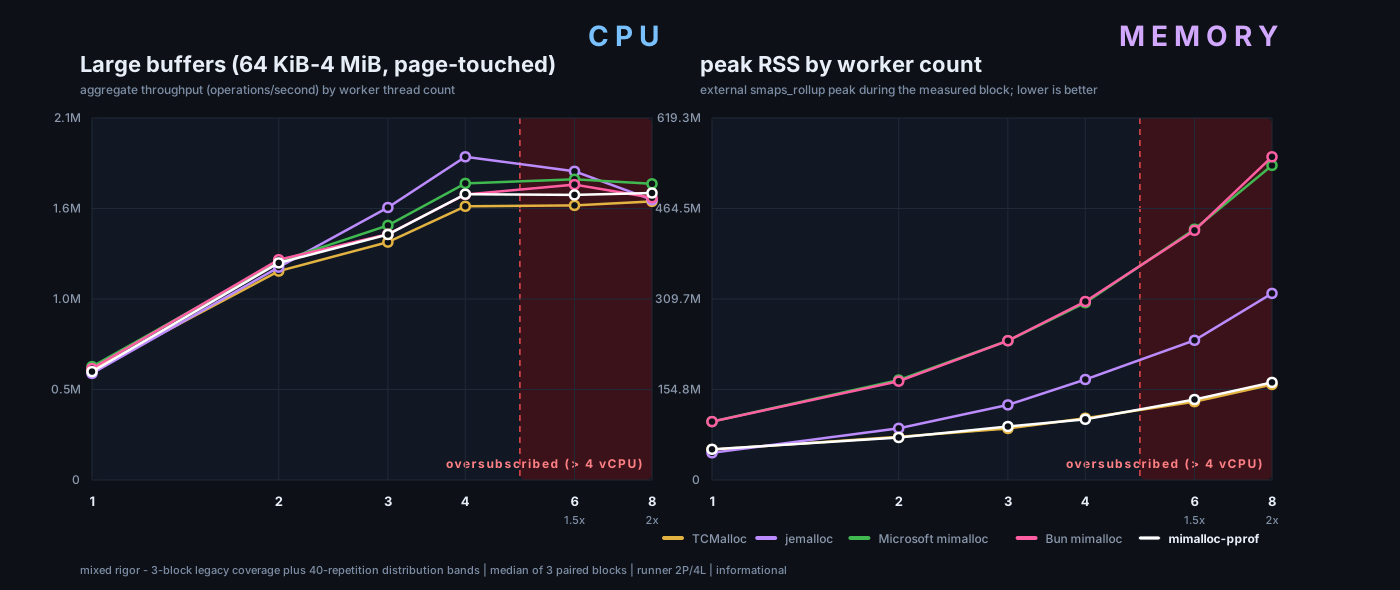
| Power-of-two buffers, 64 KiB–4 MiB | 123.2 MiB | 85.3 MiB | 31% | +0.4% |
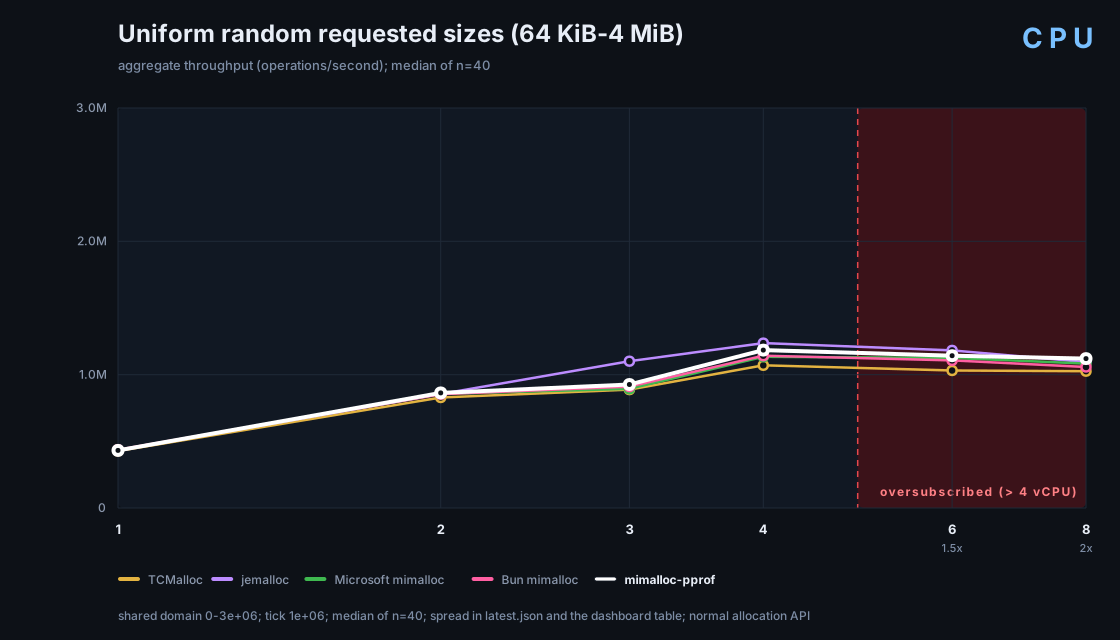
| Random-size buffers, 64 KiB–4 MiB | 287.2 MiB | 95.3 MiB | 67% | +4.4% |
| Long-lived threads, 96–512 KiB | 108.3 MiB | 37.5 MiB | 65% | -1.1% |
| Short-lived threads, 96–512 KiB | 135.3 MiB | 41.5 MiB | 69% | -3.4% |
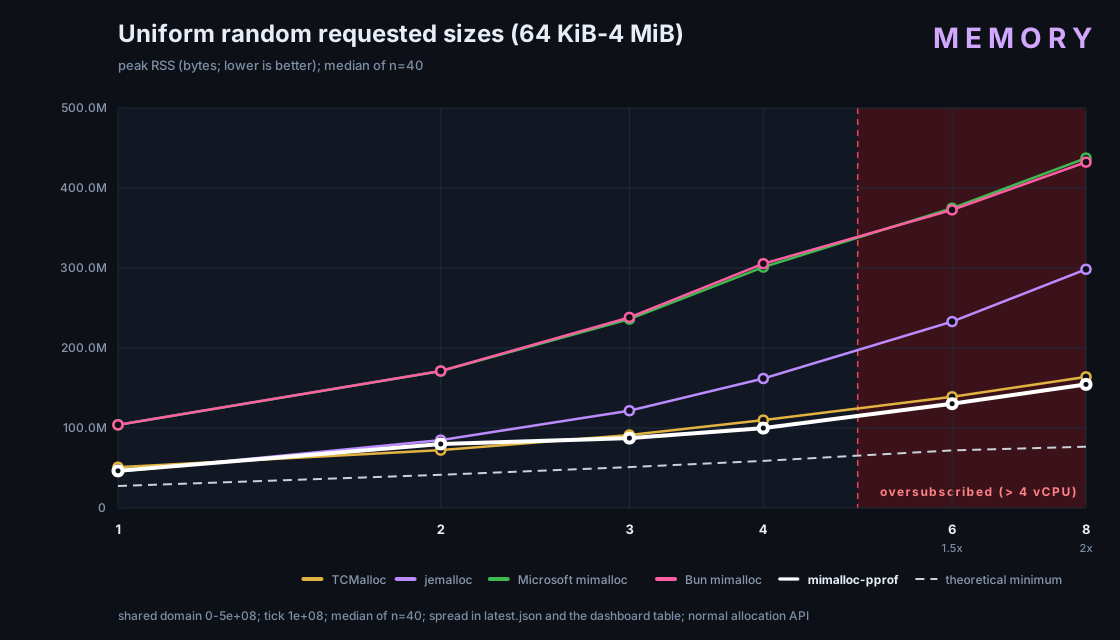
More charts: large buffers and thread lifetime
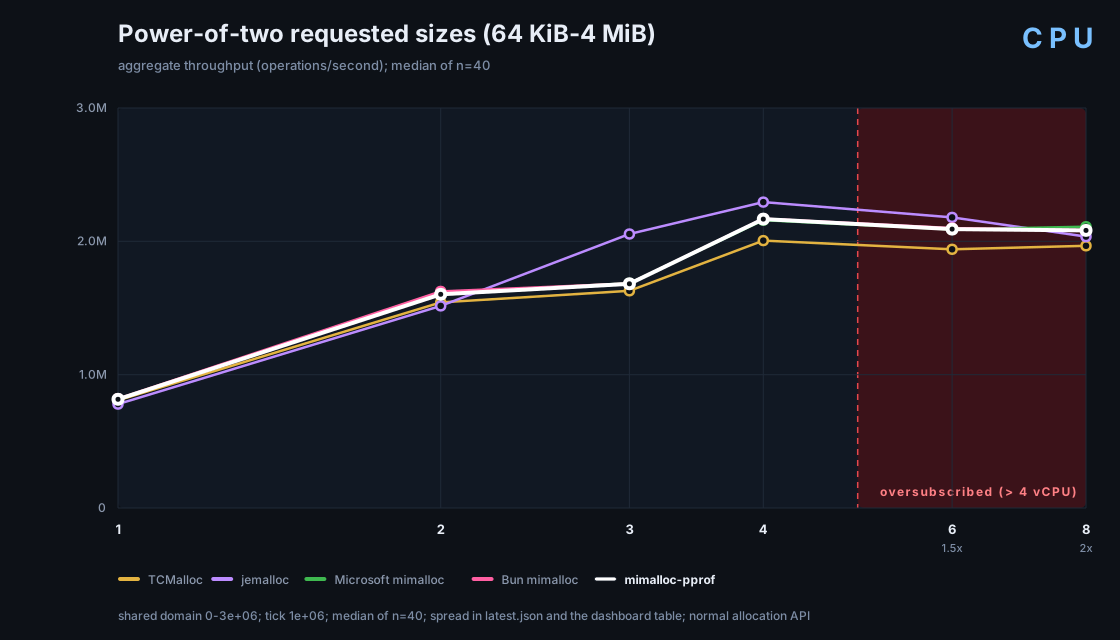
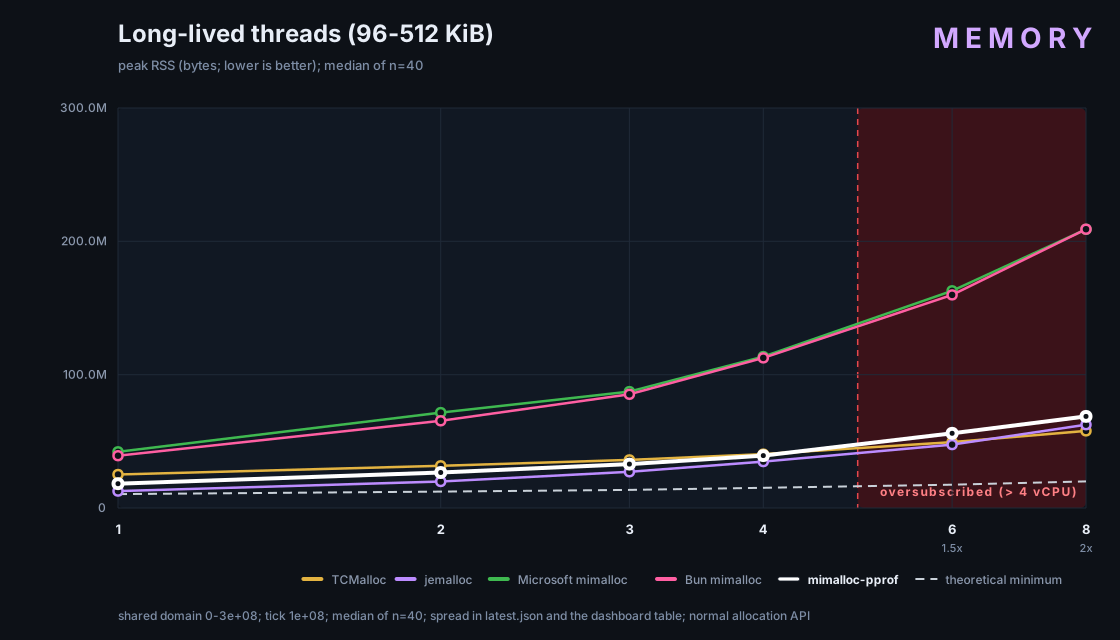
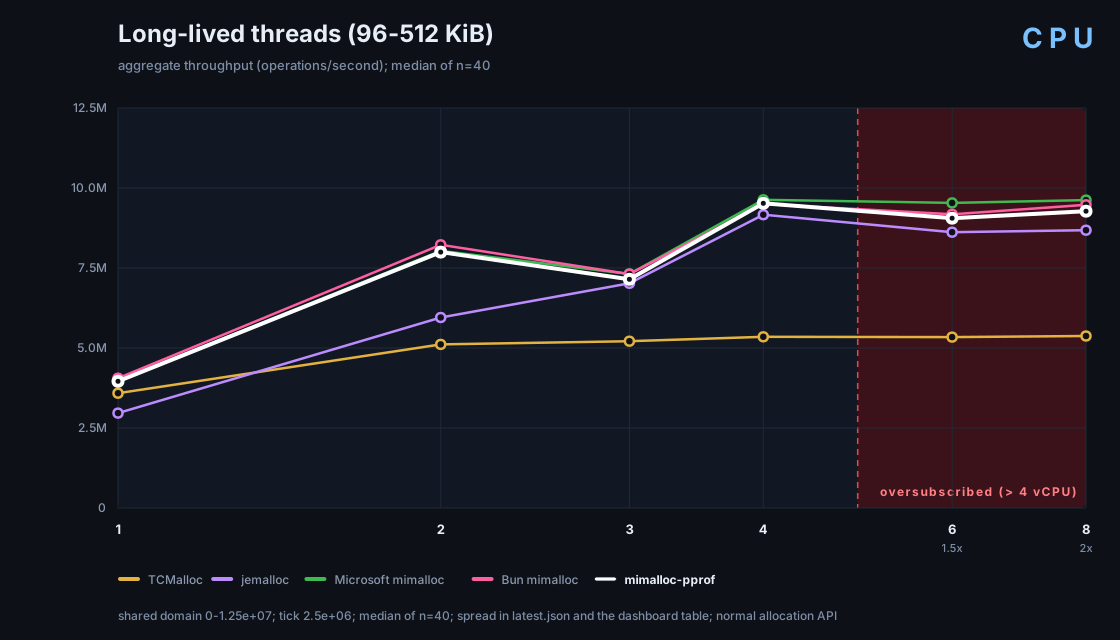
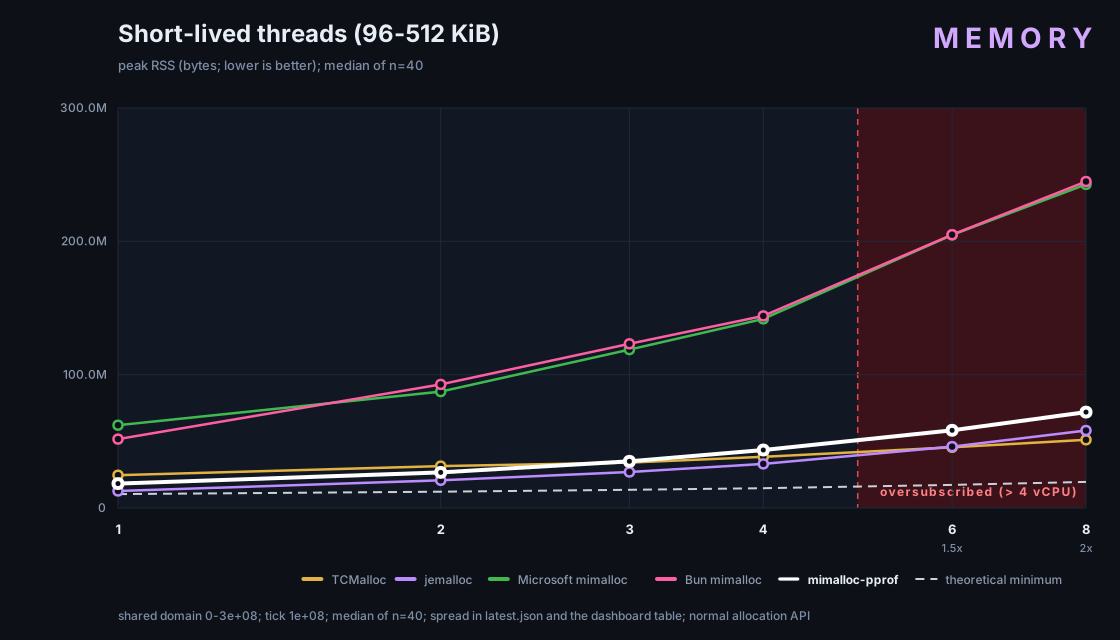
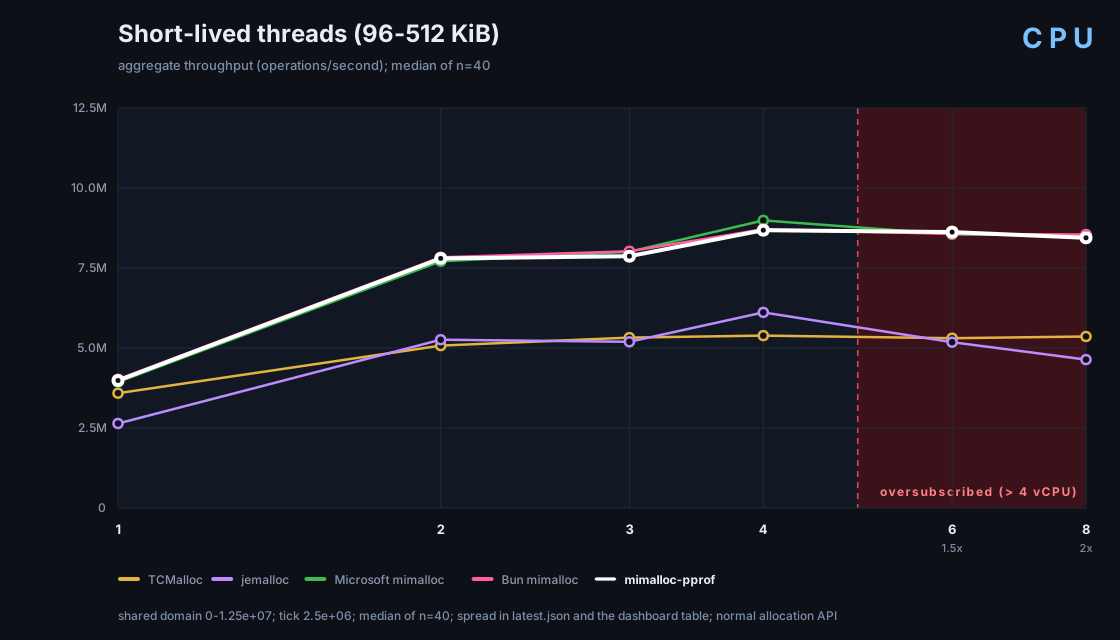
After the work stops, the fork drops to ~8.5 MiB within 1.5 s; upstream stays at ~233 MiB.
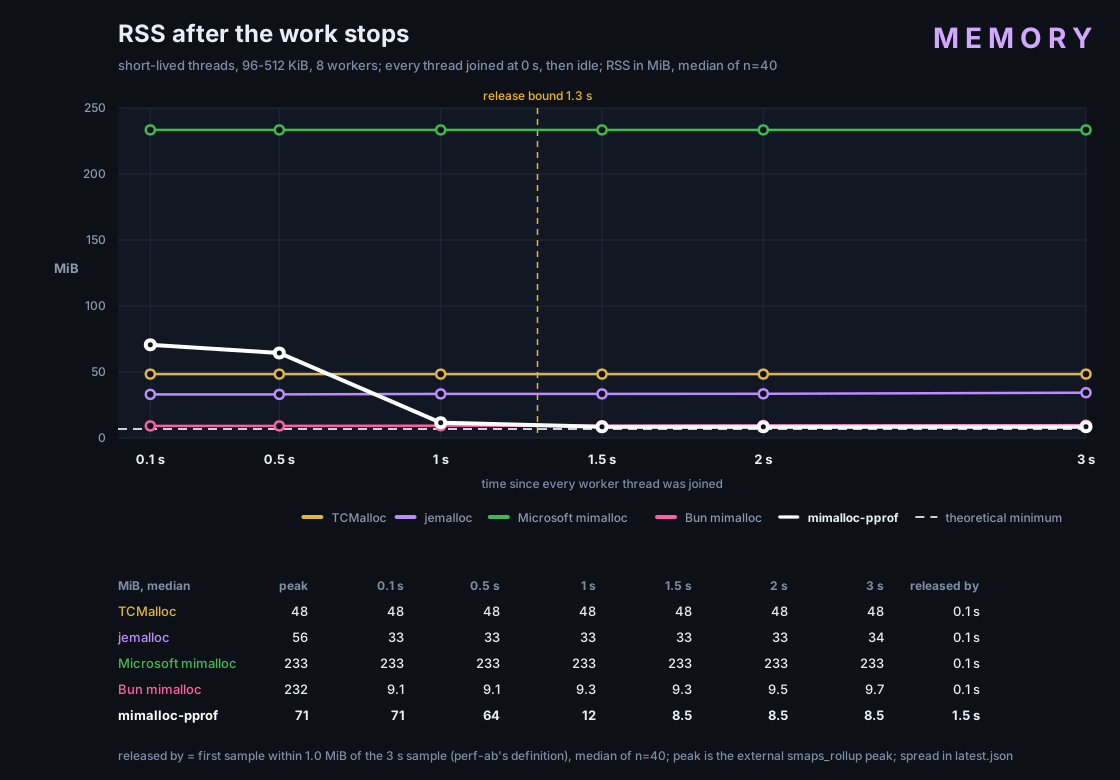
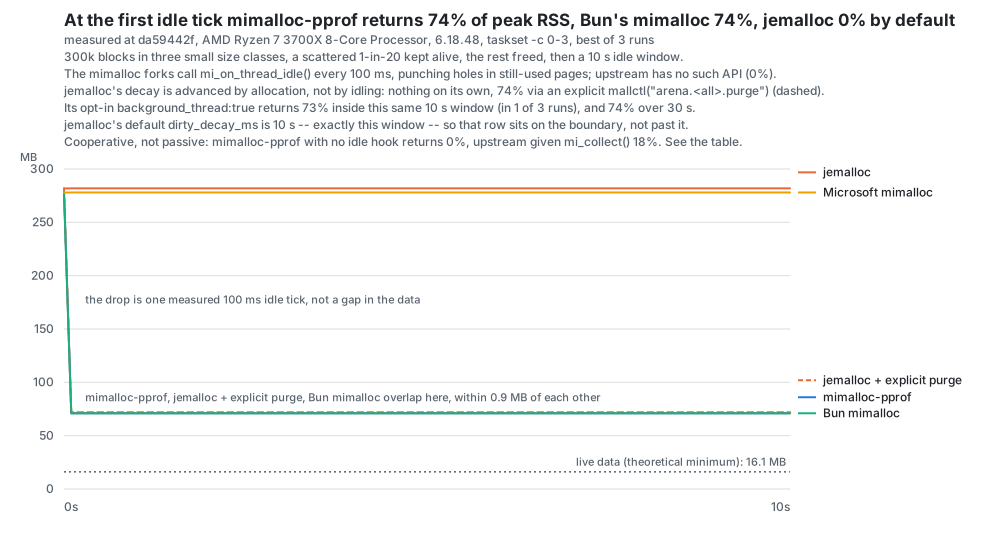
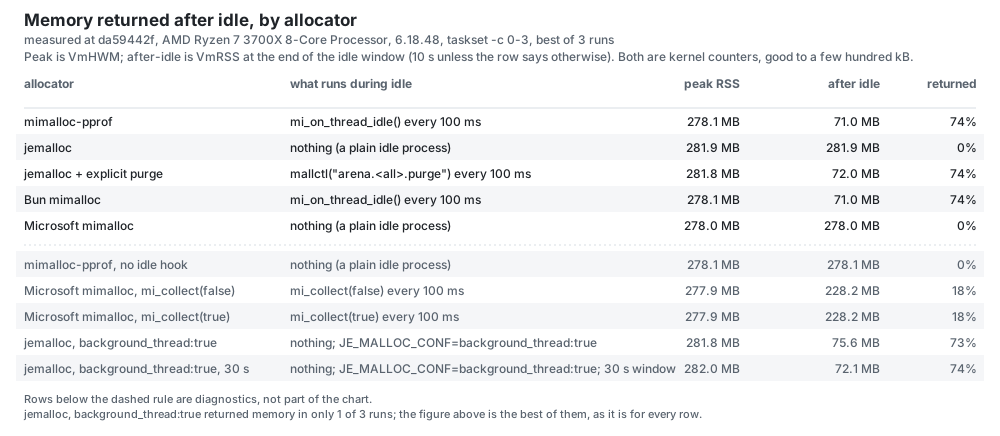
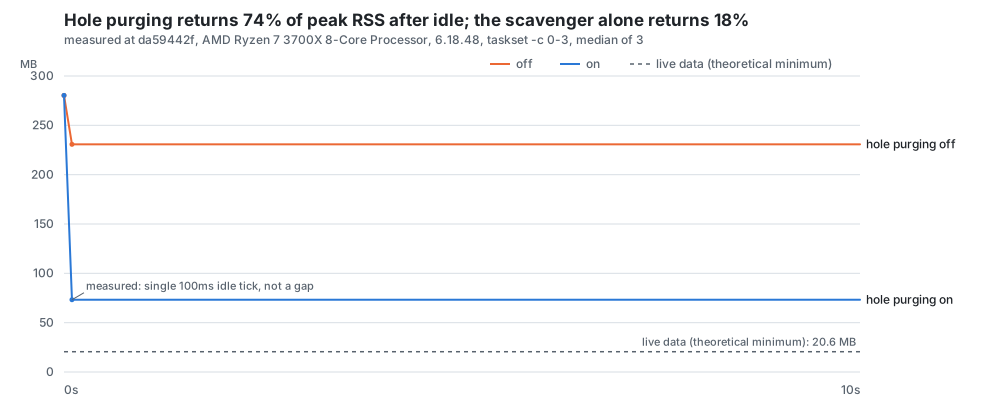
With scattered survivors (300k allocations, 95% freed), calling mi_on_thread_idle() takes RSS from 278 MiB to 71 MiB (74% returned). Upstream's mi_collect(true) returns 18%. Without the idle call the fork returns 0% in this test.
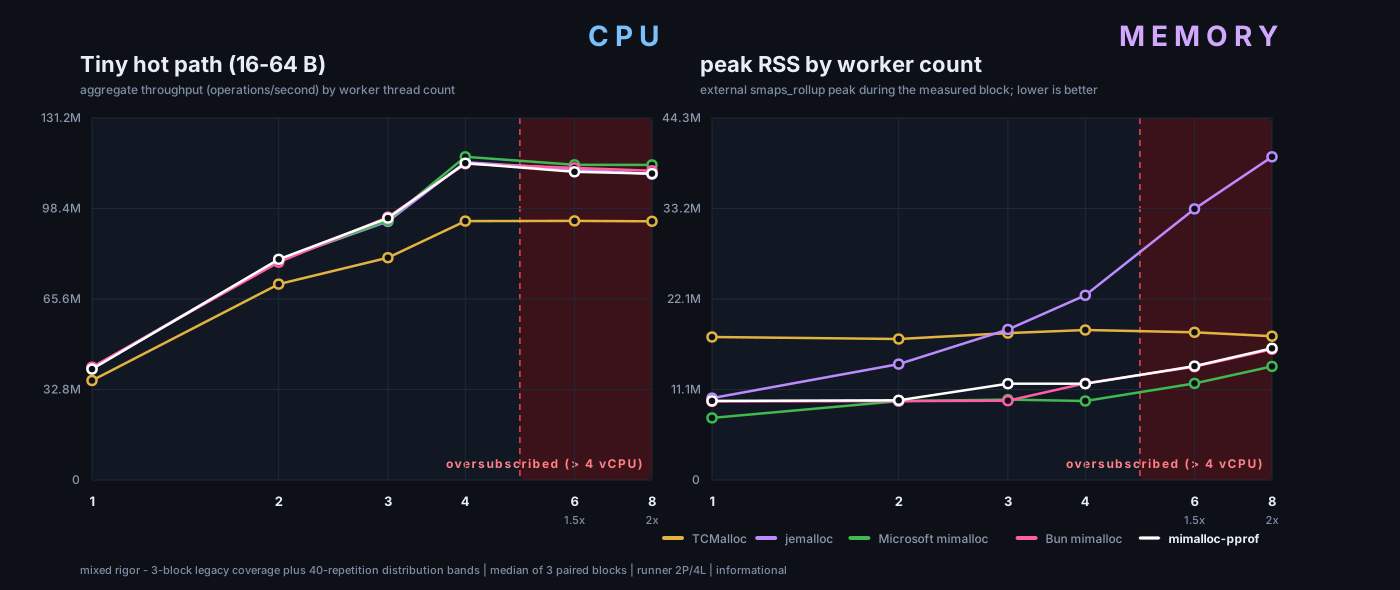
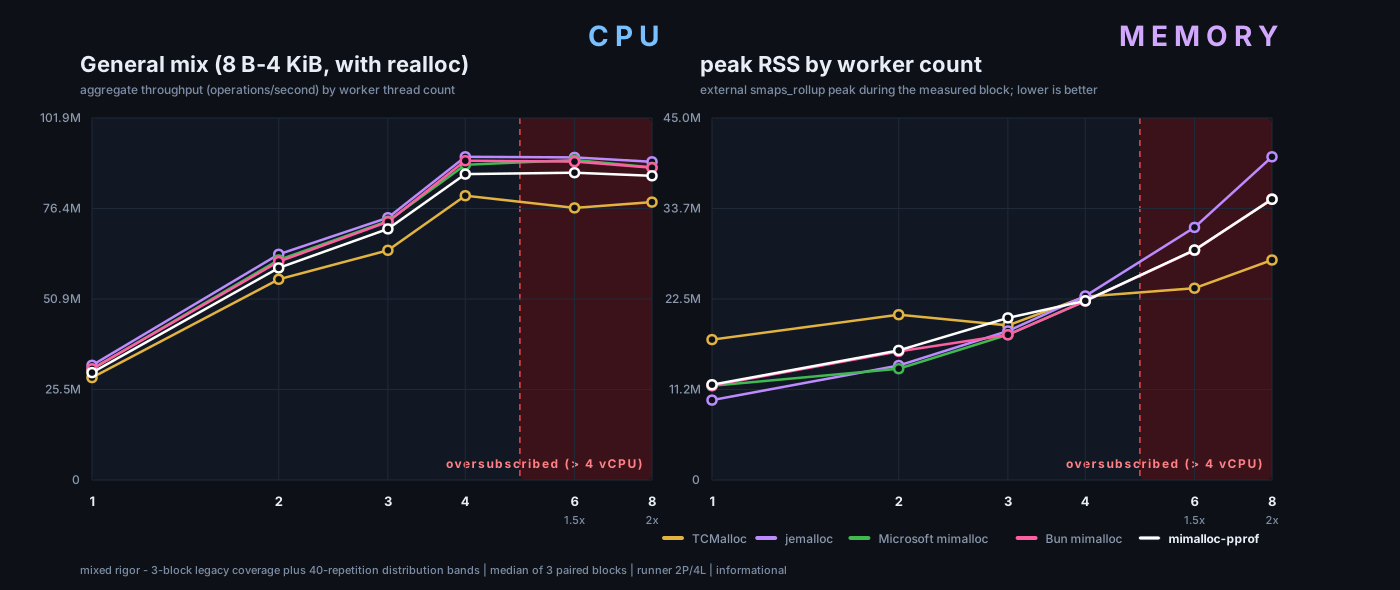
Throughput across six workloads
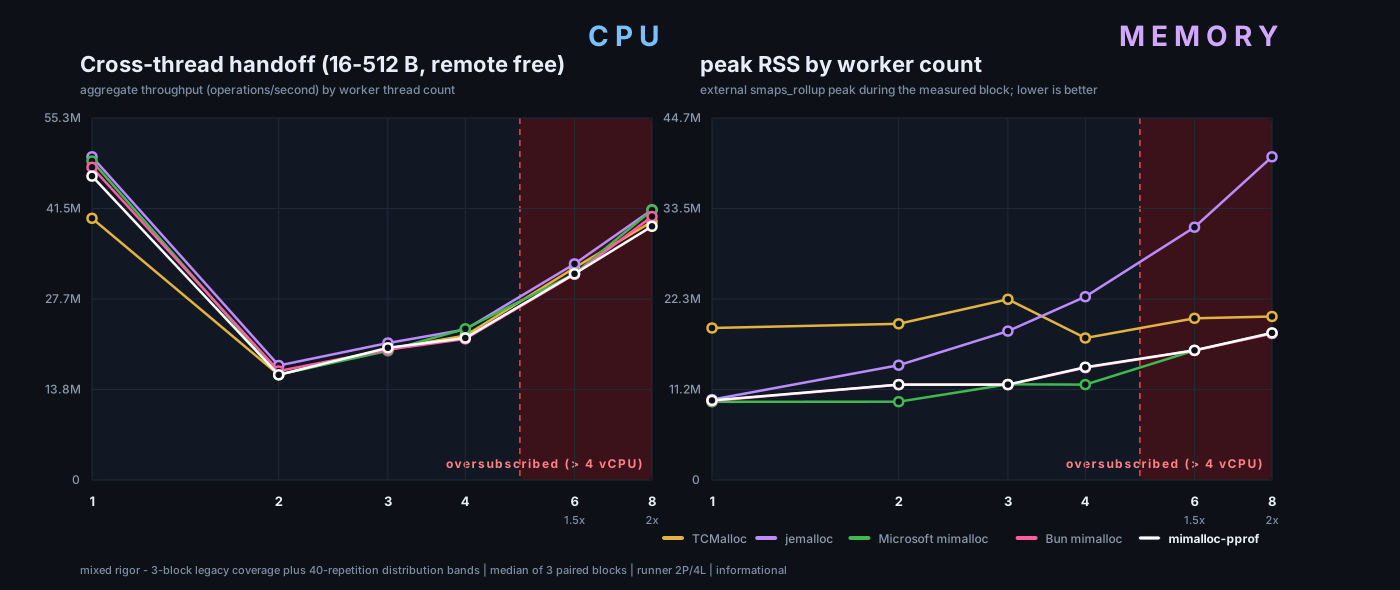
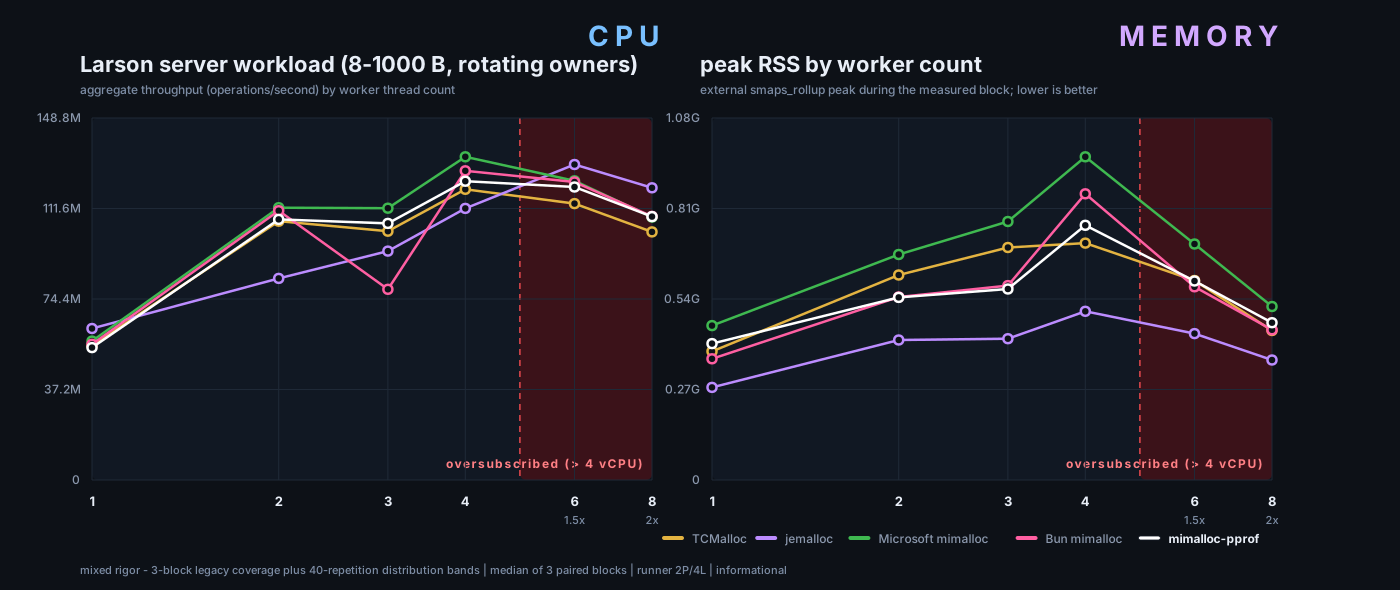
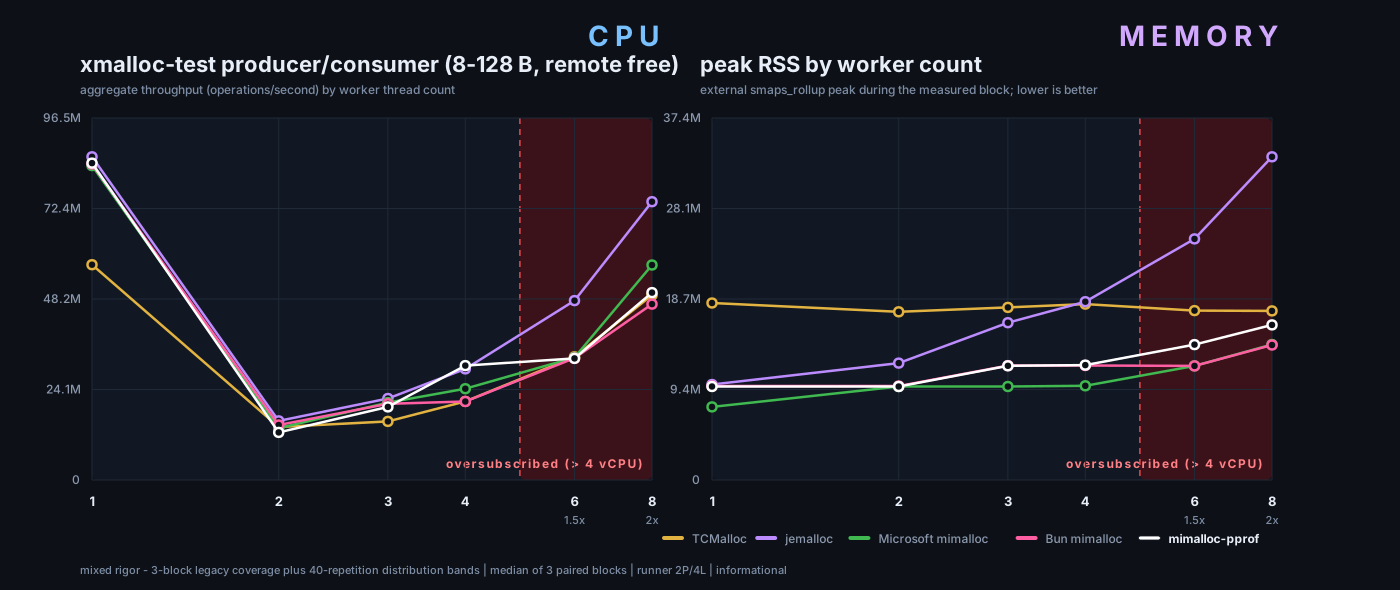
Caveats:
- The charts are from revision
ee3623f6, which is newer than 1.1.0 (80a513df). - They compare against the benchmark's pinned upstream build, not Emscripten's vendored copy.
- The PR will redo the comparison with exact 1.1.0 against Emscripten's own baseline.
Methodology: benchmarks.md · dashboard.
Profiling
Both profilers are opt-in at build time and need to be started at runtime.
- pprof (
-DMI_PPROF=1) shows which call stacks hold retained memory. Docs - DHAT (
-DMI_DHAT=1) records every allocation's size and lifetime, as JSON for Valgrind's viewer, without running under Valgrind. Docs
#include <mimalloc/profile.h>
#include <mimalloc/dhat.h>

if (!mi_prof_start(0)) return 1;            // pprof, ~512 KiB sampling interval
/* ... workload ... */
if (!mi_prof_dump("heap.prof")) return 2;
mi_prof_stop();

if (!mi_dhat_start()) return 1;             // DHAT, exact
/* ... workload ... */
mi_dhat_stop();
if (!mi_dhat_dump("heap.dhat.json")) return 2;
These are the fork's native flags and APIs, not emcc options. WebAssembly stack capture, symbolization and file export would be part of the PR.
Proposed PR
Emscripten currently vendors upstream mimalloc 3.5.1 with local changes (README.emscripten). The fork's v3 base is older. The PR would:
- Keep the Emscripten platform layer, port any relevant newer upstream fixes, and keep
-sMALLOC=mimallocunchanged. - Pass Emscripten's mimalloc tests: memory growth, allocation failure, pthreads, malloc/free/realloc.
- Compare against the current baseline with single-thread and pthread workloads: peak linear memory, peak host memory, memory after idle, throughput, binary size.
- Find places to call
mi_on_thread_idle()before a worker blocks. - Show usable pprof and DHAT output on WebAssembly for each profiler offered.
- Lenguaje dominante
- C++
- Estrellas
- 27.8k
- Forks
- 3.6k
- Merge medio
- 1 d 3 h
- PR fusionados (30 d)
- 179
Preparar el entorno
- Sin Dockerfile ni archivo de Docker Compose
- Sin plantilla de pull request
- Leer la guía de contribución
Primeros pasos
- Lee el issue completo y luego la guía de contribución del proyecto.
- Comenta en el issue que vas a ocuparte — evita que dos personas hagan lo mismo.
- Haz un fork del repositorio y trabaja en una rama.
- Abre un pull request que haga referencia al número del issue.
Más de emscripten-core/emscripten
-
`other.test_cmake_cxx_import_std` fails on CMake 3.30–4.0.2 due to missing `CMAKE_EXPERIMENTAL_CXX_IMPORT_STD` UUIDsPosiblemente ocupada @subhaushsingh la tomó hace 1 día. Abierto
Dificultad 2/5 1-3 horas Aptitud para principiantes 85/100
emscripten-core/emscripten#28160 · 1 comentario ·
Los mantenedores suelen responder en 1 día
-
Dificultad 2/5 1-3 horas Aptitud para principiantes 62/100
emscripten-core/emscripten#27994 · 2 comentarios ·
Los mantenedores suelen responder en 1 día
-
LEGACY_GL_EMULATION: generated fixed-function fragment shaders use mediump — fp16 overflow where mediump is half precisionPosiblemente ocupada @TheTomBritton la tomó hace 12 días. AbiertoDesktop OpenGL emulation
Dificultad 2/5 1-3 horas Aptitud para principiantes 78/100
emscripten-core/emscripten#27948 · 4 comentarios ·
Los mantenedores suelen responder en 1 día
-
Dificultad 2/5 1-3 horas Aptitud para principiantes 64/100
emscripten-core/emscripten#27906 · 1 comentario ·
Los mantenedores suelen responder en 1 día
-
run_python, run_python_compiler could readlink -fPosiblemente ocupada @kapouer la tomó hace 128 días. Abierto
Dificultad 2/5 1-3 horas Aptitud para principiantes 74/100
emscripten-core/emscripten#27211 · 1 comentario ·
Los mantenedores suelen responder en 1 día
Todos los issues de emscripten-core/emscripten
Issues similares
-
Dificultad 2/5 1-3 horas Aptitud para principiantes 78/100
NVIDIA-RTX/NRI#312 ·
Los mantenedores suelen responder en 1 día
-
permute_q_b_proj / permute_wv_proj accept scale factors from another devicePosiblemente ocupada @0z5a la tomó hoy. Abierto
Dificultad 2/5 1-3 horas Aptitud para principiantes 78/100
deepseek-ai/FlashMLA#247 ·
Los mantenedores suelen responder en 1 día
-
Linux npm packaging leaves workspace files that block subsequent CI checkoutPosiblemente ocupada @Spockkk0225 la tomó hoy. Abiertoci
Dificultad 2/5 1-3 horas Aptitud para principiantes 73/100
alibaba/neug#1195 · 1 comentario ·
Los mantenedores suelen responder en 1 día
-
Dificultad 2/5 1-3 horas Aptitud para principiantes 82/100
Los mantenedores suelen responder en 1 día
-
Dificultad 2/5 1-3 horas Aptitud para principiantes 78/100
Los mantenedores suelen responder en 3 días